
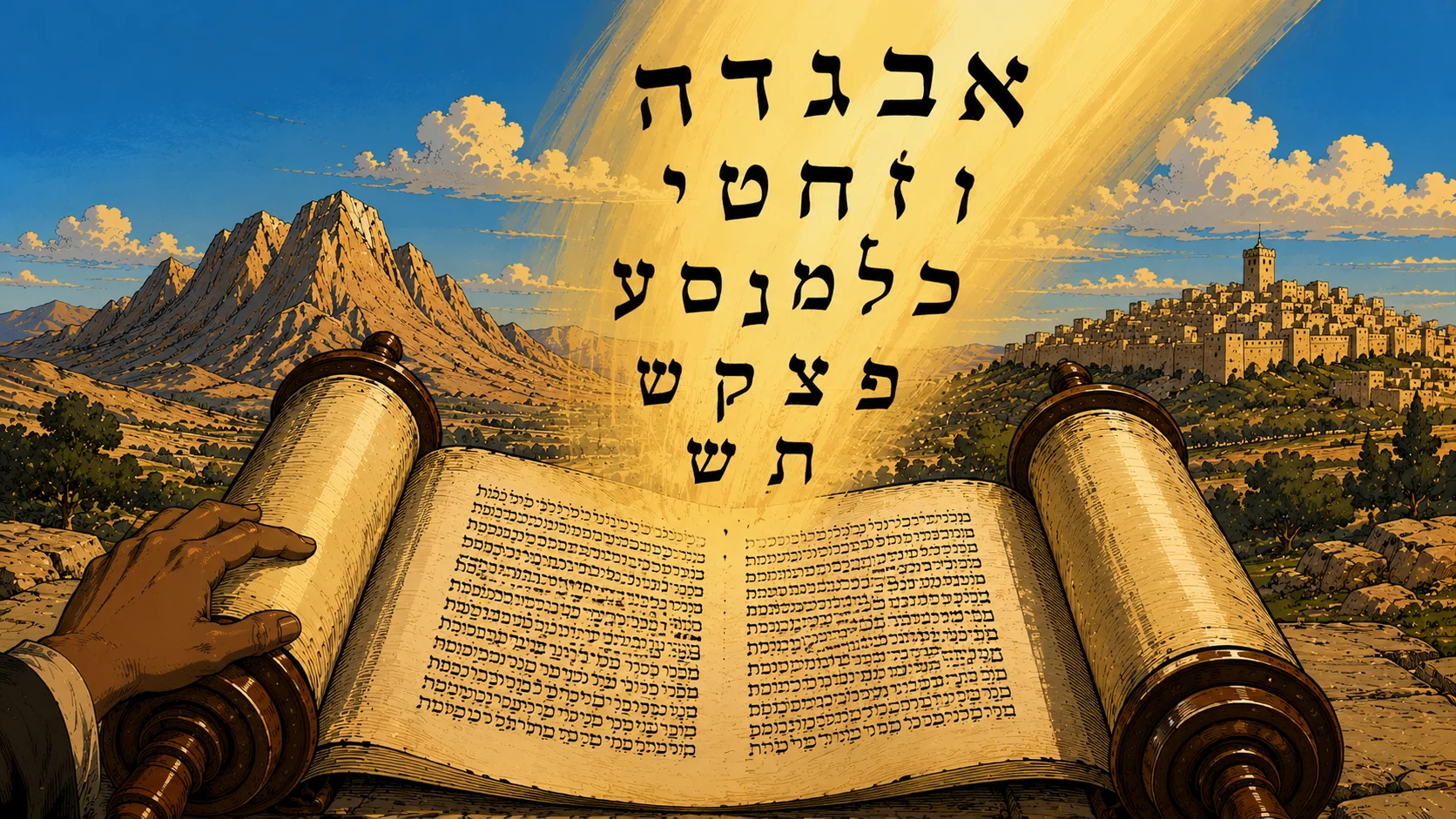
The Language of the Torah
Biblical Hebrew is the language of the Torah — the tongue of Abraham, Isaac, Jacob, Moses, and the children of Israel. Written and spoken by the Hebrew people from roughly 1200–400 BCE, it belongs to the Northwest Semitic family of languages, related to Phoenician, Aramaic, and Ugaritic. Modern Hebrew, spoken today, descends from it — but the grammar, vocabulary, and verb system have changed so significantly that Biblical and Modern Hebrew are best understood as related but distinct languages.
The Aleph-Bet: 22 Consonant Letters
The Hebrew alphabet — called the aleph-bet — contains 22 letters, all consonants. There are no uppercase or lowercase distinctions. Text is written and read from right to left. Every Hebrew word is built on a three-letter root (שֹׁרֶשׁ, shoresh), which carries the core meaning; prefixes, suffixes, and internal vowel patterns create the specific word form. The same three-letter root can generate dozens of related words — a doctor, a cure, an animal, a sacrifice — all recognizable as related to anyone who knows the root.
| Hebrew | Transliteration | Meaning |
|---|---|---|
| אָלֶף | Aleph | First letter — silent consonant, strength, ox |
| בֵּית | Bet | Second letter — house, household |
| שֹׁרֶשׁ | Shoresh | Root — the three-letter base of every Hebrew word |
| לָשׁוֹן | Lashon | Tongue, language |
Lashon HaKodesh — The Holy Tongue
Hebrew is called לָשׁוֹן הַקֹּדֶשׁ — the Holy Tongue. The Torah was composed in this language, and the names given in it — of people, places, and the Almighty — carry layered meaning in Hebrew that disappears in any translation. This is why the same event can read differently depending on whether you encounter it in English or in the original: the English gives you the story; the Hebrew gives you the depth beneath the story.
The Masoretic Text
The Hebrew text on Hebroni follows the Masoretic Text (הַנּוּסַח הַמָּסוֹרְתִּי) — the authoritative ancient manuscript tradition preserved by scribal scholars called the Masoretes, working in Tiberias between approximately 600–1000 CE. They were not altering the text; they were encoding in writing a spoken tradition of reading that had been passed down orally for many centuries. This is the textual tradition behind every modern printed Hebrew Bible and behind every major English translation, including the KJV.
You do not need to know Hebrew to study the Torah on Hebroni. But every page shows the original alongside the translation — so that the Hebrew is always present, always available, always pointing back to the real text.
✡ Read the Torah in Hebrew
The Torah Reader shows the Hebrew text alongside the English translation — chapter by chapter, verse by verse.
Open the Torah Reader More Illustrations