

The 1611 Commission
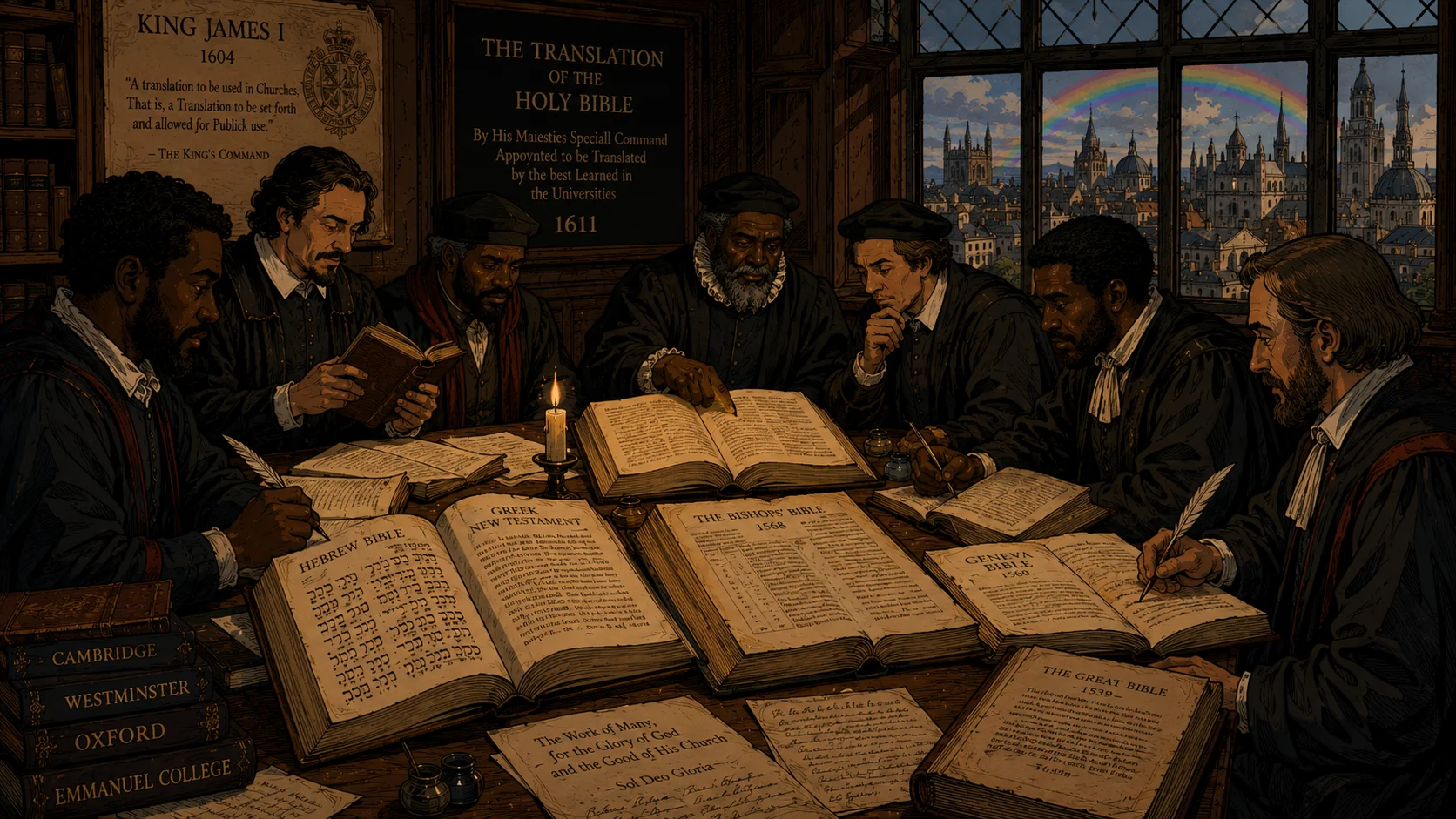
In 1604, King James I of England convened scholars at the Hampton Court Conference with a single mandate: produce one authoritative English translation of the scriptures. The result, completed in 1611, was the Authorized Version — the King James Bible. For over four hundred years it has been the dominant English-language scripture. It is the Bible through which most English-speaking descendants of Israel have encountered the words originally spoken in Hebrew.
William Tyndale: The Man Behind the Words
The most important figure behind the KJV was William Tyndale, who in 1526 produced the first English translation of the New Testament directly from the Greek, and portions of the Old Testament directly from the Hebrew. Tyndale believed that every English reader — including, as he put it, "a boy that driveth the plough" — had the right to read scripture in his own tongue. The English church authorities had him executed for heresy in 1536. His translation, however, survived, and forms the backbone of the King James Version.
Tyndale was strangled and burned at the stake in 1536 for translating the Bible into English. His last words were reportedly: "Lord, open the King of England's eyes." Within three years, King Henry VIII commissioned an English Bible based largely on Tyndale's work.
47 Scholars, Three Universities
The KJV was produced by 47 scholars divided into six companies, working at Westminster, Oxford, and Cambridge. They translated the Torah and the rest of the Hebrew scriptures from the Masoretic Text — the authoritative Hebrew manuscript tradition. They drew on earlier English translations: Tyndale's, the Geneva Bible (1560 — the Bible carried by enslaved Africans into the New World and used by early Black congregations), and others.
The Tyndale Legacy in the KJV Text
The translators were instructed to preserve familiar language wherever it was accurate. This is why so much of the KJV echoes Tyndale's translation made 85 years earlier — phrases like "In the beginning," "Let there be light," "I am that I am," "the LORD thy God am a jealous God" — these are Tyndale's English renderings of Hebrew, preserved in the KJV and carried through four centuries into the homes of the diaspora. Approximately 83% of the KJV Old Testament traces directly to Tyndale's earlier work.
The Geneva Bible and the Diaspora
Before the KJV, the most widely read English Bible among ordinary people was the Geneva Bible of 1560 — produced by English Protestants in exile in Geneva. The Geneva Bible was the Bible brought aboard the Mayflower. More significantly for readers of this site, it was the Bible distributed to enslaved Africans in the Americas and the Bible of the early Black church in the 17th and 18th centuries. The KJV eventually displaced it, partly because King James disliked the Geneva Bible's marginal notes, which questioned the divine right of kings. Yet even as these translations circulated, the Bible that plantation authorities actually enforced on enslaved people was neither the Geneva Bible nor the full KJV. It was a carefully gutted edition published in 1807 — known as the Slave Bible — with nine-tenths of the Old Testament stripped away: no Exodus, no Jubilee, no Deuteronomy 28. The scripture that had crossed the Atlantic was then deliberately shortened to remove every passage that spoke of God delivering a captive people.
Why the KJV Still Matters
The KJV matters because its translators were serious Hebrew scholars working directly from the original language. Where they expanded — adding names, inserting titles, clarifying pronouns — they did so to make the English readable, not to alter the meaning. For readers approaching the Torah through the lens of prophecy about the scattered and gathered Israel, the KJV remains the most precise major English translation and the one most deeply embedded in the Black church tradition that has carried these scriptures for four hundred years.

✡ Read the Torah they translated from
The Hebrew Masoretic Text the KJV scholars worked from — now in English and in the original, side by side.
Open the Torah Reader More Illustrations