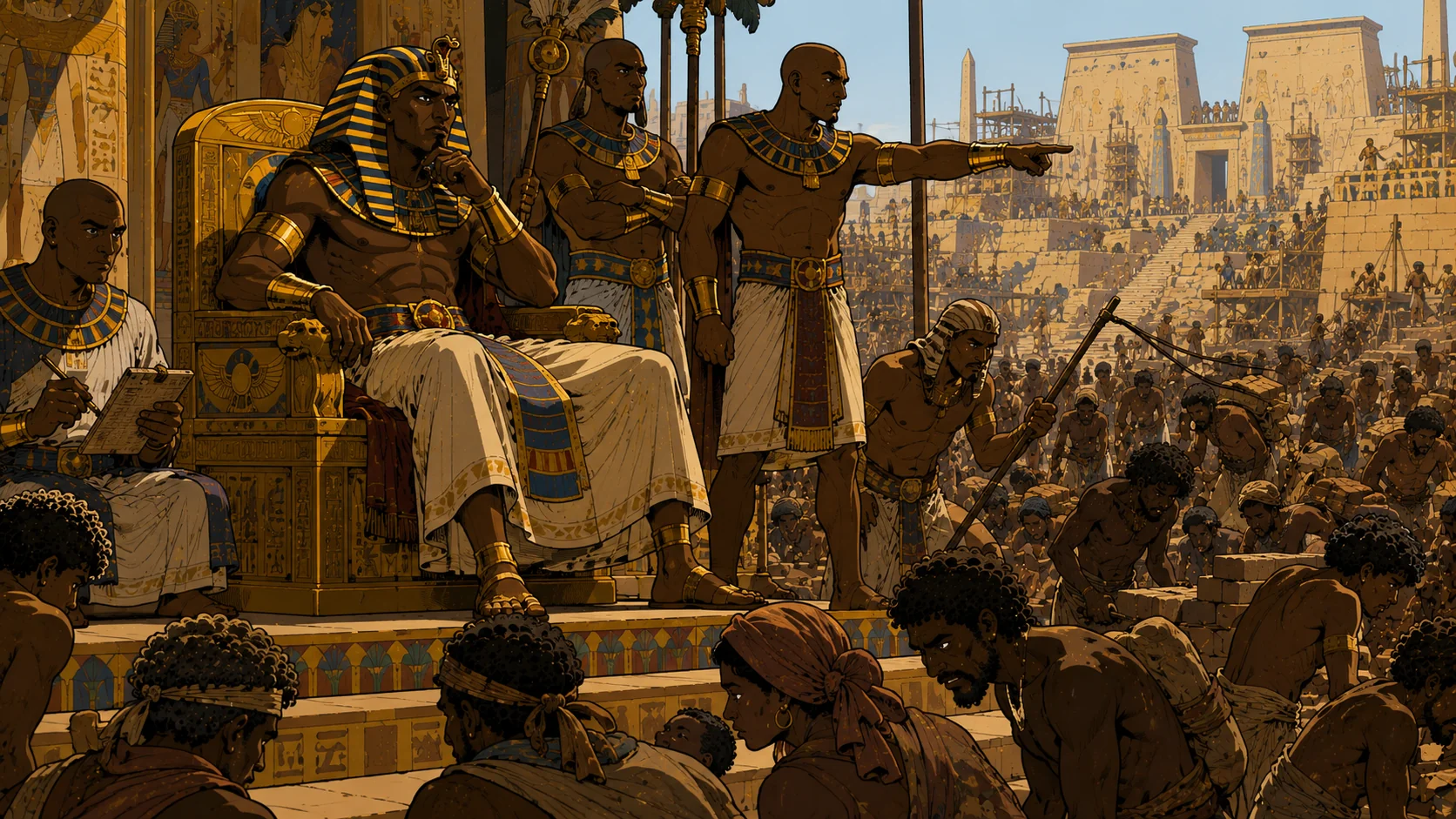
Genesis ends with Israel in Egypt, fed and favored, Joseph's family settled in the land of Goshen by the gift of Pharaoh himself. Four hundred and thirty years separate the end of Bereshit from this verse. In that gap, everything changes — not because Israel did anything wrong, but because Egypt decided not to remember.
"There arose a new king over Egypt who did not know Joseph." Eight words in Hebrew. The entire engine of the Exodus — the slavery, the plagues, the crossing of the sea — is set in motion by a single act of deliberate forgetting. The Sages debate whether this was literally a new king or the old king with new policies. Either way, the Torah's verdict is clear: the forgetting was a choice.
Verses 9 and 10 give us Pharaoh's reasoning: the children of Israel have become too many and too mighty. "Come, let us deal shrewdly with them" — the Hebrew is הָבָה נִתְחַכְּמָה לוֹ (havah nithakkemah lo). The word nithakkemah comes from חָכַם (chakham) — wisdom. But here it is wisdom turned against itself. Pharaoh does not seek wisdom to know how to live with Israel. He seeks a cleverness that will reduce them.
His fear is specific: "lest they multiply, and it come to pass, that when there befalls a war, they will join with our enemies and fight against us." He fears that Israel's growth will become a military threat. But the irony buried in the text is devastating: every measure Pharaoh takes to reduce Israel makes them stronger. Verse 12 records the paradox — "but as they afflicted them, so they multiplied and so they spread." The more Egypt pressed down, the more the blessing of Genesis 1:28 and 35:11 — be fruitful and multiply — refused to be extinguished.
Verses 13 and 14 describe the form the oppression takes: hard service in mortar and in brick, and all manner of work in the field. The buildings Israel builds — Pithom and Rameses — are store-cities. Pharaoh is not building temples or palaces. He is building warehouses. The most powerful empire on earth is using the covenant people of God as construction labor for storage facilities. The humiliation is architectural.
But the text does not end there. The last word of verse 14 is בְּפָרֶךְ — with parech. The sentence ends on the word for crushing labor. In Hebrew literary structure, the last word is the landing. The Torah wants you to feel where Israel has arrived: not simply enslaved, but made bitter. The next verse will introduce the midwives — two women who will do what all of Pharaoh's schemes could not.
