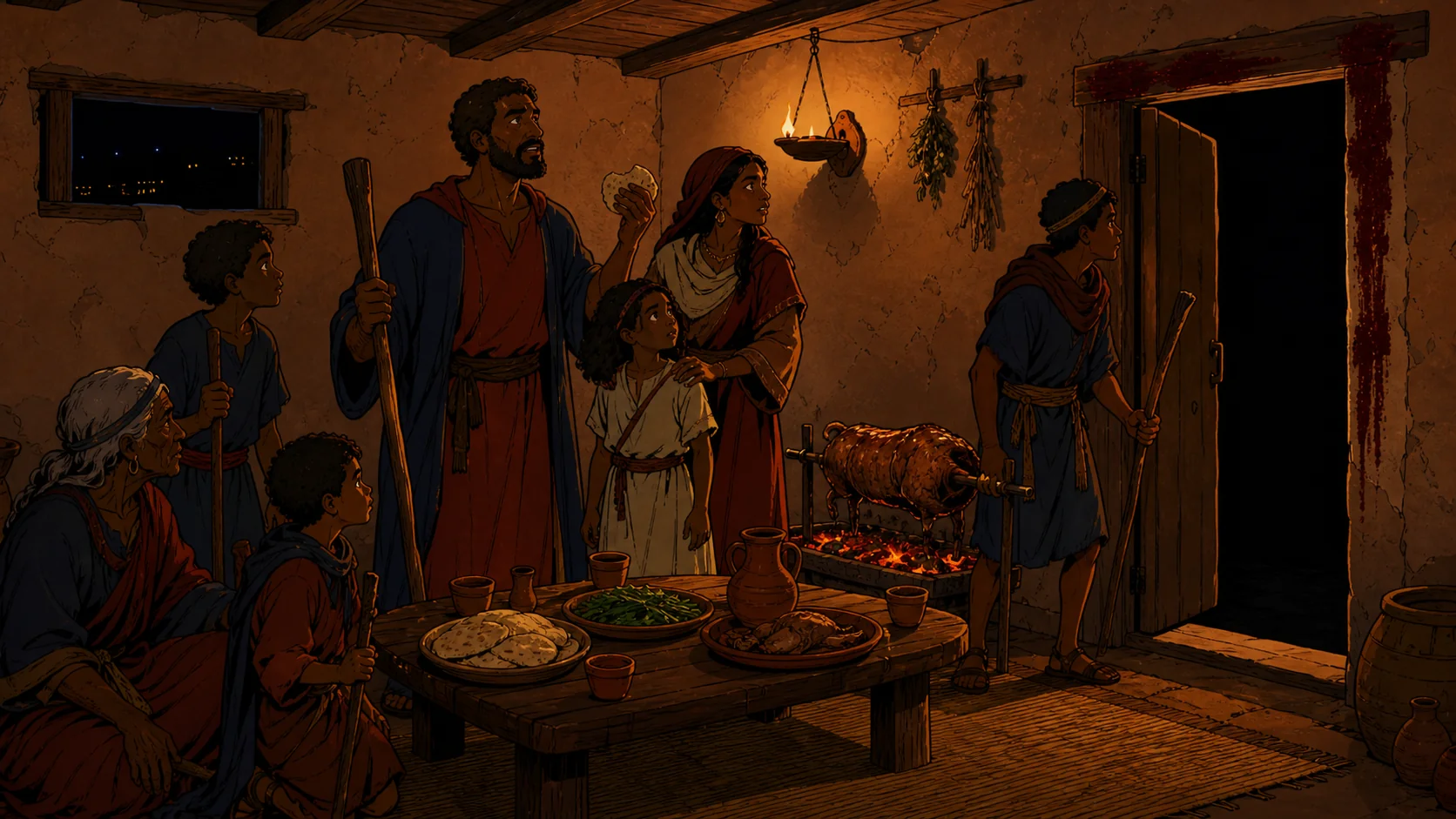
Four hundred and thirty years after the covenant with Avraham in the dark (Bereshit 15), the deliverance begins — on exactly the night Elohim predicted. The instructions are precise and strange: a lamb without blemish, selected on the tenth of the month, kept alive until the fourteenth, then slaughtered at twilight. Its blood is to be painted on the two doorposts and the lintel of every Israelite home. The family is to eat standing up, sandals on, staff in hand — ready to leave at any moment. This is not a meal; it is a final briefing before a departure.
The tenth plague is unlike any of the nine before it. Those plagues struck Pharaoh's kingdom — water, crops, livestock, bodies. This one strikes every household: the firstborn dies in every house where the blood is absent. There is no middle ground, no partial exemption. But there is a line between death and life — a painted line of blood on wood. The angel of destruction does not distinguish between Egyptian poverty and Egyptian wealth; it distinguishes between blood and no blood. The criterion is not merit. It is the mark.
Elohim commands that this night be memorialized forever: (12:14) "This day shall be for you a memorial day, and you shall keep it as a feast to YHWH; throughout your generations, as a statute forever, you shall keep it as a feast". The Passover is not merely historical — it is present tense. Every generation that celebrates it is commanded to say: (13:8) "This is what YHWH did for me when He brought me out of Egypt". The pronoun is singular: me. The liberation is not a past event to admire; it is a personal rescue to inhabit. The blood on the doorpost speaks across every generation that claims the covenant.
