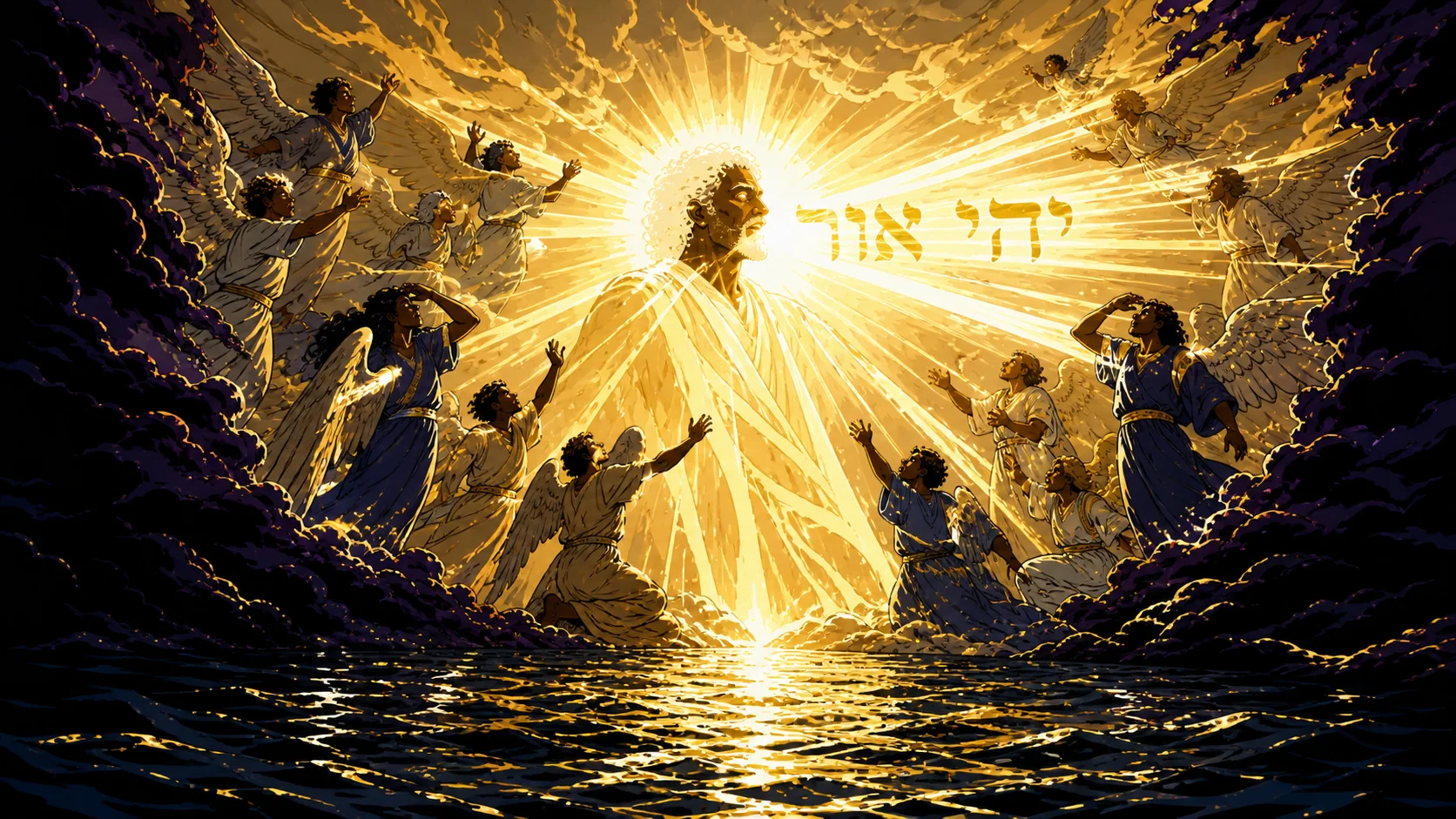
In Hebrew, the entire sentence is four words: Vayomer Elohim y'hi or vay'hi or. "And God said: Let there be light — and there was light." The gap between command and fulfillment is zero. There is no process, no delay, no resistance. The word goes out and reality reorganizes itself around it. This is the nature of divine speech in Hebrew Scripture — it does not describe reality, it creates it.
The verse has a deliberate mirror structure: y'hi or — and then immediately — vay'hi or. Command. Then fulfillment. The Hebrew ear hears the symmetry: the same two words, in the same order, with only the prefix "v" (and) marking the transition from intention to reality. It is as if the universe simply echoed back what was spoken. Creation was not a struggle — it was a conversation between the Creator and the void, and the void had no answer but to comply.
Light precedes the sun by three days in this account. This has always struck readers, but it is theologically precise. Light — pure divine radiance — is not dependent on any created body. The sun is a lamp Elohim hangs later; the Or HaGanuz, the primordial light, belongs to another order. When that original light is finally hidden, darkness is not its absence — darkness is simply the space waiting for the next word.