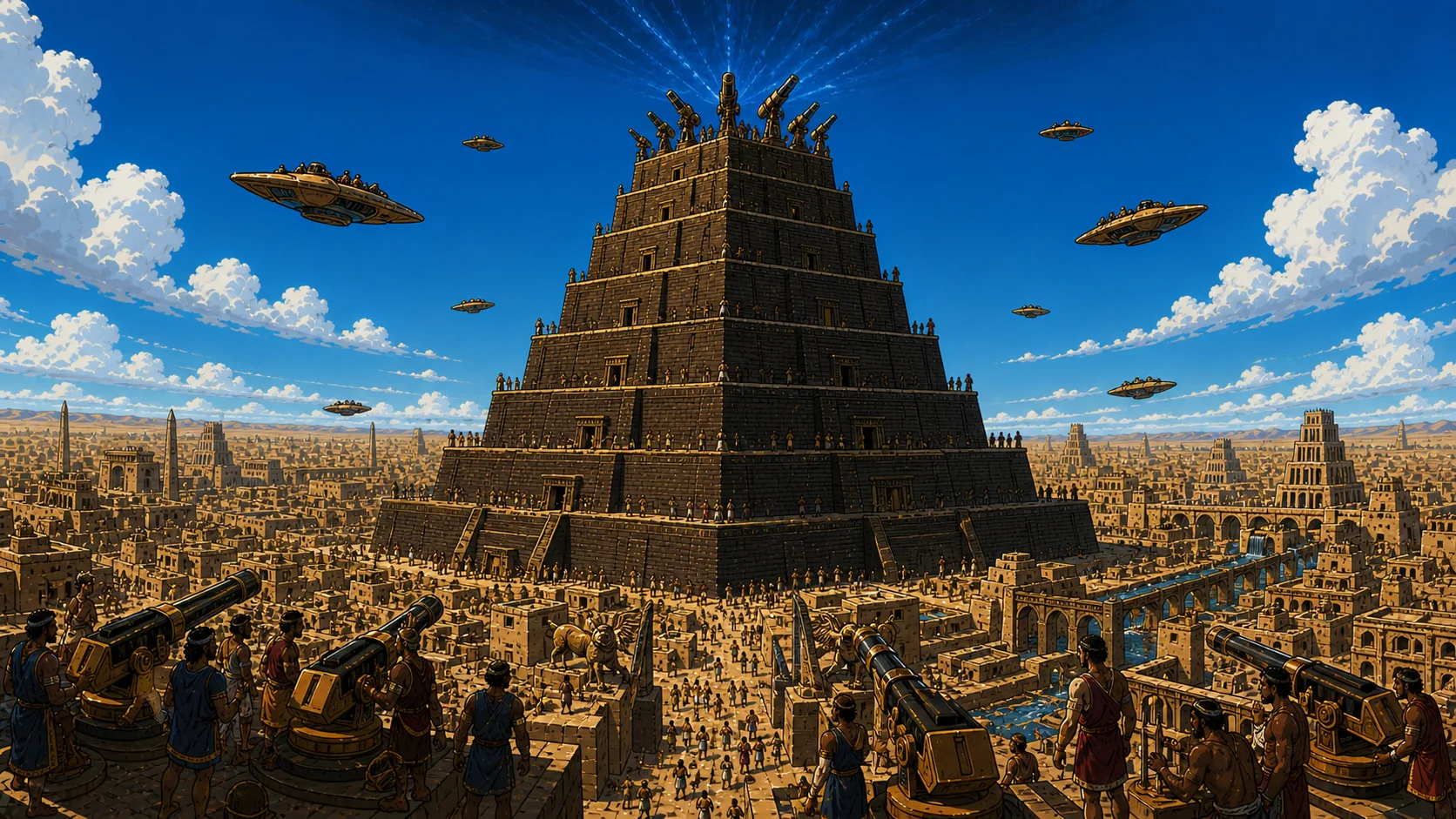
At the height of Babel, humanity had achieved something unprecedented: total unity. One language, one vocabulary, one shared vision. The ziggurat — the step-pyramid temple tower of ancient Mesopotamia — stood as the physical embodiment of that unity. It was not merely an architectural feat. It was a theological statement. In the Akkadian cosmology that surrounded this narrative, the ziggurat was the meeting point of heaven and earth, the place where the gods descended and kings ascended. Babylon's great temple tower was called Etemenanki — "House of the Foundation of Heaven and Earth."
The builders understood something true: a unified people speaking a shared language accomplishes what divided peoples cannot. Their error was in the direction they aimed that unity. Rather than filling the earth as Elohim commanded — going out, spreading, diversifying — they consolidated, concentrated, and reached upward on their own terms. The tower does not represent primitive religion; it represents sophisticated, organized, technologically advanced self-deification. That is precisely what makes it dangerous.
The image of the tower at its peak is the moment before the fall. Everything humanity had built was standing. The language was intact. The vision was coherent. It is a freeze-frame of human civilization at its theoretical zenith — and in that freeze-frame Elohim makes His move. What the text understands, and what every subsequent empire has rediscovered, is that peak human unity apart from Elohim is not stability — it is the precise moment of maximum fragility. Babel at its peak is Babel on the eve of its end.