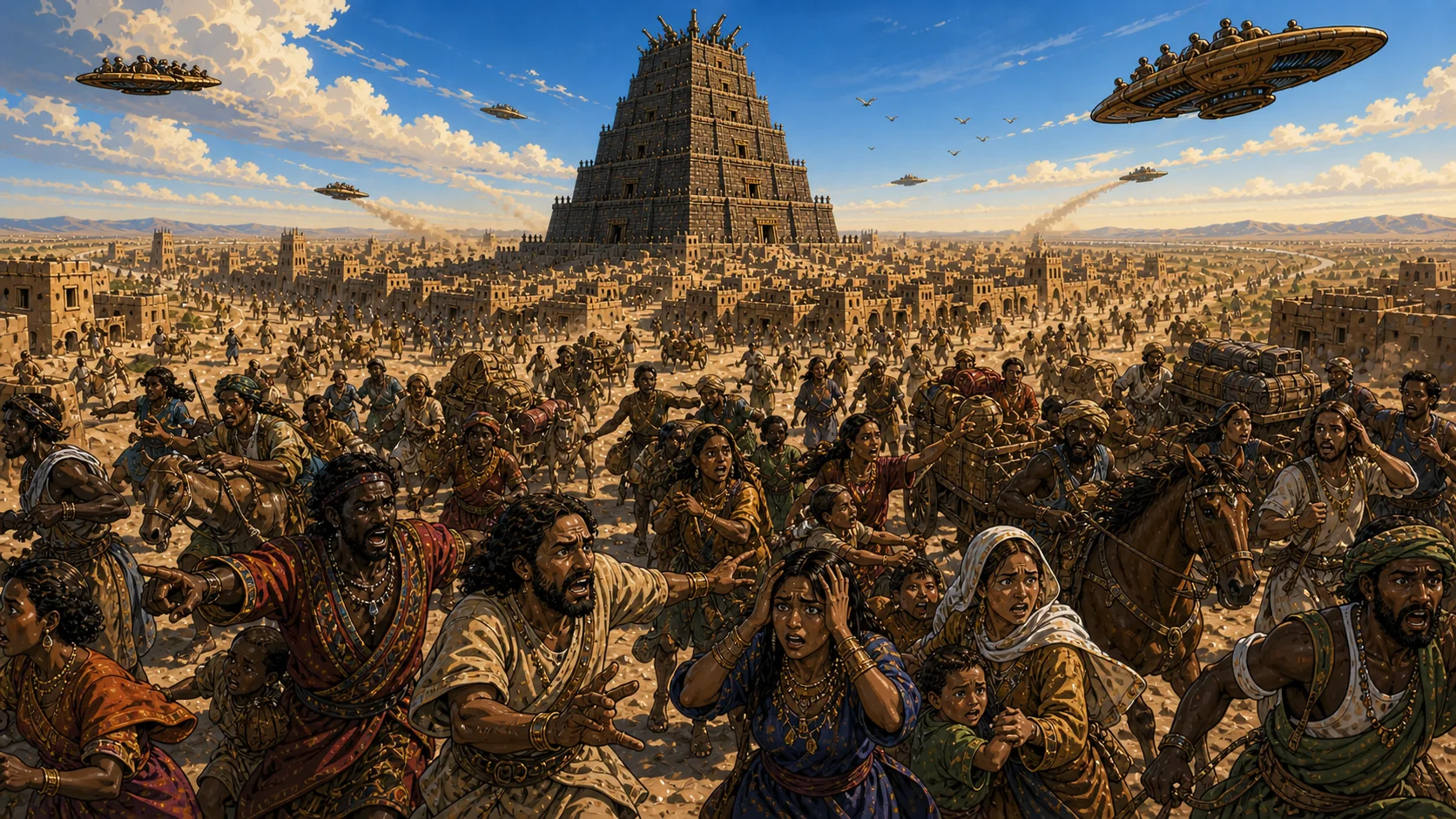
What the builders of Babel feared most — "lest we be scattered over the face of all the earth" — is precisely what happened. There is a dark symmetry in the text: their stated reason for building was to prevent scattering; the result of building was the very scattering they dreaded. This is the recurring irony of self-preservation apart from Elohim: the thing you construct to protect yourself from your fear becomes the instrument of its fulfillment.
The language Elohim uses before acting — "Come, let Us go down" — echoes the plural speech at Creation ("Let Us make man," 1:26). Scholars have long noted this divine plural. What is remarkable here is that Elohim mimics the builders' own language back at them. They said "Come (havah), let us build." Elohim says "Come (havah), let Us go down." The divine irony is deliberate: the council of Elohim answers the council of men. They gathered to build; Elohim gathered to scatter. They agreed on one thing; YHWH confuses their agreement.
After Babel, the very next narrative is the genealogy of Shem leading directly to Avraham (11:10–26). The scattering that seemed like the end of human unity is immediately revealed as the beginning of something more radical: Elohim will not work through all the nations at once — He will choose one man from one family in one city, and through that man restore blessing to all the families of the earth (12:3). Babel's failure is Avraham's calling. The scattering creates the conditions for the covenant.