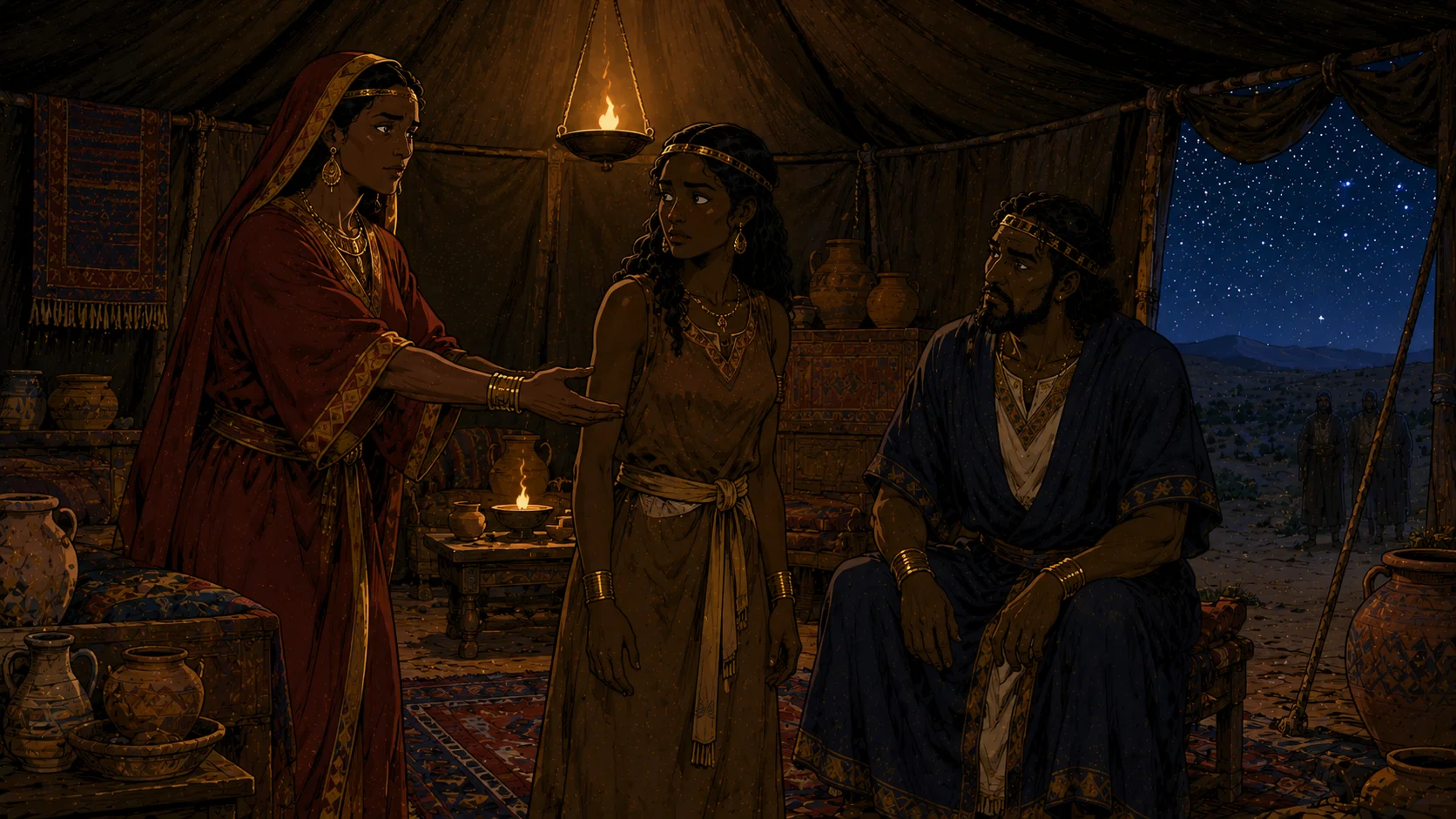
Ten years have passed since the covenant promise. Ten years of Canaan, of altars, of divine words about offspring — and Sarai is still barren. The silence of those ten years is the silence of waiting, and Sarai breaks it with a decision. Her reasoning is theologically honest: (16:2) "YHWH has prevented me from bearing children." She does not blame herself or her husband. She attributes her barrenness directly to YHWH. And then she acts from within that acknowledgment — not in faith, but in the logic of ancient surrogacy practice. If YHWH has closed her womb, perhaps He will "build her up" through Hagar's. The Nuzi tablets from the same period confirm that this was standard household law: a barren wife could give her maidservant to her husband, and the resulting children would legally belong to the wife.
Avram listens to the voice of Sarai — the Torah notes this explicitly, with the same phrasing that will echo at the fall (3:17, "because you listened to the voice of your wife"). The parallel is deliberate. The man chosen to walk in YHWH's ways takes the easiest path available when the promise is delayed. Hagar conceives immediately. The plan works by every human measure — and then it fractures. (16:4) "She saw that she had conceived, and her mistress became contemptible in her eyes." The Hebrew is blunt: Sarai is diminished in Hagar's sight. What was meant to resolve the household's crisis creates a new one, more personal and more volatile.
The conflict between Sarai and Hagar that follows drives the narrative forward, but it also illuminates the cost of the human solution to a divine delay. The covenant was promised through impossible means; it will be fulfilled through impossible means. The attempt to fulfill it through possible means — the surrogacy arrangement, entirely legal, entirely reasonable — produces Ishmael, a son beloved by Avraham but not the son through whom the covenant will pass. The Torah does not condemn Ishmael; it honors him. But it is precise about the boundary: the promise runs through the impossible birth, not the possible one. Hagar's son is not the answer to Sarai's barrenness; he is the human answer to a problem that required a divine one.