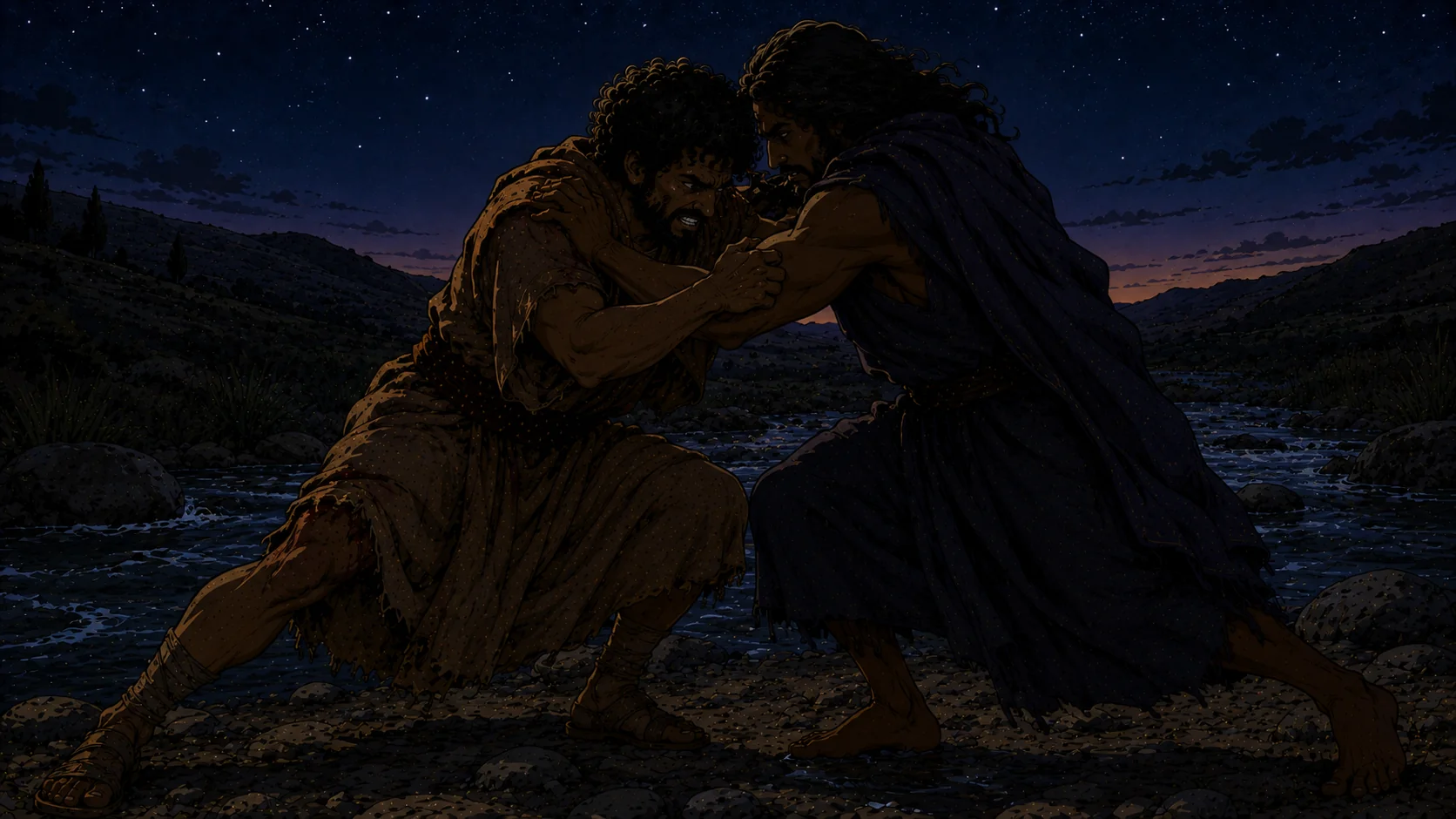
Jacob rises in the night and sends his two wives, two handmaids, eleven sons, and all his possessions across the ford of the Jabbok. He is left alone. A man wrestles with him until the breaking of dawn. The text says simply: a man — ish. Not an angel, not God — just a man. The ambiguity is deliberate. What it is becomes clear only when the encounter ends. The wrestling goes on all night, neither party gaining final advantage.
When the man sees he cannot overpower Jacob, he touches the socket of his hip and it dislocates. A single touch, in the middle of a wrestling match, and Jacob's hip is out of joint. He is wrestling injured now. He still does not let go. The man says: let me go, for dawn is breaking. Jacob says: I will not let you go unless you bless me. The demand is audacious. He is injured, he is outmatched, and he is asking for a blessing from a being whose nature he doesn't yet fully know.
The man asks: what is your name? Jacob. He gives his name this time — unlike his father's tent where he said I am Esau. Your name will no longer be Jacob but Israel — ki sarita, because you have striven — im Elohim v'im anashim, with God and with men — and you have prevailed. Jacob asks the man's name. The man refuses: why do you ask my name? He blesses Jacob and goes. Jacob names the place Peniel: I have seen the face of God and my life has been preserved.