Jacob looks up and sees Esau coming with four hundred men. He arranges his household in order of ascending priority — handmaids and their children first, then Leah and her children, then Rachel and Joseph at the back. He himself goes ahead of all of them and bows to the ground seven times as he approaches his brother. Seven bows toward the man he robbed. Jacob, who bowed to no one, bows in the dust before Esau.
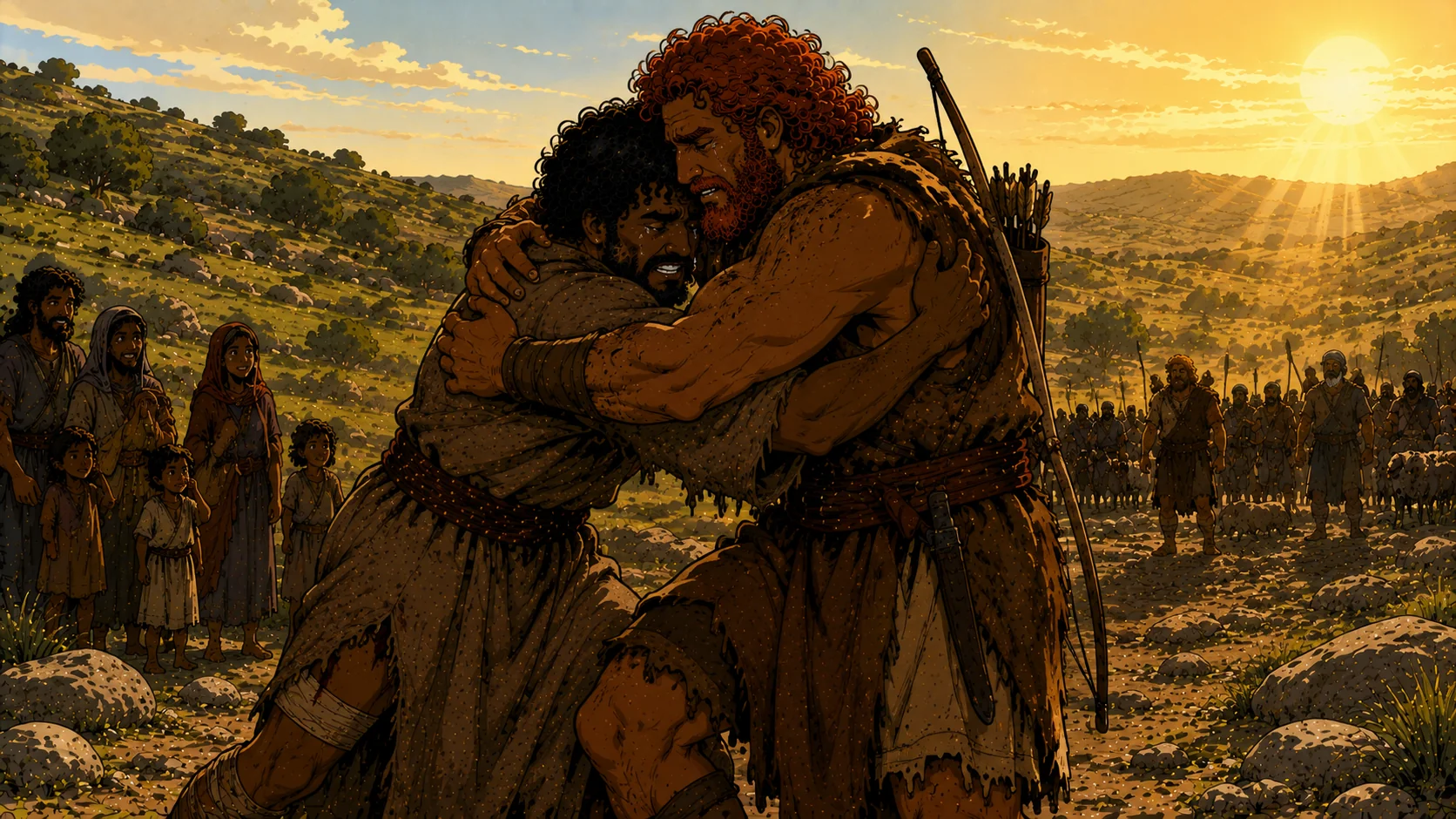
Esau runs to him. He embraces him. He falls on his neck and kisses him. And they both weep. The meeting Jacob feared for twenty years — the sword, the four hundred men, the death of mothers and children — becomes an embrace. The text records Esau's actions in rapid sequence: ran, embraced, fell on his neck, kissed. There is no calculation in any of it. The brother who was wronged runs first. The greeting is not earned by Jacob. It is given.
Jacob tells Esau: to see your face is like seeing the face of God, since you have received me with favor. He said this same thing at Peniel: I have seen God face to face. Now he says Esau's face is like God's face. The connection is exact: the God who did not destroy him in the dark, and the brother who did not destroy him at dawn — both faces belong to the unexpected mercy Jacob did not deserve. They are each other's mirror in this moment. The Torah ends the story of their conflict here, without resolution of what was taken, with only this: and they wept.