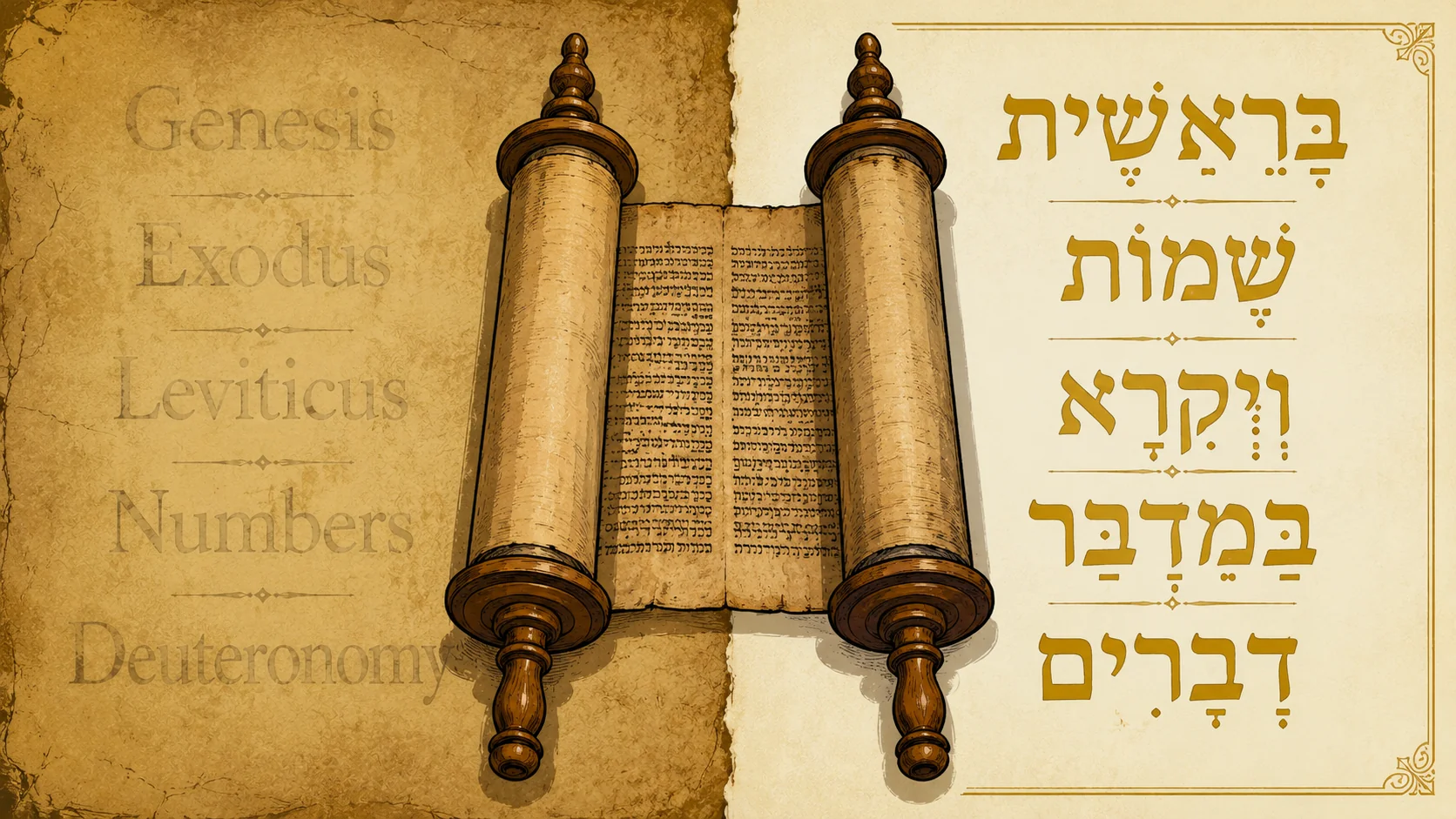
Most people who grew up reading the Bible their entire lives could not tell you the Hebrew name of a single book. They know Genesis, Exodus, Leviticus, Numbers, Deuteronomy — and they assume those are the names of the books. They are not. Those are the Greek names, imposed from outside the text roughly twenty-three centuries ago, and they describe the books from the outside like labels on a jar. The Hebrew names come from inside the text — they are the first words the books speak.
That's not a small distinction. When you read a book whose name describes its content, you approach it already knowing what to look for. When you read a book whose name is its first breath, you approach it the way the original reader did — you walk in without a summary and let the text announce itself. The Hebrew names don't tell you what the book is about. They drop you into the moment the book begins.
Here is what was changed, and what was lost.
How the Greek Names Were Made
Around 250–150 BCE, a group of scholars in Alexandria translated the Hebrew scriptures into Greek — the translation known as the Septuagint (LXX). The Jews of Egypt had been speaking Greek for generations; they needed the Torah in a language they could read. The Septuagint is an extraordinary document, still used in Eastern Orthodox churches today. But it introduced something the Hebrew tradition had never done: it named the books by their subject matter.
Genesis comes from the Greek geneseos — origins, birth, beginning. Exodus from exodos — departure, going out. Leviticus from Leuitikon — pertaining to the Levites. Numbers from arithmoi — the census counts. Deuteronomy from deuteronomion — second law. Each name is an accurate description of the book's major themes. Each name was written by someone looking at the book from the outside and deciding what to call it.
The Hebrew tradition named the books differently. It named them by their first words — the first words God or Moses or the Torah itself spoke when the book opened. Not a summary. Not a label. An entrance.
The Five Names Side by Side
| Hebrew | Hebrew Name | Greek Name | What It Means |
|---|---|---|---|
| בְּרֵאשִׁית | Bereshit | Genesis | "In the beginning" — the first word of the Torah |
| שְׁמוֹת | Shemot | Exodus | "Names" — the names of the sons of Israel |
| וַיִּקְרָא | Vayikra | Leviticus | "And He called" — God calling Moses into the Tent |
| בְּמִדְבַּר | Bamidbar | Numbers | "In the wilderness" — the place and the condition |
| דְּבָרִים | Devarim | Deuteronomy | "Words" — Moses's final addresses to Israel |
Bereshit — Not "Origins," But "In the Beginning"
The first word of the entire Torah is בְּרֵאשִׁית (Bereshit) — "In the beginning." The book is named after that word. You don't get a description before you enter; the book names itself by its opening declaration.
Genesis as a title tells you the book is about origins — which is accurate, but clinical. It tells you to read this as a book about how things started. Bereshit does something different: it tells you that the very first thing the Torah says is in the beginning — which means before that phrase, there is silence, and then the Word breaks in. The name is the event itself.
Rashi opens his commentary on Bereshit with a famous question: why does the Torah begin with creation and not with the first commandment? The question only makes sense when the book is named Bereshit — "in the beginning" — because you're forced to ask what kind of beginning this is and why the Torah chose to start there. "Genesis" doesn't raise that question. It just describes the subject.
Shemot — Not "Departure," But "Names"
The book opens: "These are the names (שְׁמוֹת) of the sons of Israel who came to Egypt." Shemot — Names. The book is named after the second word of its first verse.
Exodus focuses the reader's attention on the departure — the great event of liberation, the crossing of the sea, the defeat of Pharaoh. That's the story's climax. Shemot focuses the reader on the people — specifically, that their names were recorded. Before the plagues, before Moses, before the burning bush, the Torah stops to give you a list of names. Seventy people who came down to Egypt. Their names mattered.
The choice of title reveals what the book considers its own center of gravity. Exodus is about a miraculous event. Shemot is about a people — their identity, their names, the fact that God knew each one. By the time Moses asks God "What is your name?" in chapter 3, and God answers with YHWH — the book has already been about names since its first sentence. The liberation follows from the identity.
Vayikra — Not "For the Levites," But "And He Called"
The book opens: "And He called (וַיִּקְרָא) to Moses and spoke to him from the Tent of Meeting." Vayikra — And He called. God calling Moses is the book's first act.
Leviticus is probably the most misleading of the five Greek names. It implies a book of Levite regulations — priests and sacrifices and temple procedures for the professionals. Most readers today skip Leviticus because they've been told it's not for them. And the Greek name confirms that impression: this is the Levite manual.
But the book opens with God calling Moses — and the laws that follow are addressed repeatedly to all of Israel, not only the priests. The dietary laws are for the people. The Holiness Code in Leviticus 19 — "You shall be holy, for I the LORD your God am holy" — is spoken to the entire congregation assembled. The word vayikra contains the whole premise of the book: God is calling. The question is who is being called. And the answer, in the text, is everyone.
There is a well-known rabbinic observation that the word וַיִּקְרָא in the Torah scroll is written with a small aleph (א) at its end — the only word in the entire Torah with a deliberately shrunken letter. Tradition says it reflects Moses's humility: God wanted to write that He called Moses with the full honor the word deserved; Moses insisted on writing it smaller. The small aleph is the humility of the man who received the call. The name of the book is the record of that call.
Bamidbar — Not a Census, But a Wilderness
The book opens: "And YHWH spoke to Moses in the wilderness of Sinai (בְּמִדְבַּר סִינַי)." Bamidbar — In the wilderness. The book is named for where the people are.
Numbers takes its title from the two census counts that open the book and appear again in chapter 26. The Greek name is numerically accurate — there are census data in this book. But naming the book Numbers makes it sound like a register, an administrative record. Readers approach it as the book they have to get through on the way to Deuteronomy.
Bamidbar names the condition. The wilderness is not just a setting — it's the spiritual state between Egypt and the promise. The entire generation that came out of Egypt died in Bamidbar. Their children were born in Bamidbar. The spies failed in Bamidbar. The rebellions happened in Bamidbar. Korah, Miriam, the bronze serpent, the waters of Meribah — all of it takes place in this word. The book is the record of a people living in the in-between: no longer slaves, not yet landed, sustained only by manna they couldn't store and water that came from rocks.
Bamidbar is the name of the human condition that every generation of Israel — and every reader of the Torah — eventually inhabits. You've left something. You haven't yet arrived. You are in the wilderness. The book names where you are.
Devarim — Not "Second Law," But "Words"
The book opens: "These are the words (הַדְּבָרִים) which Moses spoke to all Israel across the Jordan." Devarim — Words. Moses speaking is the book's entire frame.
Deuteronomy — from the Greek deuteros nomos — means second law. It refers to Moses restating the law to the new generation before they cross the Jordan. That's accurate as a summary. But calling it "second law" makes it a repetition — as though you've already read this material and now you're getting a recap. Most readers approach Deuteronomy as review.
Devarim reframes the entire book. These are Moses's words — his personal address, his farewell, the testimony of the man who stood between God and Israel for forty years and never crossed the Jordan. He knows he is going to die. He has thirty days to say everything he needs to say. The book is not a legal summary; it is a man speaking to his people for the last time, knowing the weight of every word.
When you read Devarim knowing what the name means, you hear Moses's voice differently. The legal repetitions are not copies — they are a father's insistence. Remember this. Don't forget this. I am telling you again because I will not be there to tell you again. The name "Words" asks you to listen to the speaker, not just the content.
What the Hebrew Naming Convention Reveals
The difference between the Greek and Hebrew names is not just linguistic — it reveals a philosophy of text. The Greek tradition names books by their subject matter, the way a library catalog works. You look at the spine and the title tells you what's inside. That's useful. It's how we still name most books today.
The Hebrew tradition names books by their first words — the way a conversation is named by how it opens. Bereshit is not "this book is about origins." It is "the first thing this book says is: in the beginning." The name is not a description of the content; it is the entrance to the content. The book names itself by the moment it begins to speak.
This approach to naming has a theological implication that shouldn't be missed. The Torah is not a document that exists to be described. It exists to be entered. The first words of each book are not a preamble to the real content — they are the content beginning. Bereshit is the beginning of everything. Shemot is the names that matter. Vayikra is the call. Bamidbar is where you are. Devarim is the final word of the man who carried it all.
In the Jewish tradition, when a child begins studying Torah, they traditionally begin with Vayikra — the book most English readers skip. The reason given in the Talmud (Leviticus Rabbah 7:3): "Let the pure ones come and occupy themselves with the laws of purity." But perhaps there is another reason hidden in the name: Vayikra — And He called. Let the first thing a child learns be that God calls. Everything else follows from that.
Reading the Torah by Its Hebrew Names
You don't have to stop using the English names — they're what the translations use and they serve a purpose. But the next time you open one of these books, try sitting with the Hebrew name first.
Before you read Genesis, say Bereshit — "in the beginning" — and remember that you're entering a moment before which there was nothing. Before you read Exodus, say Shemot — "names" — and remember that the story of liberation begins with the names of seventy people whom God never forgot. Before you read Leviticus, say Vayikra — "and He called" — and ask who is being called and whether that includes you. Before you read Numbers, say Bamidbar — "in the wilderness" — and ask whether you know that terrain personally. Before you read Deuteronomy, say Devarim — "words" — and listen to a man saying everything he needs to say before his time runs out.
The Greek names describe what the books are about. The Hebrew names put you inside them. That is the difference between a label and a door.
Sources
- Jewish Encyclopedia — "Pentateuch" — authoritative comparison of Hebrew incipit names vs. Septuagint thematic names
- Blue Letter Bible — Hebrew name etymologies: Bereshit (H7225), Shemot (H8034), Bamidbar (H4057), Devarim (H1697)
✡ Read the Torah in the Hebrew
The Hebroni Torah reader includes all five books in Hebrew with transliteration and English — read Bereshit, Shemot, Vayikra, Bamidbar, and Devarim the way they were written.
Open the Torah Reader What Does Shalom Mean? →