You've heard it at the end of synagogue services, in reggae songs, on bumper stickers. People say shalom as hello and goodbye without ever asking what it actually means. It's become a word that sounds spiritual without doing any spiritual work — borrowed without the meaning that makes it weighty.
That's not a small problem. שָׁלוֹם (shalom) appears more than 250 times in the Hebrew Bible — Strong's H7965. In every single context, it means something deeper than a casual greeting. Understanding the word changes how you read the covenant promises, the Priestly Blessing, and the prophets. It changes what you're actually asking for when you use it.
The Root: שָׁלֵם — Shalem
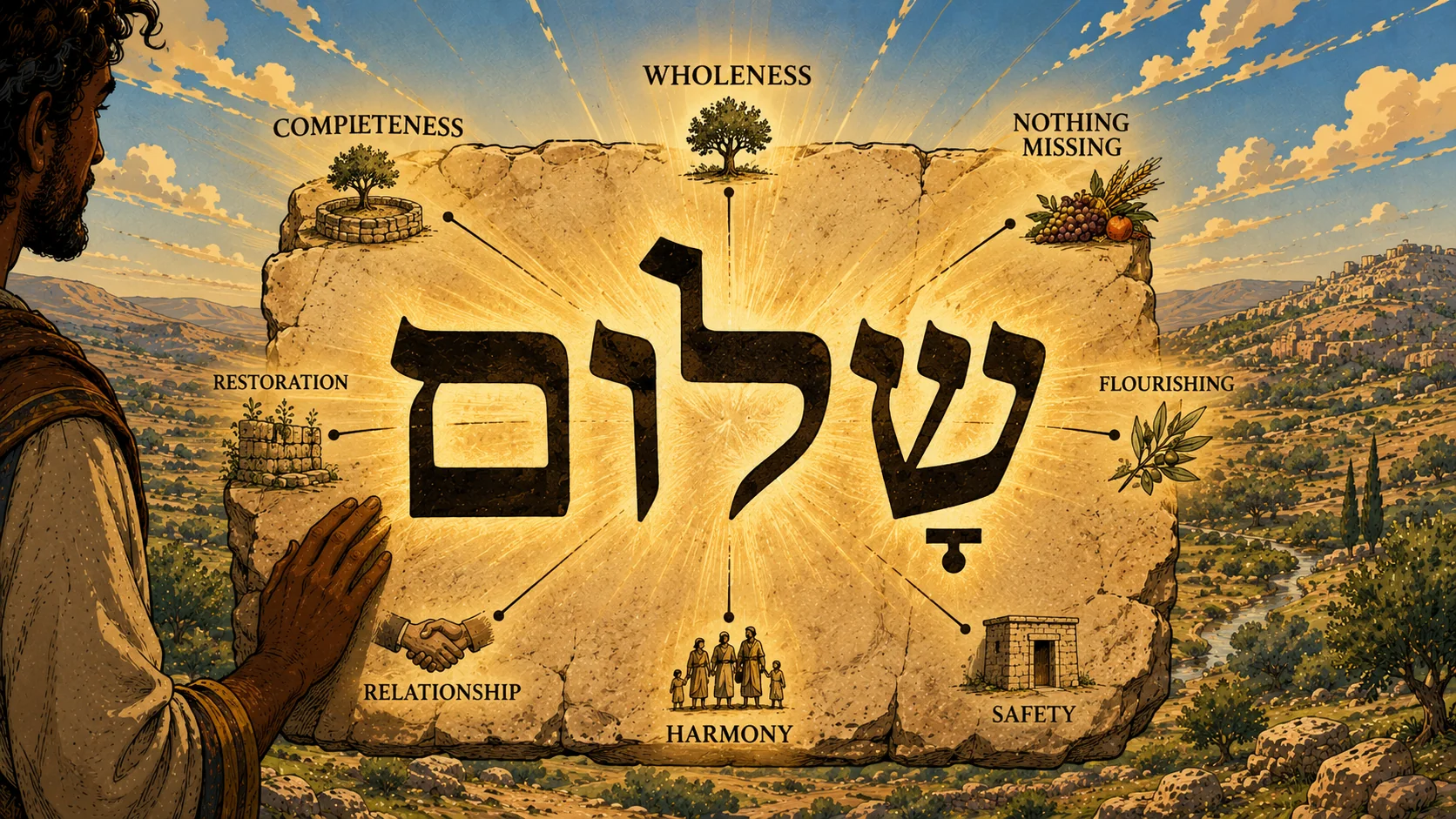
Shalom comes from the root שָׁלֵם (shalem), which carries the core meaning: complete, whole, lacking nothing, unbroken. This is not an abstract quality. The root describes a concrete state — a wall with no gaps, a payment that settles a debt in full, a relationship with no outstanding breach.
The same root runs through several connected words, each showing a different angle of the same idea:
| Hebrew | Transliteration | Meaning |
|---|---|---|
| שָׁלֵם | shalem | Whole, complete, in full — the root itself |
| שִׁלֵּם | shillem | To repay, to make whole what was taken or owed |
| שְׁלָמִים | shelamim | Peace offerings — the sacrifice that restores the bond |
| שְׁלֵמוּת | shlemut | Wholeness, integrity, completeness of character |
| מְשַׁלֵּם | meshallém | One who pays back, one who makes full restitution |
None of these words are passive. Shalom is not the absence of conflict — it's the presence of everything that should be present. A person at peace in the biblical sense is not someone who avoids trouble; they are someone in whom nothing is broken, nothing is missing, nothing is owed.
The Peace Offering Explains It Better Than Any Definition
The shelamim (שְׁלָמִים) — translated "peace offerings" in most English Bibles — shows the root in action. Leviticus 3 describes this offering in detail. It's the offering a person brought to God not as atonement for sin, but as an expression of completed relationship: gratitude, fulfillment of a vow, or a freewill act of worship from a full heart.
The word translated "peace" here isn't about quiet or calm. The shelamim was the offering that said: the relationship between me and God is whole. Nothing is outstanding between us. That's why it was accompanied by a communal meal — the offerer, the priests, and God's portion all sharing in the same animal. It was the picture of a relationship with no debt, no breach, no gap.
Shalom Across the Torah
Once you know the root, you start to hear it differently every time it appears. A few examples worth sitting with:
Genesis 15:15 — God promises Abram: "You yourself shall go to your fathers in shalom." This is the covenant promise of a complete life — not merely dying peacefully, but arriving at the end of your days with nothing unfinished between you and God, full of years, full of purpose.
Numbers 6:24–26 — The Priestly Blessing, which was spoken over Israel daily, ends with shalom. Read the progression: the LORD bless you and keep you (provision, protection) → the LORD make his face shine on you and be gracious to you (favor, grace) → the LORD lift up his countenance on you and give you shalom. The final word is the destination. All the preceding blessings build toward this state: nothing missing, nothing broken, the full weight of covenant wholeness resting on you.
Deuteronomy 20:10 — When Israel approached a city, they were first to call out to it with an offer of shalom — terms of complete relationship, not just a ceasefire. The word is the opening of a covenant offer.
Numbers 25:12 — After Phinehas acts, God says: "I give him my covenant of shalom." A covenant of completeness, of an unbreakable bond — the most serious language the Torah uses for relationship.
When Shalom Is What's Absent
The prophets reveal the full weight of the word by using it against its own absence. Jeremiah 6:14 is one of the sharpest lines in the prophetic books:
The false prophets were declaring wholeness that didn't exist. "Everything is fine. God is with us. Nothing is broken." Jeremiah calls it what it is: a lie. Not because God isn't capable of shalom, but because the people hadn't returned to covenant, and without covenant, there's no actual completion — just the word being used as a sedative.
Isaiah 48:18 shows the other side of that same coin:
Not a trickle. A river. Shalom at full capacity is abundance — righteousness rolling like waves (the verse continues), completeness that overflows. The Torah is saying clearly: this is what obedience produces. Not just rule-keeping, but an actual state of being where nothing is missing because you've stayed in alignment with the One who defines what wholeness is.
The Covenant of Shalom
Isaiah 54:10 uses the phrase that stops most readers the first time they encounter it in Hebrew:
God calls his eternal commitment to Israel a brit shalom — a covenant of completeness. This isn't the language of a peace treaty between two parties who've stopped fighting. It's the language of a bond so complete that nothing can introduce a gap into it. Even when the mountains move — the verse's full context — the covenant of shalom stands.
The Talmud (Tractate Shabbat 10b) records that shalom is one of the names of God. Not because God is passive or conflict-avoidant, but because wholeness is his nature. You don't call God "Shalom" as a description of mood. You call him Shalom because he is the one in whom nothing is missing, the one who holds all things in their proper completion.
Using the Word
None of this means you should stop using shalom as a greeting — the tradition of greeting another person with the word is old and meaningful. But now you know what you're actually invoking.
When you say shalom to someone, you're not saying "relax." You're saying: I wish for you that nothing is missing, that nothing between you and God is broken, that the full weight of covenant wholeness rests on you. That's a significant thing to say to a person. It's worth saying slowly.
And when you read it in the Torah — which you will, in nearly every book — don't mentally substitute "peace" and move on. Ask what's incomplete in that context that God is now promising to make whole. Ask what was broken that he's restoring. Ask what a life with nothing missing would actually look like for the person receiving that word.
That's the difference between knowing the word and knowing what it means.
Sources
- Blue Letter Bible — Strong's H7965 (šālôm) — BDB and Gesenius lexicon entries, full semantic range
- Numbers 25:12 (Covenant of Shalom) — Sefaria bilingual text
- Numbers 6:24–26 (Priestly Blessing) — Sefaria bilingual text
- Isaiah 54:10 (Brit Shalom) — Sefaria bilingual text
✡ Read It in the Hebrew
The Torah reader includes the full Hebrew text with transliteration. Find shalom in the Priestly Blessing, the covenant promises, and the prophets — in context, in the original language.
The Priestly Blessing — Numbers 6 What Is Biblical Hebrew?