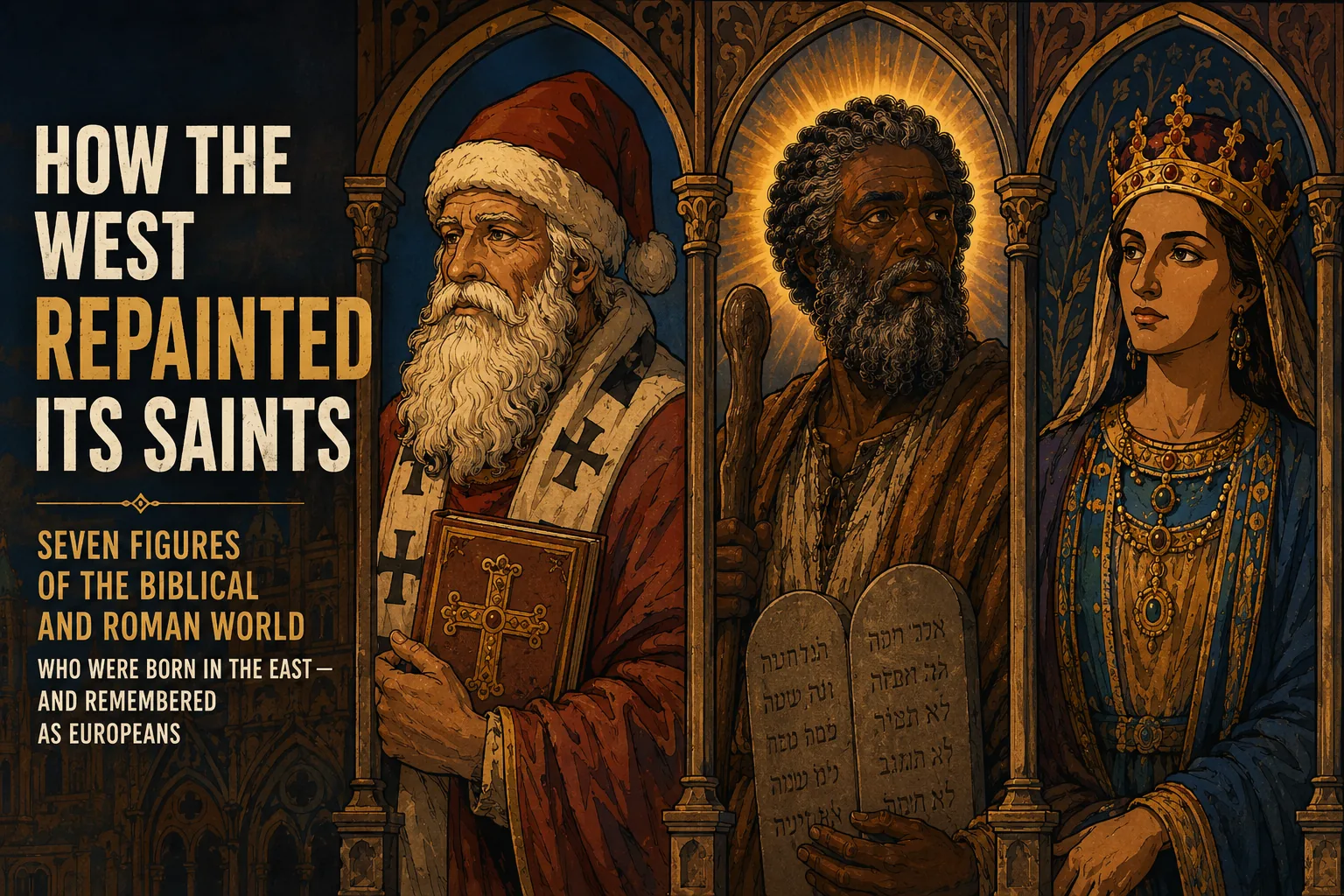
They were Berbers and Galileans, Egyptians and Anatolians, men and women of the eastern Mediterranean and the African shore. The faith they founded and died for was a faith of the East. Then the brush of empire reached them, one by one, and painted them pale.
A Word Before We Begin
This is not an argument about who was "Black." That framing belongs to the conquerors — the nations who sorted the world into colors so they could rank it. It is an argument about something the historical record actually settles: where these people came from, and how their faces were later changed.
Skin tone in the ancient world was a spectrum — olive, brown, tawny, dark — and no one left us a color chart. But origin is not a mystery. We know what lands these figures were born in, what peoples they belonged to, what tongues their mothers spoke. And we can watch, across the centuries of European art, those origins quietly erased and a fair European face painted over each of them.
That erasure has a method and a motive, and it is worth naming plainly. As one survey of the question puts it: over the centuries it was common for European artists to depict holy figures using the models around them — so a Dutch artist painted a Dutch Jesus, an Italian an Italian one — and the familiar image of a pale, flowing-haired Jesus was developed centuries later in Byzantine and Renaissance art, shaped more by the cultures that made it than by any historical memory. The same instinct that gave a Dutch painter a Dutch Christ gave all of Europe an entire heaven of Europeans.
Here are seven who were not.
I. Augustine of Hippo — The African Father of Western Thought
Begin with the man who, more than almost anyone, built Western Christianity — and was not Western at all.
Augustine was born in 354 in the town of Thagaste, in the Roman province of Numidia — today Souk Ahras, Algeria, in North Africa. His mother, whom the world remembers as Saint Monica, was of indigenous Berber (Amazigh) stock; her very name appears to reference a local Libyan deity, not a Roman one. The family spoke Latin at home and held Roman citizenship, but they were ethnic North Africans under Roman rule.
He was, in the Latin of his own world, an Afer — an African. He spent almost his entire life in the coastal regions of what are now Algeria and Tunisia, leaving only for five restless years in Italy, and an African accent marked a man out as provincial no matter his complexion. He referred to a fellow North African writer as "the most notorious of us Africans." His African identity was something he carried and named.
And yet: this towering African — author of the Confessions and City of God, one of the four Fathers of the Latin Church — has had his North African birth and Amazigh-Berber heritage simply dismissed for many centuries, his greatest works detached from the African context that produced them. Walk into a European church and find him in a window or on an altarpiece, and he will almost always be a fair-skinned European bishop in a fine mitre — the African painted out of the African.
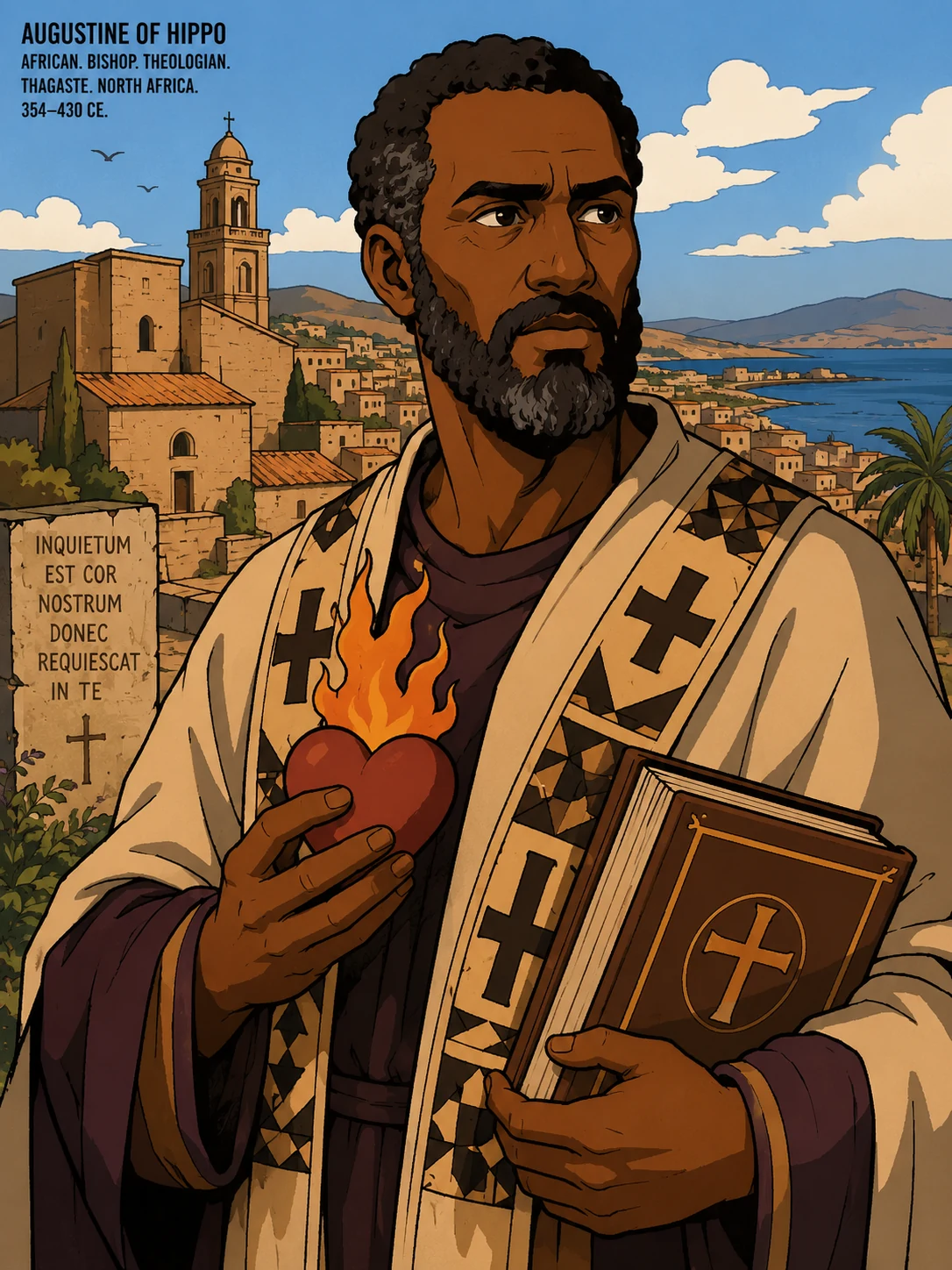
Augustine of Hippo · born 354, Thagaste, Numidia — today Souk Ahras, Algeria · the greatest theologian of the Latin West, rendered as the African he was
II. Maurice — The Black Saint Europe Painted, Then Un-Painted
No figure exposes the machinery of repainting more clearly than Saint Maurice — because with him, we can watch the brush move both ways.
Maurice was the legendary commander of the Theban Legion, a unit of the Roman army raised in Roman Egypt and composed of Christians, who in the late third century chose to be martyred together rather than obey an emperor's command to attack fellow Christians or sacrifice to pagan gods. His homeland was Thebes, in Egypt. His Egyptian origin is the bedrock of the entire legend.
For the first thousand years of his cult, European art showed him as a white Roman soldier. Then something remarkable happened. After a fire damaged Magdeburg Cathedral, a new statue was carved around 1240–1250, and the unknown sculptor rendered Maurice as a Black African man — the sculpted features and coloring unambiguously identifying him as such, in what is justly famous as the first, and arguably finest, depiction of a distinctly African saint in medieval European art. It is no caricature: a naturalistic, dignified warrior, armed with his spear, insisting on a Christian truth that transcended color.
For a time, Europe accepted him as African — even appropriate, since he came from Africa. He became the patron saint of the Holy Roman Empire, his image spreading across German lands as a Black knight. And then, in the later centuries, the brush reversed: Maurice was progressively whitened again, his African face fading back toward the European soldier he had never been.
Here is the lesson hiding in one statue. The face of a saint was never a record of history. It was a mirror of whoever held the brush — and what they needed the saint to be. When medieval Magdeburg wanted to show that Christ's army included Africa, Maurice was Black. When later Europe wanted a heaven that looked like itself, he was white again. The man from Thebes never changed. Only the people painting him did.
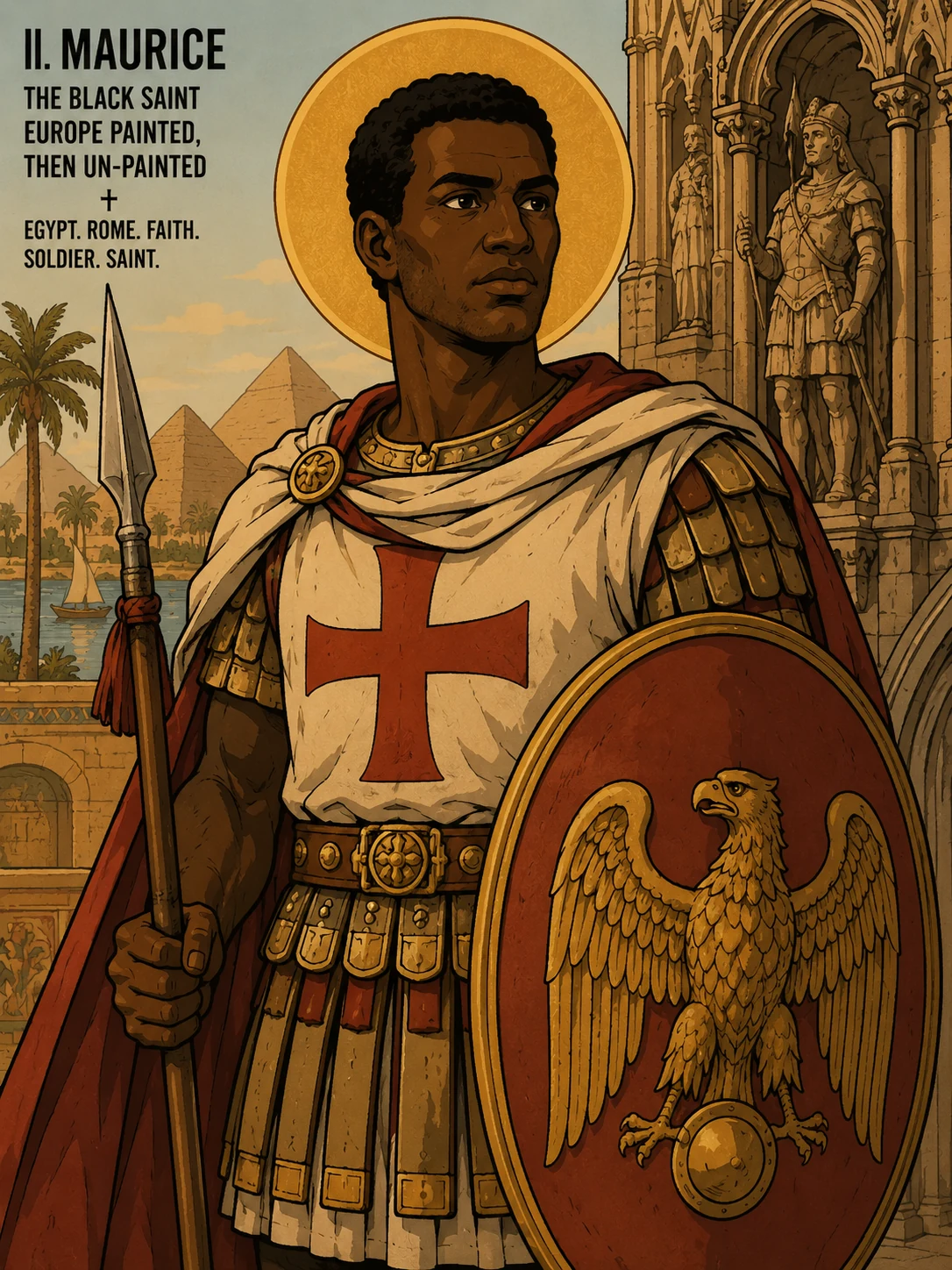
Saint Maurice · commander of the Theban Legion, raised in Egypt · illustrated here after the famous naturalistic Magdeburg statue of c. 1250 — the first, and arguably finest, depiction of a distinctly African saint in medieval European art
III. Nicholas of Myra — The Anatolian Bishop Who Became Santa Claus
Of all the repaintings, this is the one the whole world celebrates every December without ever knowing it.
The real Saint Nicholas was a Greek bishop of Myra, a maritime city in Lycia, in Asia Minor — modern Demre, in southern Turkey — who lived roughly 270 to 343, imprisoned during Diocletian's persecution and released when Constantine came to power. A Mediterranean man of the Roman East, in other words. Not a Northern European. Not a rosy-cheeked man of snow and reindeer.
And here, unusually, we are not left to guess, because his bones survive. His relics have been kept since 1087 in the Basilica of Saint Nicholas in Bari, Italy; in 2017, an Oxford team radiocarbon-dated a bone fragment and confirmed it dates to between 340 and 420 AD — precisely matching the lifetime of the historical Bishop of Myra. And forensic scientists at Liverpool John Moores University, using the skeletal measurements taken in the 1950s together with regional tissue-depth data from Turkey, reconstructed his face: the most realistic depiction ever made, of a middle-aged man with a long beard, a round head, a square jaw — and a nose that had been badly broken and healed asymmetrically.
A broken-nosed Anatolian bishop. That is the man behind the red suit. The transformation of this Mediterranean Greek into the fur-trimmed, snow-white Santa of the modern Christmas card is perhaps the most complete and most cheerful act of repainting in the entire Western tradition — a saint of the Roman East turned into the mascot of the European North.
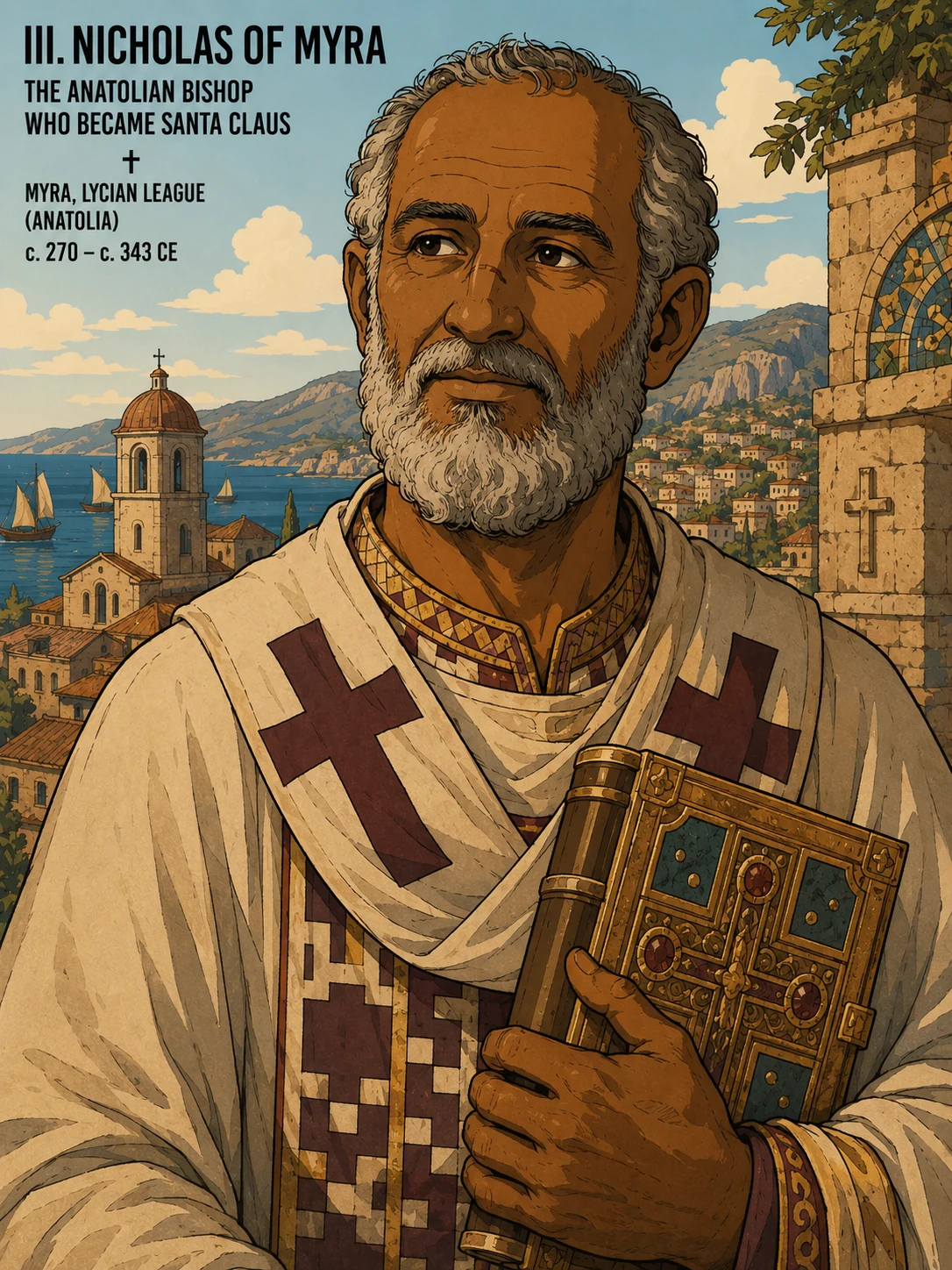
Nicholas of Myra · born c. 270, Myra, Lycia — modern Demre, Turkey · illustrated based on the 2017 forensic reconstruction: olive complexion, full grey-white beard, a healed broken nose · a Mediterranean bishop, before the myth
IV. Catherine of Alexandria — The Egyptian Scholar-Martyr
She shared an altar with Maurice — and the same fate at the hands of the brush.
Catherine was, by tradition, a learned virgin-martyr of Alexandria, in Roman Egypt — a woman renowned for confounding pagan philosophers with her learning before her martyrdom. At Magdeburg Cathedral, the Egyptian Catherine of Alexandria was honored alongside Maurice as co-patron, and she received sculptural treatment in a figure of the same size, materials, and composition as the famous Maurice.
Think on that pairing for a moment: a medieval German cathedral whose two great patron saints were an Egyptian soldier and an Egyptian scholar — both from Africa, both from the Christian East. That was the memory once carved in stone. In the centuries of European painting that followed, Catherine became a fair European princess at her wheel, her Alexandrian, North African world dissolved into a European court. The scholar of Egypt was given a European face and a European crown.
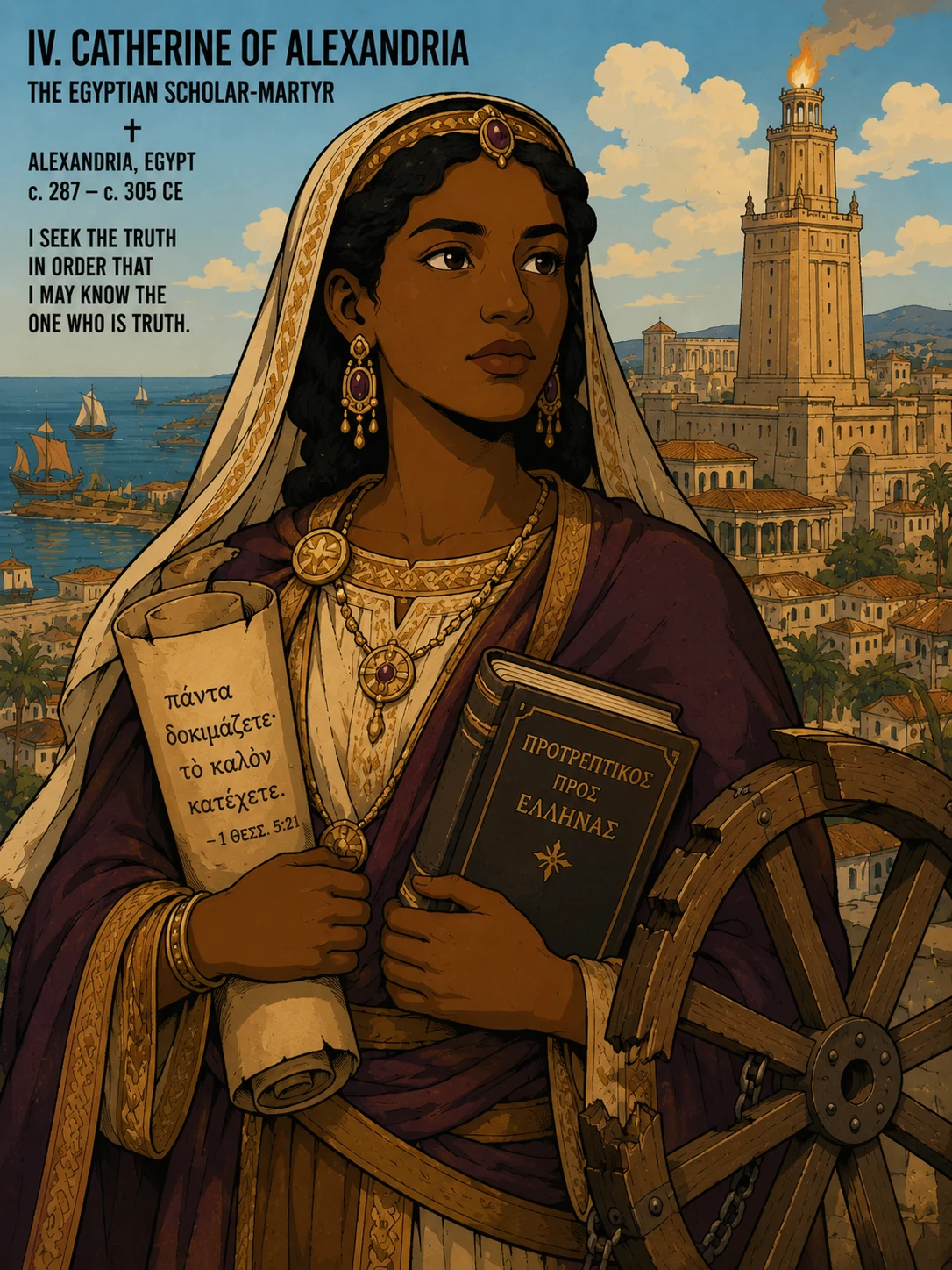
Catherine of Alexandria · scholar-martyr of Alexandria, Roman Egypt · co-patron of Magdeburg Cathedral alongside Saint Maurice — both from Africa, both from the Christian East · the Egyptian painted out of the Egyptian
V. Simon of Cyrene — The African Who Carried the Cross
Some figures were not invented by legend at all, but stand in the Gospel text itself.
When the soldiers led Jesus to be crucified, the Gospels record that they seized a passer-by and forced him to carry the cross — Simon, a man of Cyrene. Cyrene was a city in North Africa, in what is now Libya — a major center of the ancient world with a significant Jewish community. Simon was, by the plain geography of the text, an African — a Jew of the North African diaspora, present in Jerusalem likely for Passover.
The Gospel of Mark adds an intimate detail: Simon was "the father of Alexander and Rufus" — naming his sons as if the early Christian community knew them personally, suggesting his family became part of the church. An African man and his sons, woven into the founding story of the faith at its most agonizing hour.
For centuries of European art, Simon — when shown at all — was frequently rendered as just another European face in the crowd at Calvary, his Cyrenean, African origin quietly set aside. The one man the Gospel pulls out of the crowd by name and homeland was folded back into a European scene.
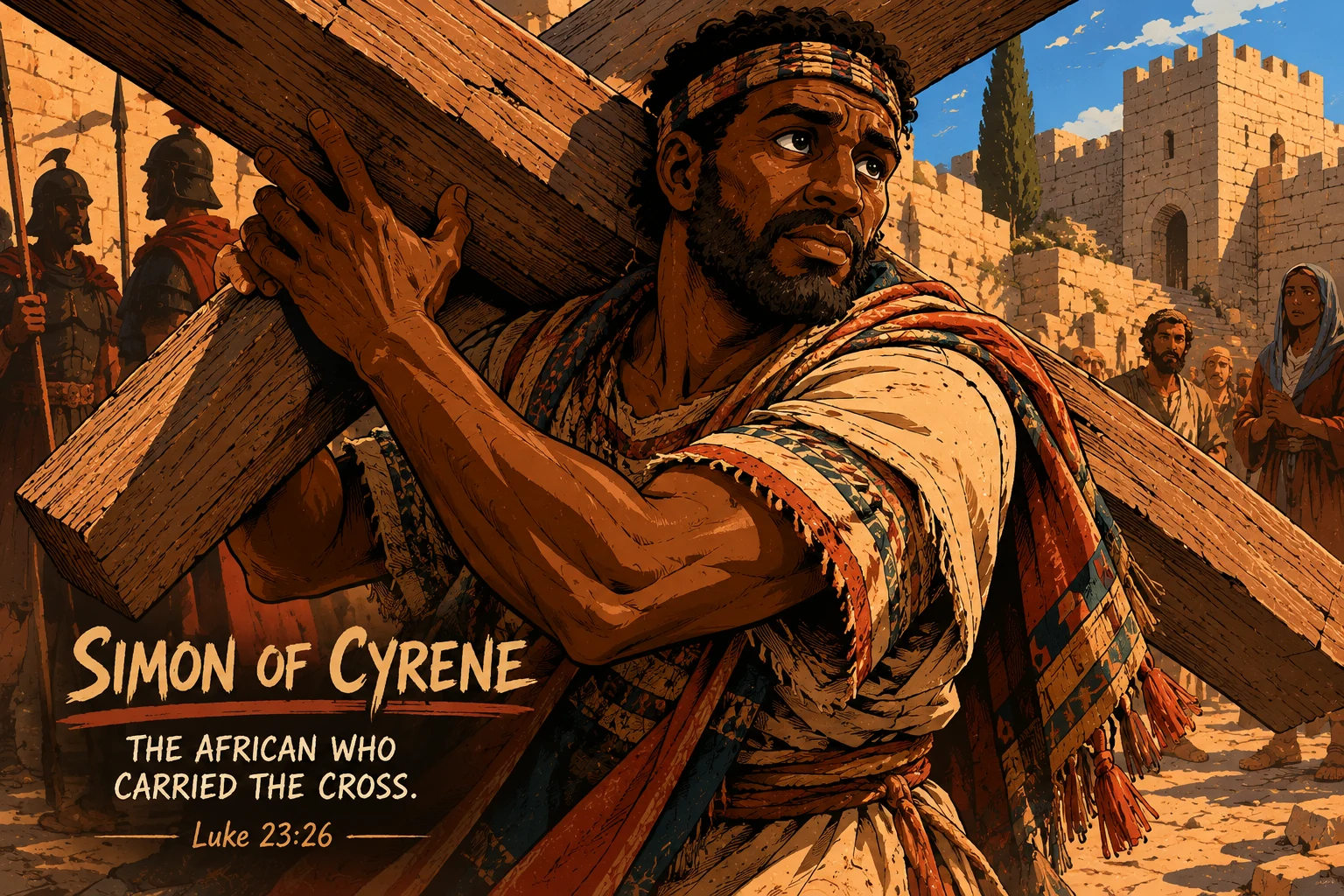
Simon of Cyrene · a Jew of the North African diaspora, named by Mark as "the father of Alexander and Rufus" · his city, Cyrene, is in modern Libya · pulled from the crowd by name in the Gospel — and quietly given a European face for centuries of European art
VI. Moses — The Hebrew Lawgiver Beneath the European Patriarch
He is the spine of your own tradition, and he too was repainted.
Moses was a Hebrew — an Israelite, born in Egypt, drawn from the Nile, raised in Pharaoh's house, formed in the deserts of Midian. Every coordinate of his life sits in the Levant and North Africa: Goshen, the Nile, Sinai, the wilderness of the eastern Mediterranean world. He was a man of the biblical East from first breath to last.
European art made him a different man entirely: the fair, flowing-bearded patriarch of the Renaissance, sometimes literally crowned with horns — a famous error born of a mistranslation of the Hebrew, which said the skin of his face shone (karan), misread in the Latin Vulgate as horned (keren). Read Exodus 34 in the Torah reader. The same instinct that gave Europe a European Christ gave it a European Moses; scholars have noted that the familiar fair Jesus was even modeled partly on existing artistic types like Moses and the Greco-Roman gods. The Hebrew lawgiver of the Exodus was absorbed into the visual language of Europe — his Israelite face, like his shining one, painted over.
The word at the center of the error: Exodus 34 describes Moses descending Sinai after speaking with God. The Hebrew says the skin of his face karan — shone, radiated. The Latin Vulgate, translated by Jerome in the late 4th century, rendered it cornuta — horned. The confusion is a single letter: the root qof-resh-nun (קרן) means to emit rays of light. Jerome's reading created one of the most consequential mistranslations in the history of Western art — and every horned Moses from Michelangelo onward inherits it.
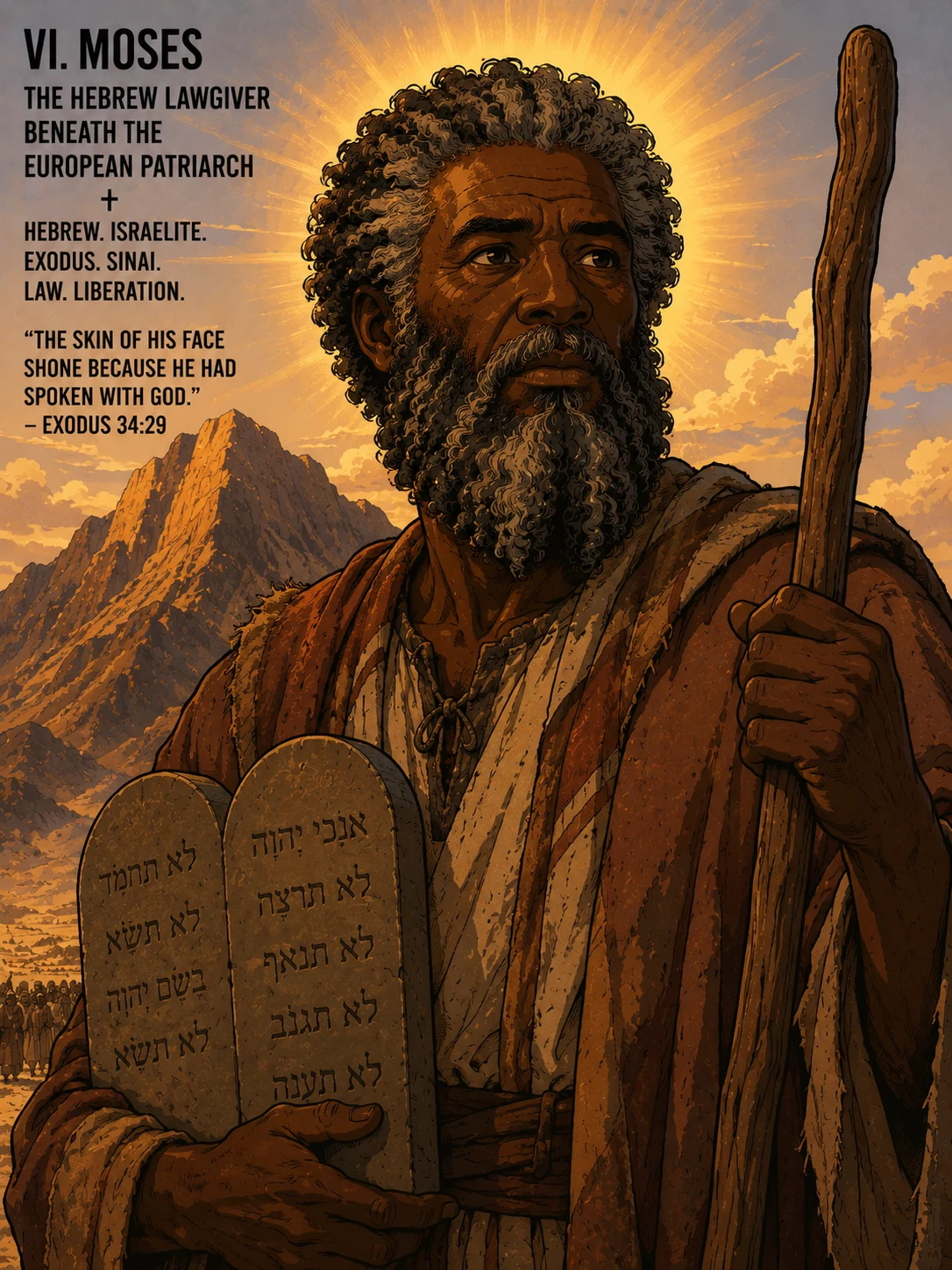
Moses · Hebrew lawgiver of the Exodus · his face shines — karan (קרן) — as Exodus 34 says · the shining, not the horns · born in Egypt, formed in Sinai, a man of the biblical East
VII. Jesus of Nazareth — The Galilean the World Re-Made in Its Own Image
And so to the center of it all — the most consequential repainting in human history.
Jesus was a Galilean Jew of the first century, a Levantine Semite of Roman Judea. On this, historians and forensic scientists now broadly agree, and the conclusion is striking precisely because it is so ordinary. The biblical scholar Joan Taylor, in her study What Did Jesus Look Like?, used skeletal remains, texts, and the funerary art of the period to conclude that, like most people of Judea in his time, Jesus most likely had brown eyes, dark brown to black hair, and olive-brown skin, and stood about five foot five. A separate forensic reconstruction led by Richard Neave, working from first-century Judean skulls, produced a man with tan olive-toned skin, dark eyes, a short beard, and dark hair cropped close to the head.
It is worth being precise here, because the popular label "Middle Eastern" is misleading — it is itself a modern, imprecise term, and many people called Middle Eastern today appear quite fair. That is not an accident; it is the result of two thousand years of migration, conquest, and intermarriage washing over the region — Greek, Roman, Turkic, and Crusader layers among them. The modern regional "look" cannot simply be read backward onto the first century. So the scholars do not rest on a vague regional appearance; they are specific. Taylor concludes that the people of Jesus's time and place were biologically closest to the Iraqi Jewish population of today — a community that preserved more of the ancient Judean line with less of the later European admixture. That is the measure: not "Middle Eastern" in general, but the specific descendant population, with olive-brown skin, dark eyes, and dark hair.
The Gospels themselves never describe his earthly appearance — which, Taylor argues, is the surest sign that he looked utterly typical; ancient writers noted the remarkable, and they noted nothing, because to his contemporaries there was nothing outwardly remarkable to note. He looked like any other rural Galilean Jew.
There is, however, one place where the New Testament does paint a face — and it is telling. In the Revelation of John, the glorified, risen Christ appears with hair "white like wool, white as snow" and feet "like burnished bronze, refined in a furnace" (Revelation 1:14–15). This is vision-imagery, not a snapshot — the white wool signals divine eternity, echoing the "Ancient of Days" of Daniel, not the hair color of a man of thirty. But notice even so what the imagery reaches for: wool and burnished bronze — a coiled, woolly texture and a deep metallic glow — a world away from the straight-haired, pale figure of the European altarpiece. Even the one scriptural portrait the West inherited leans away from the image the West painted.
We cannot know his exact features, and certainty here is dishonest. As Joan Taylor puts it, what we can say is what Jewish Galileans looked like two thousand years ago — and "they probably didn't have blue eyes and blond hair." The argument was never that we possess his portrait. It is that we know what he was not: he was not European, and the European world made him one.
The consequences were not merely artistic. Black American servicemen in the Second World War were handed a light-skinned, fair-haired image of Jesus as they went to fight; in Nazi Germany, depictions of a strong, blond Jesus were actively encouraged, alongside the lie that he was not even Jewish. The repainting of one Galilean face became a tool in the hands of empires and ideologies.
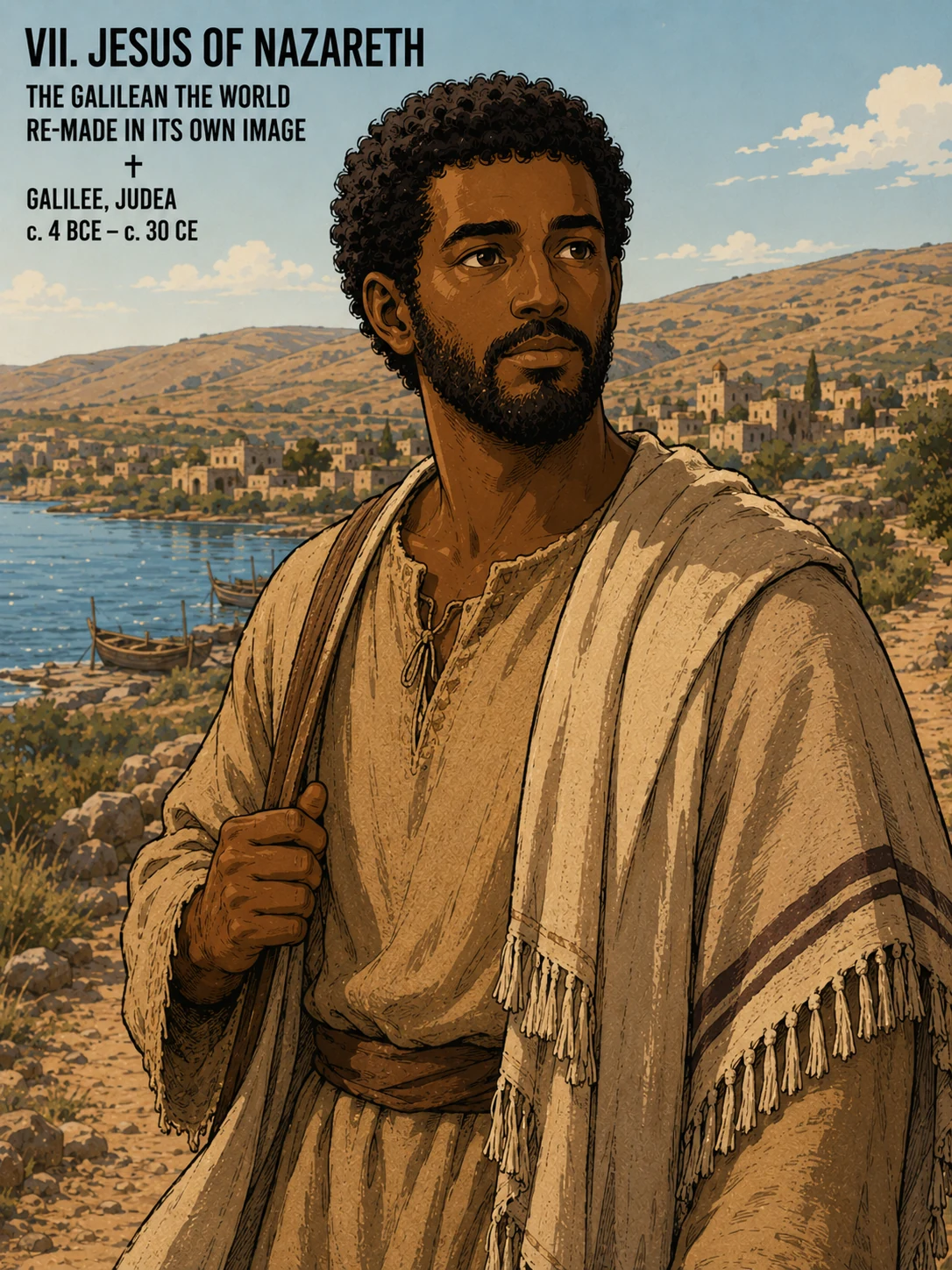
Jesus of Nazareth · a Galilean Jew of the 1st century · illustrated consistent with Joan Taylor's What Did Jesus Look Like? and Neave's forensic reconstruction from 1st-century Judean skulls · the man before the European canvas
What the Seven Have in Common
Lay them side by side — the Berber theologian, the Egyptian soldier, the Anatolian bishop, the Egyptian scholar, the African cross-bearer, the Hebrew lawgiver, the Galilean teacher — and the pattern is impossible to miss.
Every one of them came from the lands of the Bible and the Roman East — North Africa, Egypt, Anatolia, the Levant. Every one belonged to the peoples of that world: Berbers, Egyptians, Greeks of Asia Minor, Hebrews, Galilean Jews. And every one was later given, by the dominant art of Europe, a face that erased that origin and replaced it with a European one.
This was not, in most cases, a conspiracy. It was something quieter and more total: a civilization painting heaven in its own likeness, until the East was no longer visible in the faces of its own saints. The Dutch painter's Dutch Christ, multiplied across a thousand churches and ten thousand Christmas cards, became the only face the world could see.
To remember where they actually came from is not to take them from anyone. Augustine still belongs to every reader of the Confessions; Nicholas still gives gifts in every language; Jesus is still proclaimed on every continent. It is only to give them back their first home — the biblical East — and to let the historical record speak louder than the brush.
They were sons and daughters of the lands where the story began. The West did not create them. It inherited them — and then forgot, on purpose, to keep their faces.
Sources & Further Reading
- Augustine of Hippo: University of Notre Dame, Church Life Journal, "Augustine the African" (on his Berber-Amazigh mother, his birth at Thagaste, his self-identification as African); U.S. Catholic, "How Augustine's North African context shaped his theology"; Catholic Bishops' Conference of England & Wales, "Saints of Colour"; Wikipedia, "Augustine of Hippo" (Numidia, 354–430).
- Maurice & the Theban Legion: Yale University Press, "Reflections on Africans in Gothic Sculpture" (the c.1250 Magdeburg statue as the first depiction of a distinctly African saint); BlackPast.org, "St. Maurice"; Black Central Europe, "St. Maurice in Magdeburg (ca. 1240)"; Geraldine Heng, The Invention of Race in the European Middle Ages.
- Nicholas of Myra: Liverpool John Moores University Face Lab reconstruction (Prof. Caroline Wilkinson); the 2017 Oxford radiocarbon study (Prof. Tom Higham) dating the Bari relics to 340–420 AD; St. Nicholas Center, "The Real Face."
- Catherine of Alexandria: Yale University Press, "Reflections on Africans in Gothic Sculpture" (Catherine as co-patron of Magdeburg, given parallel sculptural treatment to Maurice); standard hagiography of the Alexandrian martyr.
- Simon of Cyrene: Gospels of Mark (15:21), Matthew (27:32), and Luke (23:26); standard reference on Cyrene as a North African (Libyan) city with a major Jewish community.
- Moses: Joan E. Taylor, What Did Jesus Look Like? (on the fair Jesus being modeled partly on Moses and Greco-Roman gods); standard scholarship on the karan/keren ("shone"/"horned") Vulgate mistranslation behind the horned Moses of European art.
- Jesus of Nazareth: Joan E. Taylor, What Did Jesus Look Like? (T&T Clark, 2018), incl. her conclusion that 1st-century Judeans were biologically closest to today's Iraqi Jews; Richard Neave's forensic reconstruction from 1st-century Judean skulls (BBC); History.com, "What Did Jesus Look Like?"; Revelation 1:14–15 (the glorified Christ with hair "like wool" and feet "like burnished bronze"), cited as symbolic vision-imagery rather than a physical description of the earthly Jesus.
Every claim of origin and every documented case of later repainting in this article is drawn from the historical, archaeological, and art-historical record. Where the evidence cannot establish a person's exact appearance — as with Jesus, or any figure who left no portrait — this article says so directly. The argument rests not on skin tone but on origin and on the documented history of how these faces were changed.
✡ Read the Texts These Figures Came From
Augustine, Moses, Jesus, Simon — all formed by the same scriptures. Read the Torah and the biblical record for yourself.
Scripture Breakdowns Saint George Was Never English