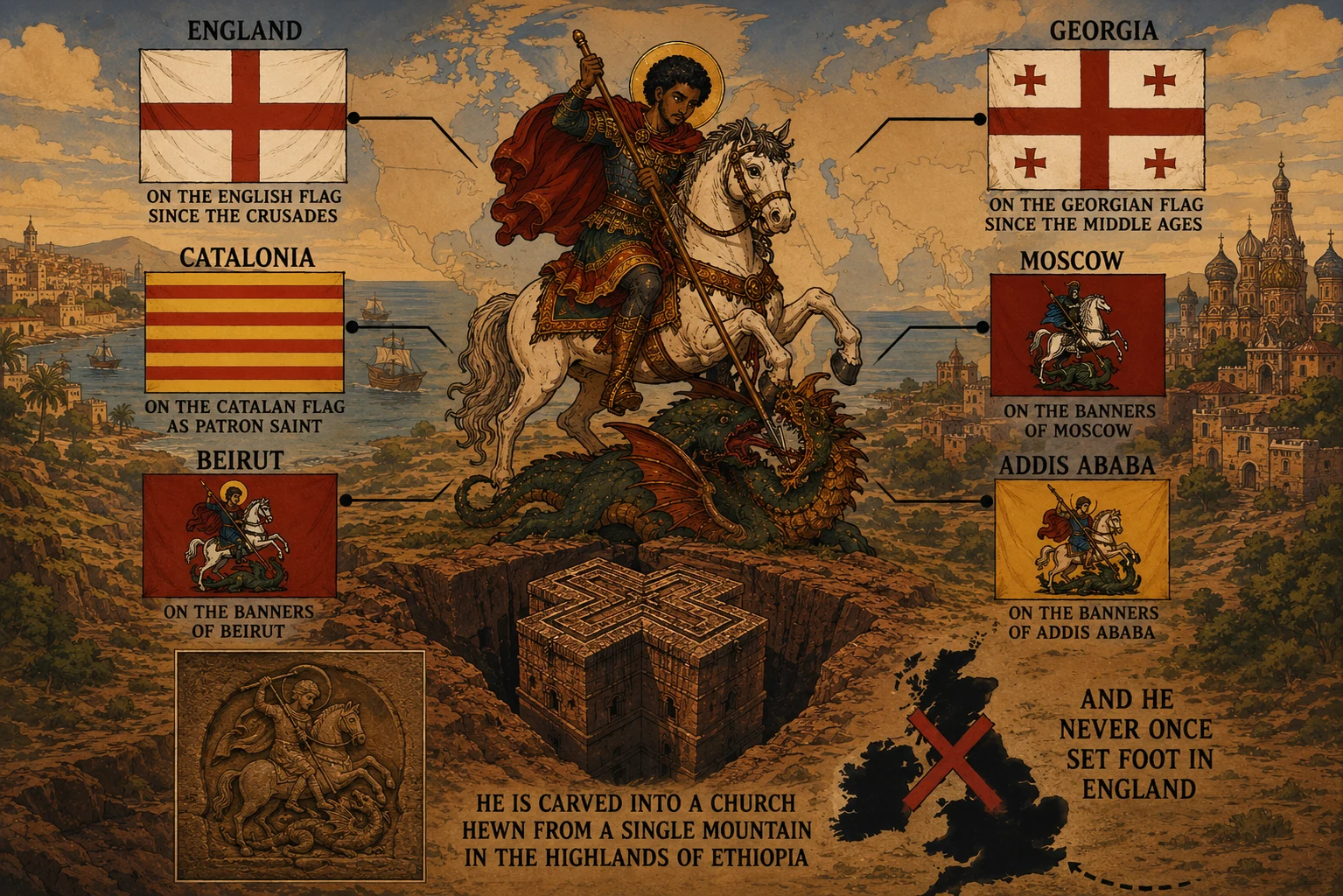
He is on the English flag. He is on the Georgian flag, the Catalan flag, the banners of Moscow and Beirut and Addis Ababa. He is carved into a church hewn from a single mountain of rock in the highlands of Ethiopia. And he never once set foot in England.
I. The Flag That Lies
Walk through England on the twenty-third of April and you will see his cross everywhere — a red cross on a white field, snapping from pubs and football terraces and town halls. Ask most people who Saint George was, and you will hear some version of the same answer: the patron saint of England, the English knight who killed the dragon.
It is one of the most successful pieces of rebranding in the history of the West. Because Saint George was not English. He was not a knight. He never saw England, never spoke a word of any English tongue, and died more than seven centuries before England had a coherent identity to be the patron of.
He was a soldier of the Roman East — a man of the lands the Bible calls home.
II. A Son of the Levant
First, a word that matters: the Levant. It is the old name for the eastern Mediterranean shore — roughly modern Israel and Palestine, Lebanon, Syria, Jordan, and the southern edge of Turkey. The word comes from the French levant, "the rising," as in the place where the sun rises — the East. It is, in other words, the land of the Bible itself: Canaan, Judah, Galilee, the Phoenician coast. When you read that George died in "Syria Palaestina," you are reading that he died in the heart of the biblical world.
What do the actual sources say about him?
The Eastern Christian tradition, which has venerated him without interruption for over 1,600 years, is remarkably consistent. George was born around 280 to a prominent Greek Christian family; his father was a military official from Cappadocia and his mother was from Lod — Lydda — in Palestine, and when his father died, mother and son returned to Lod, where he was raised. Lydda sits near modern-day Tel Aviv in Israel; there his mother had inherited a large estate, and there George grew up before joining the army of the Emperor Diocletian.
So the geography is not vague. His father's people were from Cappadocia, in Anatolia — modern Turkey. His mother's people, and the home he was raised in, were in Lydda, in the land of Israel. This is a Near Eastern man, of the eastern Roman provinces, formed in the same soil as the prophets and the apostles.
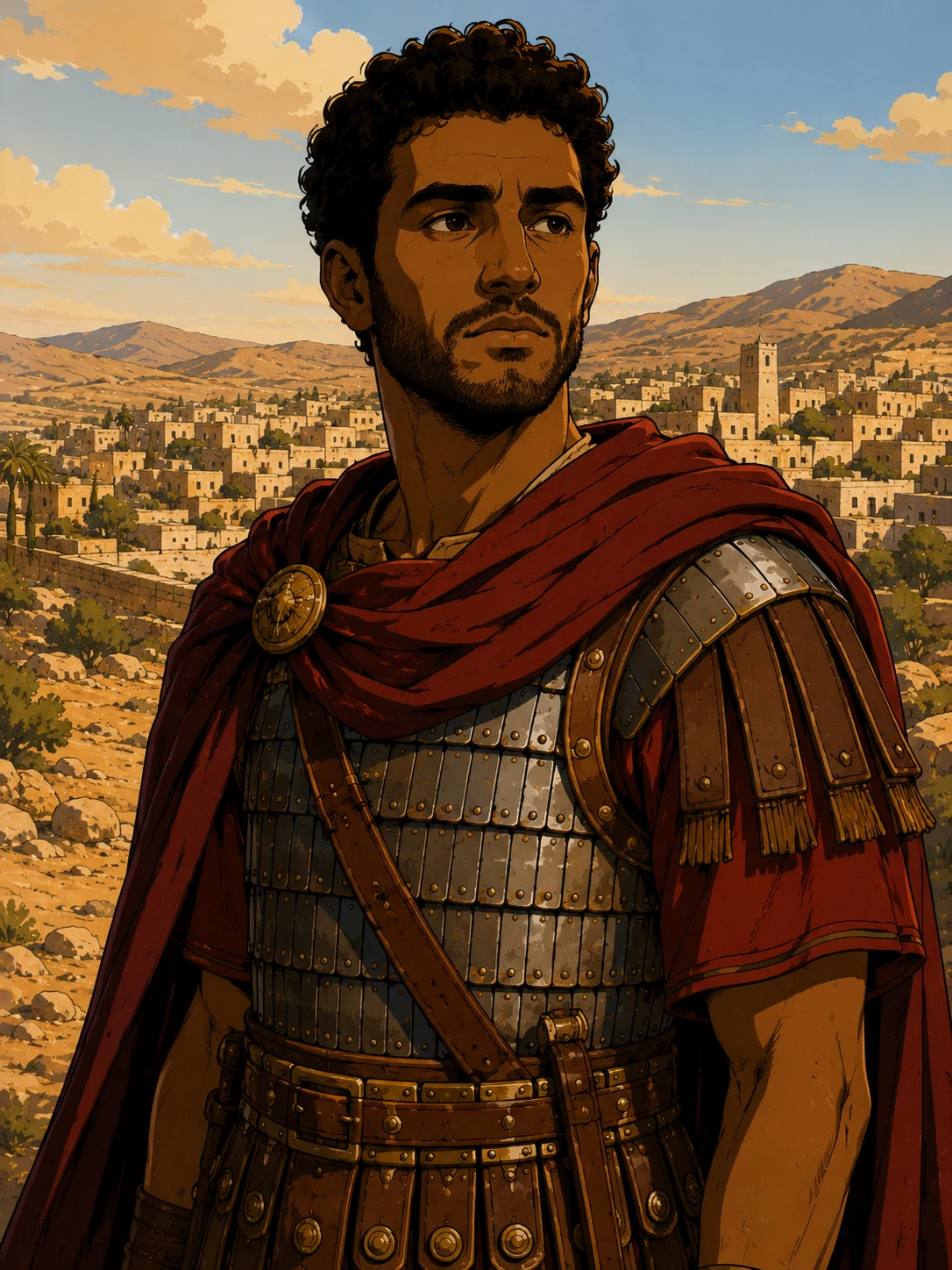
George of Lydda — a soldier of the eastern Roman provinces · born in Anatolia, raised in the land of Israel
III. The Soldier and the Edict
George rose fast. He followed his father into the army, proved a charismatic soldier, and by his late twenties had gained the titles of tribunus (tribune) and then comes (count), serving in Nicomedia as a member of the personal guard attached to the Emperor Diocletian.
Then, in 303, the world turned. Diocletian issued an edict authorizing the systematic persecution of Christians across the Empire; George was ordered to take part, but instead confessed that he himself was a Christian and openly criticized the imperial decision.
What followed is the kernel of fact beneath all the later legend. An enraged Diocletian ordered his torture and execution; after various tortures, George was beheaded before Nicomedia's wall on 23 April 303, and his body was returned to Lydda for burial, where Christians soon came to honor him as a martyr.
This is the part historians treat as bedrock. Even the most cautious admit the core. As the scholar Donald Attwater put it, no historical particulars of his life have survived, but the widespread veneration for George as a soldier-saint from early times had its center in Palestine at Diospolis — now Lydda — where he was apparently martyred at the end of the third or beginning of the fourth century. The Diocletianic Persecution of 303, aimed at Christians among the professional soldiers of the Roman army, is itself of undisputed historicity.
A real man. A real persecution. A real grave at Lydda. Everything else — the dragon, the princess, the white horse — grew on top of this, like ivy on a tombstone.
IV. Where the Dragon Came From
Here is something most people never learn: the dragon is not English either.
The earliest known depictions of Saint George killing the dragon come from Cappadocia — in what is now Turkey — in the eleventh century, and the legend exists in Christian tales in Syriac, Arabic, Coptic, Nubian, Ethiopian, Armenian, Latin, and Greek. Notice the order and the company: Syriac, Arabic, Coptic, Nubian, Ethiopian — the languages and churches of the Near East and Africa. The Latin and the European versions are latecomers to a story that was already old in the East.
And the setting of the dragon legend itself? According to the tradition, the city of Beirut, in Lebanon, was under siege by a vicious serpent that preyed on the citizens and their livestock; the governor's daughter was chosen by lot to be sacrificed to it, and on the night she was left outside the city walls, George was called on to destroy the creature — and succeeded.
Beirut. Lebanon. The Levant again. The dragon was slain on the eastern Mediterranean shore, not in an English meadow.
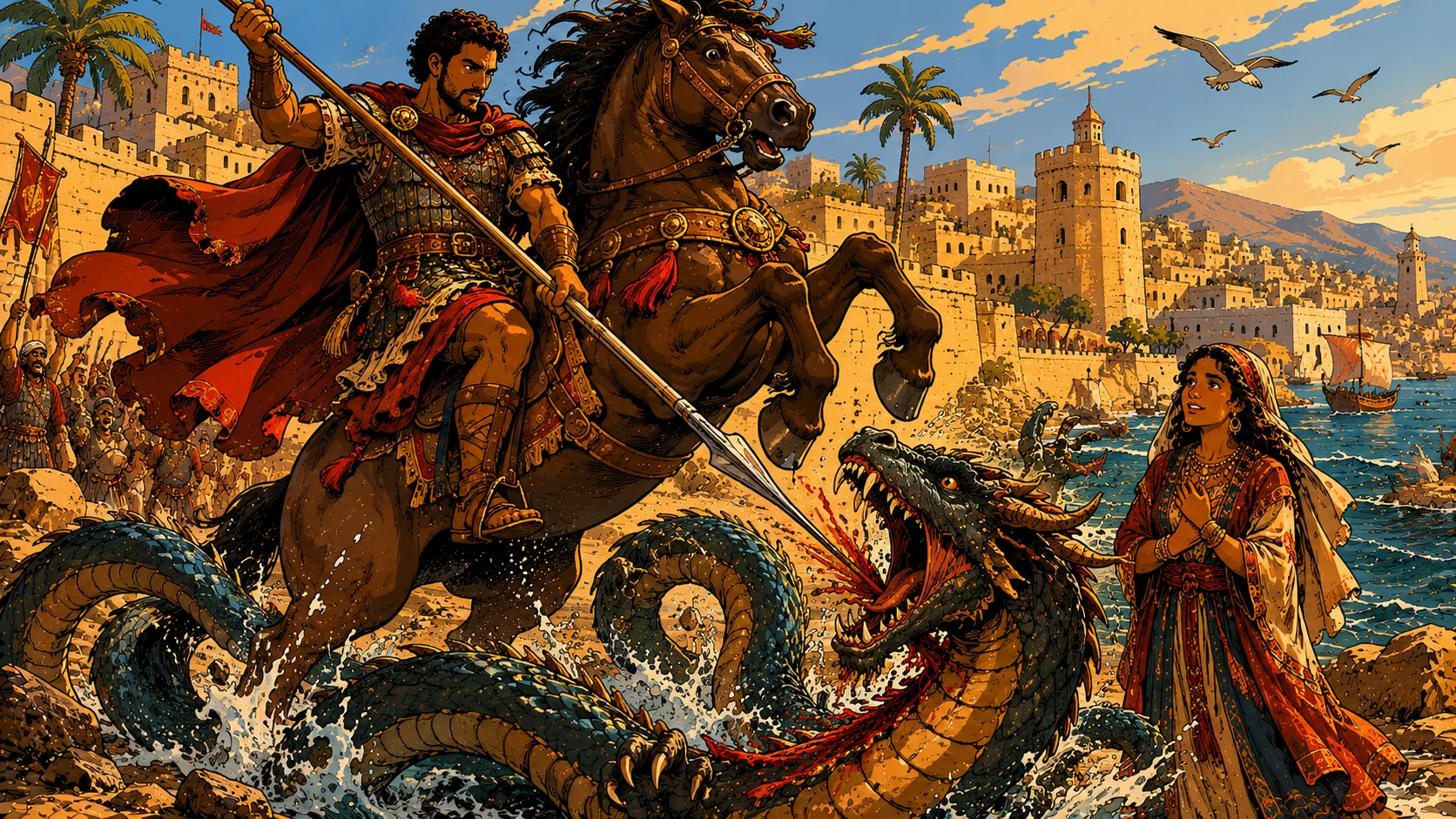
The dragon-slaying as the East tells it — a Levantine coastal city, the Mediterranean behind · Beirut, not Britain
V. The Saint of the African Church
If you want to see how the people closest to George's own world pictured him, do not look to London. Look to Ethiopia.
Ethiopia is one of the oldest Christian nations on earth. The Ethiopian Orthodox Church traces its roots to the Apostles and was made the official church of the Kingdom of Axum in the 4th century, making it one of the earliest nations to adopt Christianity; its kings claimed descent from the biblical King Solomon and the Queen of Sheba. This is a Christianity with its own ancient claim to Israelite descent — and George is woven into its very stone.
In the town of Lalibela — a pilgrimage site for Ethiopian Christians — eleven churches were hewn from solid rock between the 7th and 13th centuries, and the best-preserved and best-executed of them all, the Biete Giyorgis, is the Church of Saint George. It was carved out of a single slab of stone embedded in the earth, and from above it forms a stark cross rising from a cavern dug out of the rust-colored mountain rock. According to tradition, it was sculpted under King Gebre Mesqel Lalibela in the 13th century after Saint George appeared to him in a vision and instructed him to build it.
And in the art of that church and a thousand others, George does not look like an English knight. He appears constantly in Ethiopian religious art and iconography — in Addis Ababa, Lake Tana, Aksum, and Lalibela — rendered in a joyful riot of color, slaying his dragon as a saint of the African church.
This is the quiet scandal at the center of the whole story. The same saint that England turned into a fair European on a white horse was, for the African and Eastern churches, one of their own — venerated for over a millennium as a man of their world, painted in their image, honored in their stone.
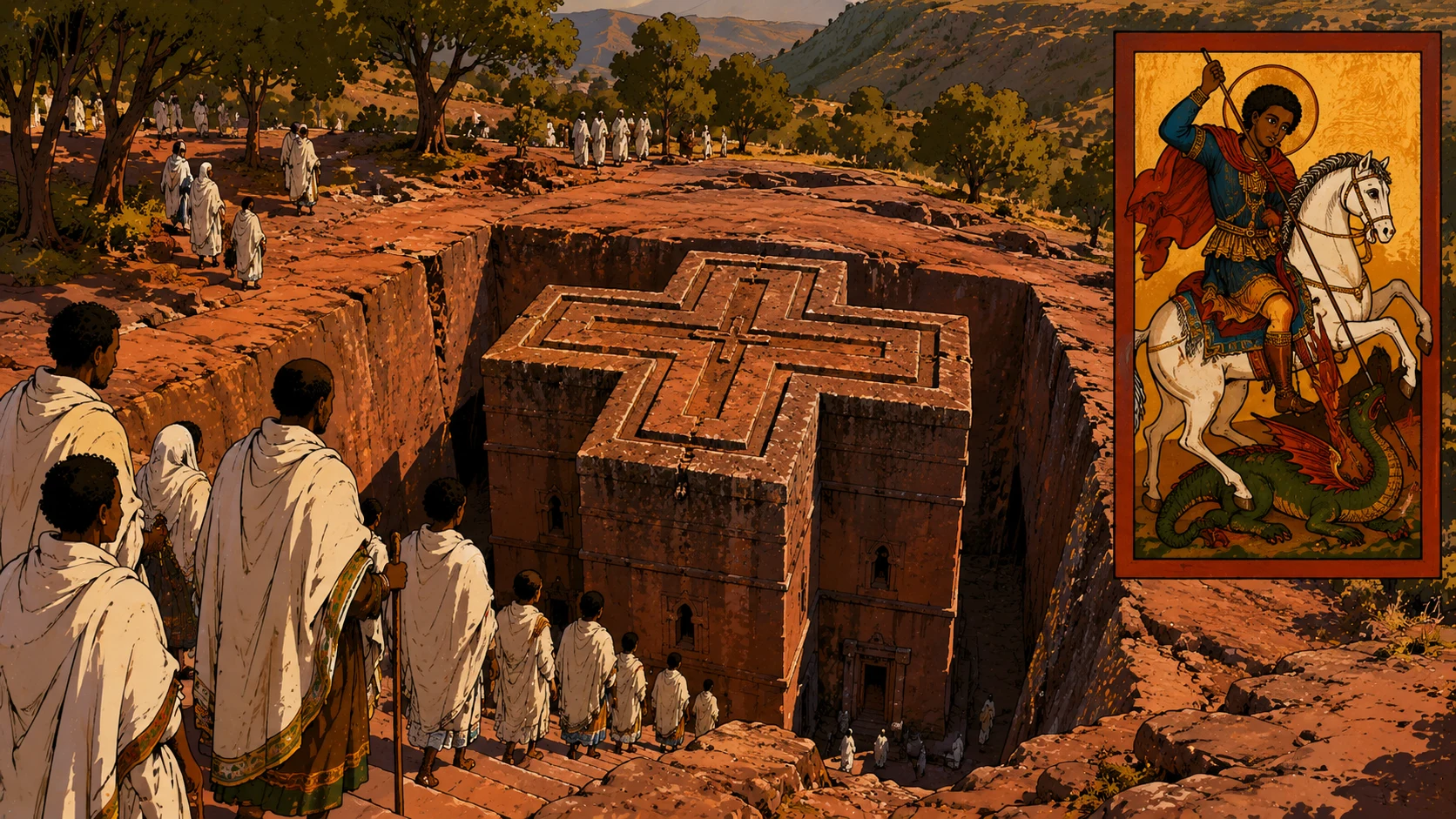
Biete Giyorgis — the Church of Saint George at Lalibela, Ethiopia · carved from a single rock mountain, a cross descending into the earth · with an Ethiopian-style icon of George at the side
VI. Shared by the Whole East
George does not belong to one church. He belongs to the entire world of the Christian, and post-Christian, East.
His shrines and major churches stand at Lalibela, at the Cathedral of Saint George in Damascus, at the Church of Saint George in Cairo, at St George's Cathedral in Addis Ababa — and, yes, at St George's Chapel in Windsor Castle. He is venerated in Eastern Orthodoxy, the Catholic Church, Oriental Orthodoxy, the Church of the East, the Anglican Communion, and is honored as well within the Druze faith and by some Muslims as a martyr of monotheistic faith.
Sit with that list. A saint born in Anatolia and buried in the land of Israel is honored in the same breath by Ethiopian Christians, Syrian Christians, Egyptian Copts, Druze, and Muslims. A carving of George slaying his dragon was even found at the 9th-century Ben Ezra Synagogue in Cairo. He is the shared inheritance of the entire eastern Mediterranean and African religious world.
And then, somewhere along the way, the West took him, and quietly painted out everything that connected him to it.
VII. The Repainting
How did a Levantine martyr become an English knight?
The hinge was the Crusades. George had been venerated as a military saint since the early centuries — and it was the crusading armies, marching east into the very lands where George had actually lived and died, who carried his cult home to Europe and recast it in their own image. The Near Eastern soldier-martyr became the mounted Christian warrior of European chivalry. The eastern Roman armor became medieval plate. The olive-skinned, dark-haired man of Lydda became, on canvas after canvas and shield after shield, a fair European knight.
We cannot, and should not, claim to know the exact complexion of a man who died in 303 and left no portrait. Anyone who tells you they know precisely what George's skin looked like is selling certainty that does not exist.
But we do not need that certainty to prove the theft. Because the theft is not about a shade of skin — it is about a place and a people. The documented, undeniable facts are these: George was not European. He was born of Anatolian and Levantine parents, raised in the land of Israel, served in the army of the Roman East, slain by a Roman emperor, and buried at Lydda. The earliest images of his great legend came from Cappadocia, and the richest devotion to him grew in Syria, Egypt, and Ethiopia.
Every one of those facts was painted over to produce the blue-eyed knight on the English flag. The West did not invent George. It inherited him from the East — and then erased the East from his face.
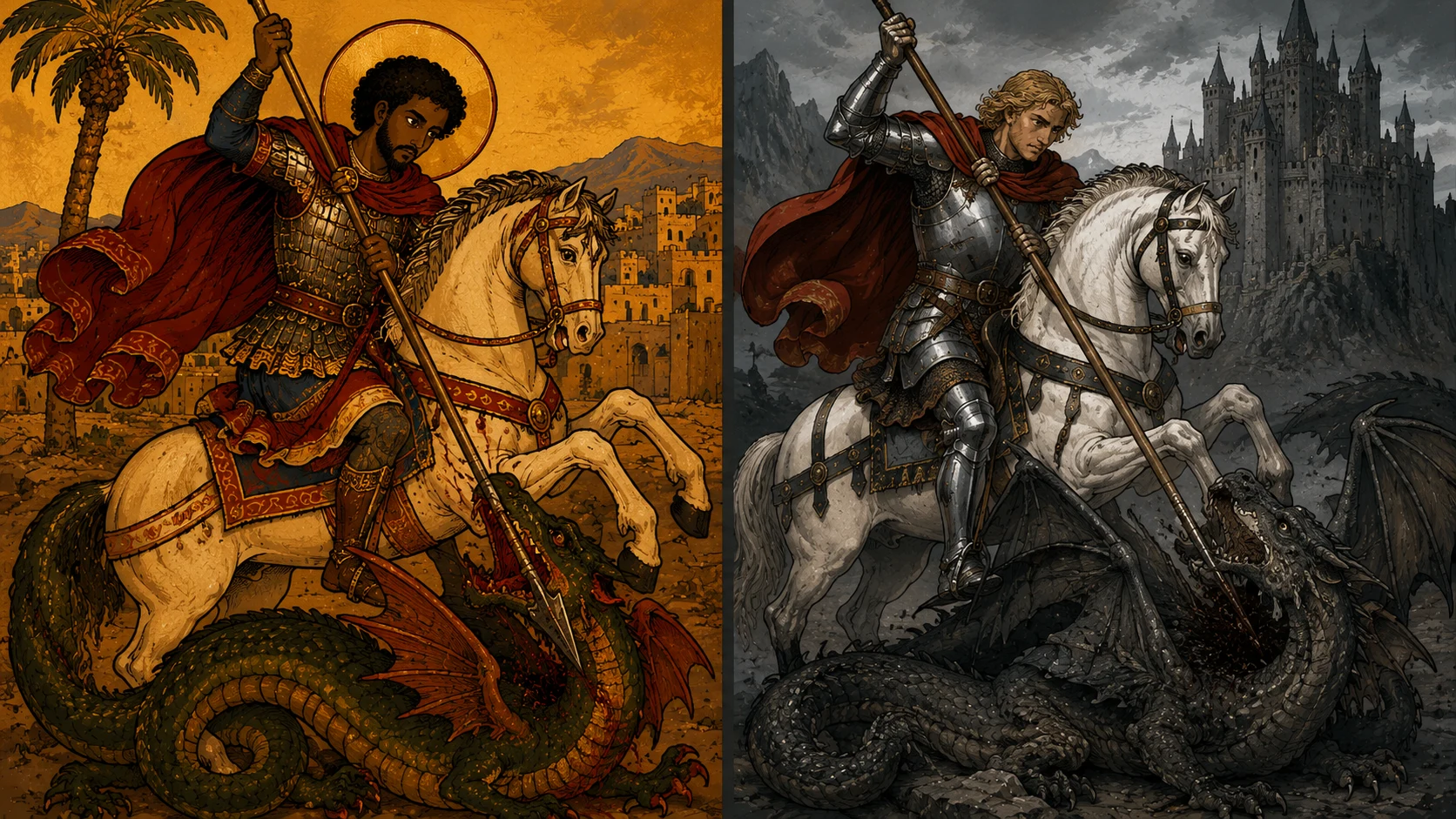
The same saint — as the East knew him, and as the West repainted him · same origin, erased in translation
VIII. A Note on the Dragon's Symbolism
One honest caution, so the story is told true. In the Ethiopian and Eastern tradition, the dragon is not a statement about race or peoples. In Ethiopian depictions the dragon often has a small black devil-figure sitting on it, because in the medieval imagination the dragon represented the devil, and the image visually reinforces the battle of good against evil. The dragon is sin and death and the adversary — never a human nation. To read it otherwise is to misread the icon.
The point of this article is the opposite of division: it is that a saint of the East was made to belong to everyone, and then quietly claimed by one part of the world that erased the rest.
IX. What the Flag Should Remind Us
The next time that red cross snaps in the wind over an English field, it is worth remembering what it actually points back to: a young man from Lydda, in the land of Israel, son of a Cappadocian soldier and a Palestinian mother, who served the Roman East and died rather than deny his God — and who is honored to this day in the rock churches of Ethiopia, the cathedrals of Syria, the Coptic sanctuaries of Egypt, and the shrines of the Druze.
He was a man of the biblical world. The flag is not wrong to honor him. It is only wrong to forget where he came from.
The saint was never English. He was never European. He was a son of the East — and the East has never stopped knowing it.
Sources & Further Reading
- Saint George — biographical tradition: Greek Orthodox and Melkite hagiographies on his Cappadocian father, his mother from Lydda, his rank as tribune and count, and his martyrdom under Diocletian, 23 April 303.
- Historicity: Herbert Thurston, The Catholic Encyclopedia; Donald Attwater on the limits of what can be known; the undisputed historicity of the Diocletianic Persecution of 303.
- The dragon legend's origins: "Our Migration Story" (University of Cambridge / Runnymede Trust), From the Middle East to Britain: the migrating legend of Saint George — earliest dragon depictions from 11th-century Cappadocia; the legend in Syriac, Arabic, Coptic, Nubian, Ethiopian, Armenian, Latin, and Greek.
- The Beirut setting of the dragon tale: Legacy Icons / Eastern Christian hagiography.
- Ethiopia and Lalibela: Horniman Museum & Gardens, Saint George, Patron Saint of Ethiopia; UNESCO World Heritage listing on the Church of Saint George, Lalibela (Biete Giyorgis); the Solomonic-descent tradition of the Ethiopian crown.
- Breadth of veneration: encyclopedic entries listing his shrines at Lalibela, Damascus, Cairo, Addis Ababa, and Windsor, and his veneration across Orthodox, Catholic, Oriental Orthodox, Druze, and Muslim traditions.
- The Crusader transmission: standard accounts of George's veneration "as a military saint since the Crusades."
Every claim of fact in this article is drawn from the documented historical and hagiographical record. Where the record is silent — for instance, on the exact complexion of a man who left no portrait — this article says so plainly. The argument does not rest on his skin; it rests on his origin, which is beyond dispute.
✡ The Land George Came From
George was raised in the land of Israel — in Lydda, near the heart of the biblical narrative. Read the text of that land for yourself.
Scripture Breakdowns Who Were the Pharisees?