
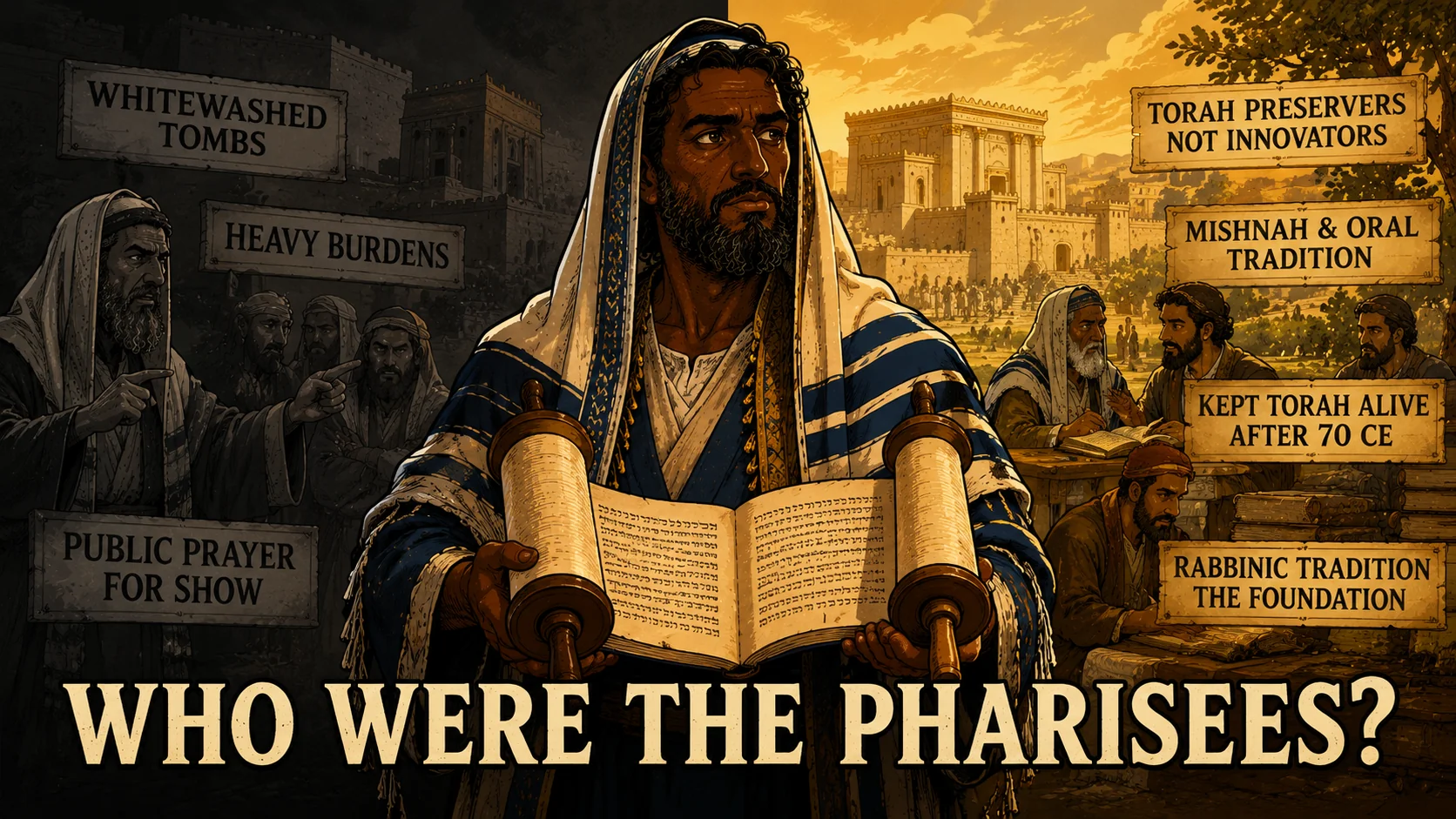
Ask most Christians who the Pharisees were and you'll get a quick answer: hypocrites. Religious elites who opposed Yeshua. The villains of the Gospels. That's the Sunday school version — and it's not wrong exactly, but it's incomplete enough to be misleading.
The full answer is harder. And more important. Because the Pharisees were not just a group from the first century. They're a pattern — one that shows up in every generation, in every religious community, among people who have the text and have lost the spirit. Including ours.
The Name: Perushim — Separated Ones
פְּרוּשִׁים (Perushim) comes from the root parash (פָּרַשׁ) — to separate, to distinguish, to set apart. They called themselves "the separated ones" because they distinguished themselves from ritual impurity, from Hellenistic customs that had diluted Jewish practice after Alexander's conquests, and from the laxity that had crept into religious life after the Maccabean revolt.
This was not a movement founded by cynics or opportunists. It began as a serious attempt to bring Deuteronomy 6 to life — to make the Torah livable, applicable, and daily. The problem wasn't the founding intention. The problem was what it became.
Who They Actually Were — The Historical Record
The Pharisees emerged as a distinct group around the 2nd century BCE, in the aftermath of the Maccabean revolt. They stood in contrast to the Sadducees — the priestly aristocracy who controlled the Temple, held political power under Roman governance, and interpreted the Torah strictly on the written text alone, rejecting oral tradition entirely. Encyclopædia Britannica documents their emergence in the Maccabean period (~165–160 BCE) and traces their succession into Rabbinic Judaism.
The Pharisees took the opposite position: Moses received both a written Torah and an oral Torah at Sinai, and the oral tradition was necessary to apply the written law to the details of daily life. This oral tradition — the legal discussions, rulings, and interpretations passed from teacher to student — eventually became the Mishnah (compiled around 200 CE by Rabbi Judah HaNasi), and then the Talmud. Josephus describes them directly in Antiquities of the Jews, Book XVIII: "They are esteemed most skillful in the exact explication of their laws."
Every rabbi today — Orthodox, Conservative, Reform, Mizrahi, Sephardic — traces their interpretive tradition directly through the Pharisees. When the Temple fell in 70 CE, the Sadducees collapsed with it. No Temple, no function. The Pharisees survived because their Torah was portable. It didn't require a building. The covenant continued after the destruction of Jerusalem because the Pharisees had built a system for carrying it.
This is the part of the story most Sunday school curricula skip entirely.
Real Israelites by Blood
This matters and should be said plainly: most Pharisees were Israelites by blood. The movement was not a priestly class — it was populated by scribes, merchants, craftsmen, Torah lawyers, and educators — the working and educated middle class of Judean society.
Paul writes in Philippians 3:5: "circumcised on the eighth day, of the people of Israel, of the tribe of Benjamin, a Hebrew of Hebrews; as to the law, a Pharisee." He lists this as credentials and lineage. Not shame, not a confession of a former life of villainy — credentials. Being a Pharisee, in Paul's own accounting, was part of being a serious Hebrew who took the covenant seriously.
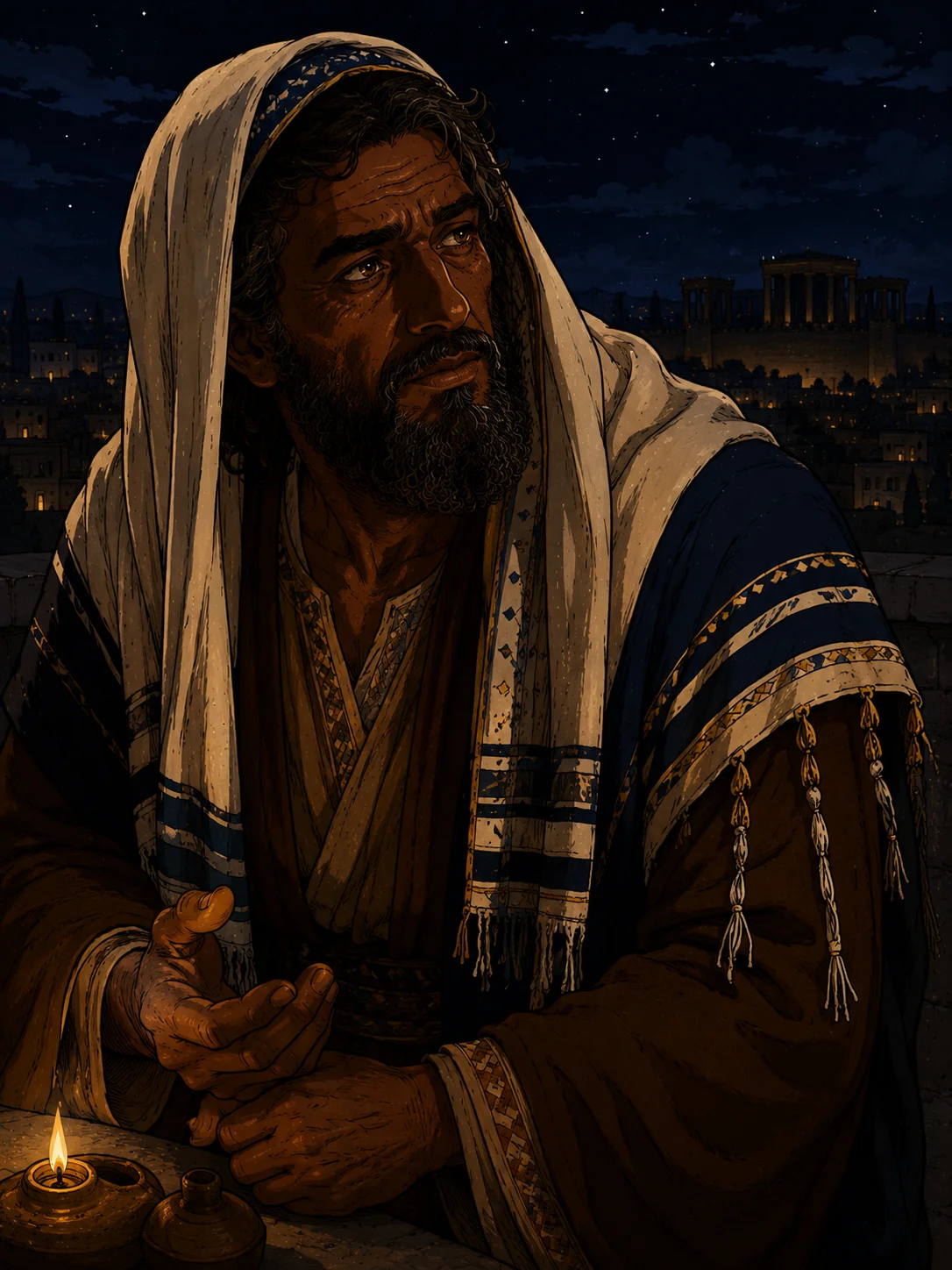
Nicodemus — the Pharisee who came to Yeshua at night · John 3:1–2
Nicodemus — who came to Yeshua at night and later defended him before the Sanhedrin (John 7:50–51) and helped bury him (John 19:39) — was a Pharisee. Joseph of Arimathea, who provided the tomb, is described as "a good and righteous man" (Luke 23:50). Gamaliel, one of the most respected teachers in Jewish history, stood before the Sanhedrin in Acts 5:34–39 and counseled them to leave the disciples alone: "If this plan or work is of men, it will fail. But if it is of God, you cannot stop it." That was a Pharisee. They were not a monolith of corruption.
What the Text Actually Says
The New Testament's critique of the Pharisees is specific, not wholesale — and understanding the specificity is important. The disputes Yeshua had with certain Pharisees centered on: Sabbath observance (specifically healing on the Sabbath), ritual hand-washing before meals, the weight given to oral tradition versus Torah, and questions about his authority to forgive sin.
Many of these debates were internal debates that the Pharisees themselves were already having. The famous schools of Beit Shammai and Beit Hillel disagreed sharply on hundreds of legal questions, with Hillel's school generally taking more lenient and people-centered positions. Some of Yeshua's positions align closely with Beit Hillel. These were theological disputes within a living tradition — not a confrontation between the "good guy" and "bad guys."
The most pointed critique — Matthew 23 — is not really about Torah observance being wrong. Matthew 23:3 is clear: "Do what they say, but not what they do." The law they teach is not wrong. The problem is the gap between the mouth and the heart. They wear broad phylacteries and love the seats of honor at feasts and the greetings in the marketplace. They do the visible things for visibility, and the inner man is hollow.
The Pattern — How It Happens
The Pharisees were real Israelites. They knew the scripture — not approximately, not secondhand. They memorized it. They debated it. They built an entire civilization around transmitting it. And they still missed what mattered most — not because the text wasn't clear, but because a specific and familiar corruption had set in:
Status replaced service. Recognition replaced righteousness. Tradition replaced transformation.
When a person knows enough scripture to sound right, when they hold a position that earns them deference, when their religious identity is something others see and admire — the temptation is to start performing righteousness rather than practicing it. The performance is easier. It gets the same social reward. And over time, the performer forgets there's a difference.
That story is not unique to first-century Judea. It is the story of every religious institution that has ever existed. It is the story of pastors who preach sacrifice and live in wealth. It is the story of people who can cite chapter and verse from memory but cannot tell you the last time the scripture actually changed something about how they live. It is, if we're honest, available to any one of us who has been walking with the Torah long enough to become comfortable with it.
The Pharisees are not the villain of a story that ended 2,000 years ago. They are a warning that is still current.
The Prayer — Luke 18:9–14
The parable of the Pharisee and the tax collector is one of the sharpest things Yeshua ever taught. It is aimed directly at the failure described above, and it is impossible to read honestly without feeling the point turn toward yourself.
The text says this before the prayer even begins. His prayer was directed at himself, not at God. Everything that follows confirms it.
The entire prayer is a comparison. Not a confession, not a request, not worship. He came to God's house and used it to run a personal inventory of his superiority. God is addressed once, briefly. Then the Pharisee talks about himself for the rest.
Both statements are true. Fasting twice a week exceeded the Torah requirement. Tithing everything he owned was above the minimum. He was doing more than required — and it counted for nothing, because it was done for the audience. Even if the only audience was himself.
The tax collector — a man who worked for Rome and extracted money from his own people, one of the least respected figures in that society — came to God with the weight of what he was and no defense for it. He didn't need a comparison to the Pharisee to feel small. He already knew.
Seven words. No credentials. No comparison. No resume. No list of what he's done right. Just: I know what I am. Have mercy. That's the entire prayer. Yeshua says this man went home justified. The other didn't.
The lesson is not that obedience doesn't matter — the Pharisee's fasting and tithing were good things. The lesson is that obedience performed for visibility, comparison, or self-justification has already spent its reward. He came for the feeling of being righteous. He got it. That was the whole transaction.
The Question This Leaves You With
The discomfort of this article, if you've gotten this far, is that it's not really about the Pharisees. It's about a pattern that runs through anyone who has the text long enough to get comfortable with it.
Most people who read Luke 18 read it as a story about someone else. The Pharisee probably would have too. That is precisely his mistake.
The real Israelites of the first century — the people who had the Torah, memorized it, taught it, and structured their entire identity around it — missed what it was pointing toward while standing inside it. That's not a condemnation of their bloodline or their scripture. It's a description of what power and comfort and the approval of men does to people who started out genuinely wanting to serve God.
The Pharisees preserved the Torah for us. We should be grateful for that. And we should take the warning seriously. The question is not which group you identify with. The question is: which prayer are you praying?
Sources
- Josephus, Antiquities of the Jews, Book XVIII, Ch. 1 §3 — University of Chicago, primary source on Pharisee beliefs and practice
- Encyclopædia Britannica, "Pharisee: Definition, History & Legacy" — covers Second Temple origins and Rabbinic succession
- Luke 18:9–14 — Sefaria text; Matthew 23 — Sefaria text
✡ Read the Torah They Preserved
The Pharisees fought to keep the Torah alive. Read it for yourself — in Hebrew, with transliteration, free.
Read the Torah Who Authorized the KJV?