In 1847 They Were Called Black
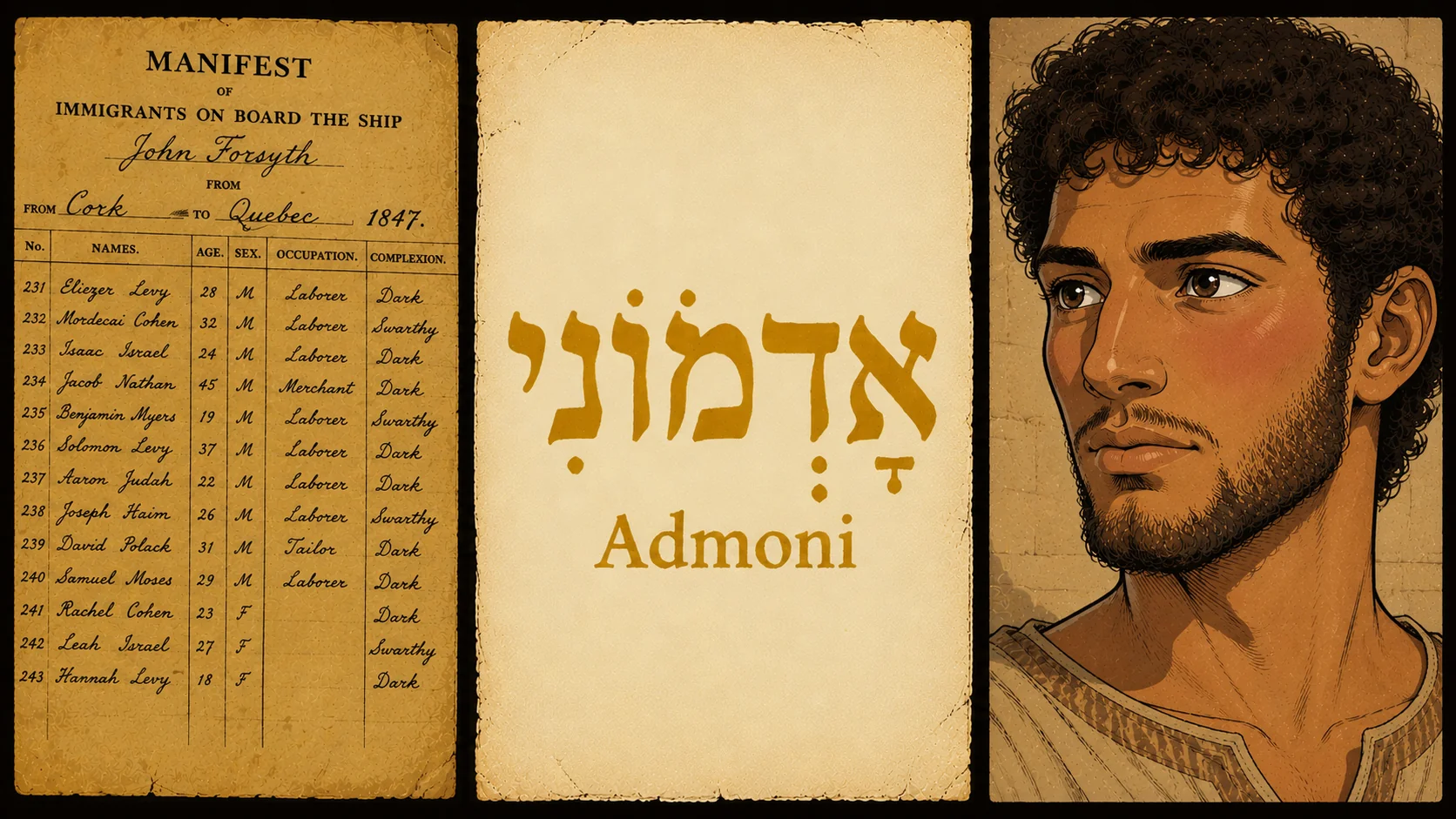
When Irish immigrants stepped off ships at American ports during the Famine years — 1845 through the early 1850s — the clerks who logged them into the official record did not write "white." They wrote: swarthy. Dark. Black.
This is not an interpretation. It is in the documents. Historian Noel Ignatiev spent years in the archives and published the findings in How the Irish Became White (1995). Matthew Frye Jacobson did the same in Whiteness of a Different Color (1998). Ship manifests, census records, nativist press accounts — across the mid-19th century, Irish and Scottish immigrants occupied a category in American racial taxonomy that was distinctly not white. Thomas Nast drew them in the pages of Harper's Weekly with ape-like features alongside Black Americans. The New York Times referred to Irish neighborhoods as inhabited by a "black" population. The classification was systematic enough that historians have a name for the decades-long process by which it reversed: "the wages of whiteness."
By 1924, Irish Americans were unambiguously white. In 1847 they were not. The same people. The same bloodline. Seventy-seven years apart. Two entirely different racial categories.
Hold that in your head. Because now we need to walk into a birth room in the ancient Near East, 3,500 years ago, and figure out what a Hebrew word actually means.
The Birth Room — Genesis 25:25
Rebekah has been carrying twins. The pregnancy was violent enough that she asked God directly what was happening inside her, and the answer she got back — "two nations are in your womb" — was not reassuring. Now the first child arrives, and the text stops to describe what the midwives and everyone in that room immediately saw:
Three things in that sentence, each doing specific work:
Admoni — the complexion word. Ruddy. Reddish. We'll come back to this in detail.
Kullo — all of him. The redness was not a patch or a birthmark. It was a whole-body quality. The text is giving you a physiological observation, not a metaphor.
Ke'aderet se'ar — like a garment of hair. The child was covered in thick, visible body hair at birth. This is the trait that gives him his name: Esau, from a root related to asui (עָשׂוּי) — made, complete, as if fully formed and hairy from birth.
Here is what the midwives actually saw: a newborn whose entire body was flushed with birth redness — admoni — and covered in body hair. Newborn redness (erythema neonatorum) is a physiological reality. Every newborn arrives flushed from the birth canal. But this flushing is dramatically more visible on lighter-toned skin. On a deeper base complexion, the redness is present but muted. On a lighter one, it burns red. The text is describing an infant whose redness was so noticeable and all-encompassing that it became part of his identity — a family that thought it worth recording.
This is the first piece of evidence: within a Semitic, ancient Near Eastern family, one twin was noticeably lighter than the other. Not white. Not European. The lighter end of the same family — the same variation that produces the "Black Irish" within the Celtic family — a dark sibling and a light sibling from the same womb, neither of whom belongs to a racial category that would be invented 3,000 years after their birth.
The Hebrew Word — Admoni and Its Root Family
You cannot understand admoni without the root family it comes from. Hebrew roots work differently from English words — they carry meaning in clusters, and the cluster tells you what you're actually talking about.
| Hebrew | Transliteration | Meaning |
|---|---|---|
| אָדָם | Adam | Man, human — also: the ground-colored one |
| אֲדָמָה | Adamah | Ground, soil, earth — the red-brown soil of the ancient Near East |
| אָדֹם | Adom | Red — the base color word |
| אַדְמוֹנִי | Admoni | Ruddy — the complexion derived from that redness |
This root family is not about bright red — not crimson, not blood-red. It is the warm, reddish-brown quality of the soil of the Levant. The adamah — the ground — is the color reference. Adam was named for it: the ground-colored man, shaped from the soil, returning to it. When the text says admoni, it is describing someone with the complexion quality of that earth — warm, ruddy, at the lighter-toned end of the spectrum.
Now here is the critical fact: the word admoni appears in the entire Hebrew Bible exactly three times — and only for two people.
Esau at birth. The whole-body redness that named a nation. A note: five verses later in Genesis 25:30, Esau asks Jacob for the red stew — calling it adom adom (very red). The stew is adom. Esau is admoni. The text distinguishes carefully between the color word and the complexion word.
David, brought from the fields before his anointing. Samuel arrives to anoint one of Jesse's sons, passes over seven older brothers who look the part, and then God stops him: "I have not chosen these. Man looks at the outward appearance — YHWH looks at the heart." Then they bring in the youngest. He's admoni. Beautiful eyes. And God says: arise, anoint him.
David, facing Goliath. The Philistine looks across the valley, sees who they've sent, and despises him. A boy. Ruddy. Good-looking. No armor. No military bearing. Goliath says: am I a dog, that you come at me with sticks? He reads the admoni and sees weakness. He is wrong about everything.
Same word. The man who lost the covenant birthright. And the man who became the covenant's greatest king. The text is not careless with this — it uses admoni for both with full knowledge of what it's doing.
What Ship Manifests Prove About Reading Complexion Across Time
Now we return to the Irish.
The process Ignatiev and Jacobson documented is worth understanding precisely, because it makes the interpretive point better than any theological argument can. Irish immigrants in the 1840s arrived in a country with a binary racial taxonomy: white and Black. The Irish did not fit cleanly into either category. They were Catholic in a Protestant nation, poor in an economy that associated poverty with Black Americans, and their complexion — often described as olive, swarthy, or dark — did not register as unambiguously white to the officials and commentators doing the classifying.
Over the following decades, through a combination of political alignment with the Democratic party, labor competition with Black workers, active participation in anti-Black violence, and the gradual lightening of nativist attitudes toward Catholic immigrants, Irish Americans were absorbed into the white category. By the 1920s, the shift was complete. The same families whose grandparents had been called swarthy were now unambiguously white.
The lesson is not that the Irish were Black — they were not. The lesson is that the categories used to describe them were historically constructed, not biological. If the category "white" could expand to include people who had been called swarthy and dark within living memory, then the category is not a stable biological description. It is a social arrangement. And social arrangements are the wrong tool for reading a 3,500-year-old Hebrew text.
When modern readers open Genesis 25 and ask "what race was Esau?" they are carrying a question that was invented in the 18th century into a text written in the ancient Near East. The text has no concept of race as modern people understand it. It has complexion. It has nation. It has bloodline. And it uses admoni — the warm, ruddy, lighter end of the Semitic range — to describe what the midwives saw that day.
What Esau Actually Was
Here is the honest synthesis the text supports:
Esau was genuinely lighter than Jacob. The birth admoni is evidence of this. The later episode in Genesis 27 — where Jacob covers his hands and neck with goat skin to feel like Esau's hairy, rough skin and fool their blind father Isaac — confirms that the physical difference between the twins was visible and tactile. Jacob, unblemished and smooth-skinned, needed a disguise to pass as Esau. The contrast was real.
Within the ancient Near Eastern Semitic family — the same family that produced the deep brown complexion of the covenant line — there was real complexion variation. That variation is not unusual. Every extended family has it. The darker siblings and the lighter siblings. The olive skin and the warm brown and the reddish-ruddy. Esau was the admoni end of the variation that Jacob and Esau shared. Not outside the family. The lighter sibling within it.
Not white. Not Northern European. Not the pale complexion of a people whose ancestors spent ten thousand years without sunlight. The warm, reddish, medium-light complexion of an ancient Near Eastern man who was lighter than his twin — which is not the same thing as being light.
The closest modern analogy the outline of this article offers is exactly right: the way the "Black Irish" — a term for dark-complected, dark-haired Irish people with Mediterranean features — are the darker end within the Celtic family. No one argues the Black Irish are a different race from the fair Irish. They are variation within the same bloodline. Esau and Jacob were variation within the same Semitic bloodline. The admoni quality was Esau's end of that variation.
The Covenant Was Never in the Complexion
This is where the David connection matters most.
The same word used to describe the man who traded his birthright for stew is used to describe the man who killed a giant, wrote the Psalms, and established the dynasty from which the Messiah would come. Admoni. Both of them. The text is explicit about this, and it is not a coincidence — it is a theological statement delivered through vocabulary.
When Samuel arrived at Jesse's house to anoint the next king, God told him plainly: "Do not look at his appearance or the height of his stature, because I have rejected him. For the LORD sees not as man sees: man looks on the outward appearance, but the LORD looks on the heart" (1 Samuel 16:7). Then they bring in the admoni boy from the sheep pen, and God says yes.
The covenant chose Jacob over Esau. The text tells you why: "the elder shall serve the younger" — the oracle given to Rebekah before the twins were born, before any admoni was observed, before any goat skin was felt. The election preceded the complexion. The reason was not because Jacob was darker. The text never says that. The covenant weighed something else entirely — and it weighed it before the birth room, before the stew, before the mess of birthright theology that followed.
The complexion was the description. It was never the criteria.
Reading Ancient Texts With the Right Tools
If you are part of a diaspora community that has been recovering Hebrew roots — reading the text more carefully, learning the language, pushing back against the European iconography that has colonized the biblical imagination — this article gives you three tools, not just one.
The linguistic tool: admoni means ruddy, warm, reddish — the lighter end of the ancient Near Eastern range. It shares a root with Adam and adamah — the ground. It is not a European complexion word. It is a Hebrew one, and it describes variation within a Semitic family, not an import from outside it.
The physiological tool: birth redness is most visible on a lighter base complexion. The text's observation that Esau was kullo admoni — all of him ruddy — is a medical observation about a newborn. It tells you something real about his natural coloring. And it tells you the covenant line was dark enough that this was remarkable to note.
The historical tool: the Irish. If complexion categories could shift enough in 77 years of American history to move an entire people from swarthy-and-dark to unambiguously-white, then those categories are not biological facts. They are social constructions. And social constructions cannot be safely read backward onto a text that predates them by 3,000 years.
The covenant people were dark-complected. The text is consistent on this. The lighter among them — Esau, David — were still ancient Near Eastern. Still Semitic. Still within the same family. The admoni quality is the lighter end of that family's variation, not the beginning of a European claim and not an anomaly that needs explaining away.
Read the text in its own language. It will tell you exactly what it means.
Sources
- Noel Ignatiev, How the Irish Became White (Routledge, 1995)
- Matthew Frye Jacobson, Whiteness of a Different Color (Harvard University Press, 1998)
- David R. Roediger, The Wages of Whiteness (Verso, 1991) — origin of the "wages of whiteness" framework
- Thomas Nast's Irish caricatures in Harper's Weekly, documented at thomasnastcartoons.com
- U.S. National Archives, Passenger Arrival Records — primary source for 19th-century ship manifests
- Genesis 25:25 — Sefaria bilingual text; 1 Samuel 16:12 — Sefaria; 1 Samuel 17:42 — Sefaria
א Explore the Family Tree
See Esau, Jacob, and the entire Genesis genealogy — illustrated, with Hebrew names and identifications — in the Hebroni Family Tree.
Open the Family Tree Sons of Ham Breakdown