Every English speaker was taught that God "passed over" Egypt the night of the tenth plague — skipping the blood-marked houses as He moved through the land. The Hebrew says something entirely different. And the difference changes the entire picture of what happened at midnight.
The Word Every Translation Gets Wrong
The holiday is called Pesach (פֶּסַח) in Hebrew. It was translated into English as "Passover" — and "pass over" has dominated the English-speaking imagination ever since. The picture it produces: God, or the angel of death, moving through Egypt and skipping over the homes marked with lamb's blood. Bypassing them. Passing them by.
That is not what the Hebrew root records.
The root פ-ס-ח (p-s-ch) appears a handful of times in the Hebrew scriptures. Its clearest use outside of Exodus 12 is in Isaiah 31:5, where it appears alongside other words for protection and shielding:
The same verb — פָּסֹחַ — is paired here with "shielding" (גָּנוֹן) and "delivering" (הִמְלִיט). The image is a bird hovering over its nest with spread wings, covering its young against a predator. God is not moving past Jerusalem — He is stationed above it, wings spread, guarding it.
That is the verb used in Exodus 12. God did not skip the blood-marked houses. He stood guard at them.
What Exodus 12:13 Actually Says
The key verse is Exodus 12:13, where God explains in His own words what the blood on the doorposts will accomplish:
The preposition matters: פָּסַחְתִּי עֲלֵכֶם — "I will pasach upon you," or "over you." Not past you. Not bypassing you. The hovering is over the people inside, not a route that avoids the house.
A Lamb Per Household — The Logic of the Blood
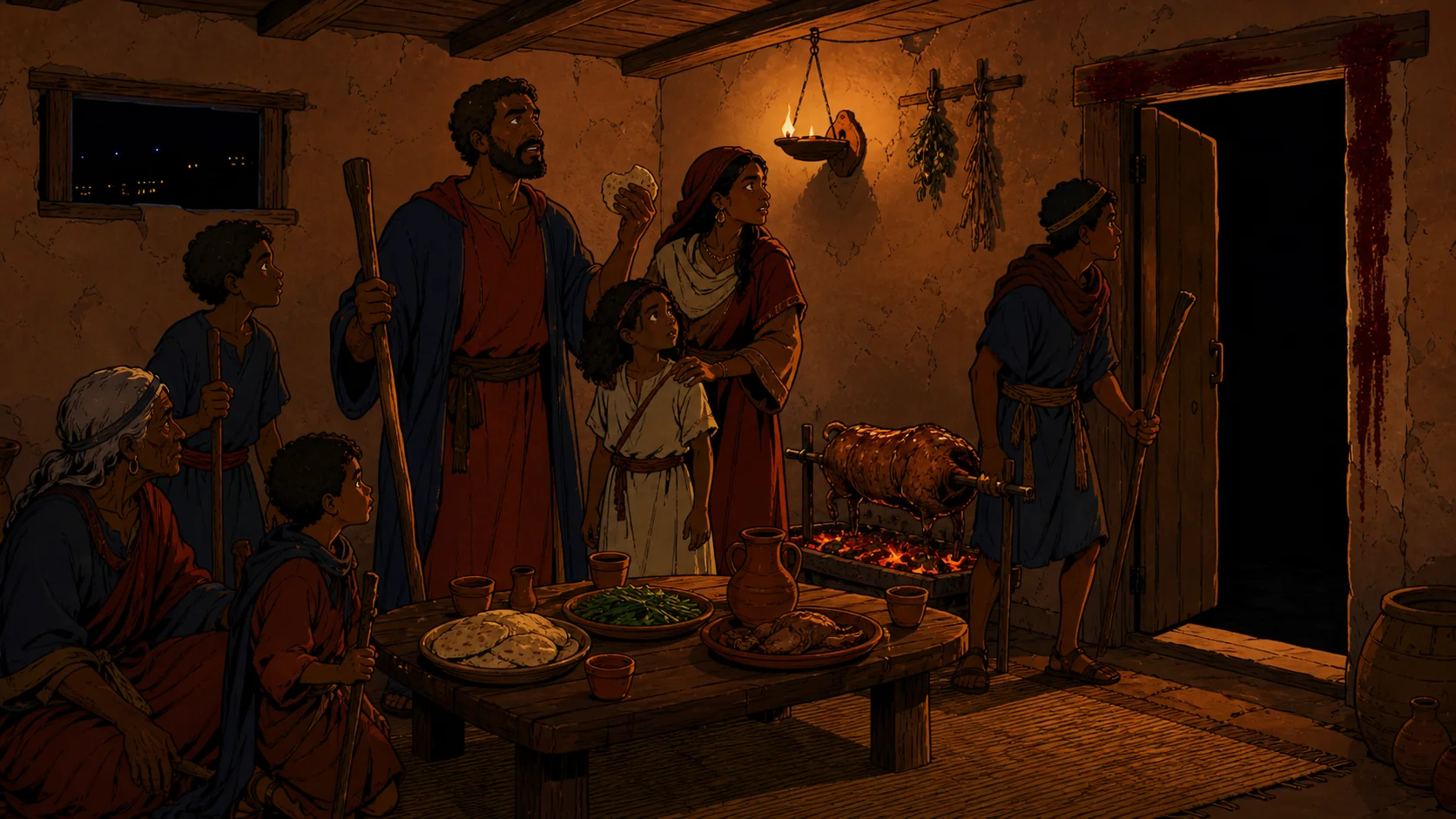
The instructions in Exodus 12 are precise and, at first reading, strange. A lamb without blemish is selected on the tenth day of the first month, kept alive until the fourteenth, then slaughtered at twilight. Its blood is to be applied to the two doorposts and the lintel — the frame of the door — using a bundle of hyssop. The family eats standing up, sandals on, staff in hand, ready to leave at any moment. This is not a relaxed meal. It is a final briefing before a departure that has been four hundred and thirty years in the making.
The tenth plague is unlike the nine before it. Those plagues struck systems — water, crops, livestock, human bodies. This one is personal. The firstborn dies in every house where the blood is absent. Egyptian poverty and Egyptian wealth are treated the same. There is no argument to be made, no petition to file. The criterion is not merit. It is the mark.
But the mark is not a passive signal. It is not a flag on the mailbox saying "skip this house." It is the identification of a home under divine protection — a home where the LORD of hosts is hovering, wings spread, standing between the destroyer and the people inside.
The 430-Year Precision
One detail in Exodus 12 that most English readers pass over is a number. Exodus 12:40–41 records:
The phrase בְּעֶצֶם הַיּוֹם הַזֶּה — "on that very day" — is the same phrase used in Genesis 17 for the day Abraham was circumcised, and in Deuteronomy 32 for the day Moses died. It marks a day of divine exactness. And the 430-year figure points back directly to Genesis 15:13, where God told Abraham in the dark: "Your offspring will be strangers in a land not theirs, and they will be enslaved and afflicted — four hundred years." What began in the night of the covenant between the pieces ends on the night of the first Pesach. God did not approximate. He kept the appointment to the day.
A Memorial That Is Present Tense
Exodus 12:14 establishes the feast forever: "This day shall be for you a memorial day, and you shall keep it as a feast to YHWH; throughout your generations, as a statute forever, you shall keep it as a feast."
But the command that follows in Exodus 13:8 is the most personal instruction in the whole passage: "You shall tell your son on that day, 'This is what YHWH did for me when I came out of Egypt.'" The pronoun is singular: me. Not what He did for my ancestors. Not what happened long ago to a people I descend from. What He did for me.
The Passover is not an anniversary. It is a present-tense inhabiting of an event that the Torah insists every participant actually experienced. The protection that stood at the door in Egypt was not a one-time act for one generation. It is the shape of how this God acts — hovering over His people, blood-marked and guarded, in every generation that will call on the name.
Read the Passover Chapter in Hebrew
Follow the full text of Exodus 12 word by word — Hebrew, transliteration, and English — in the Hebroni Torah Reader.
Open Torah Reader — Exodus 12 → Breakdown: The Night of the Protected →