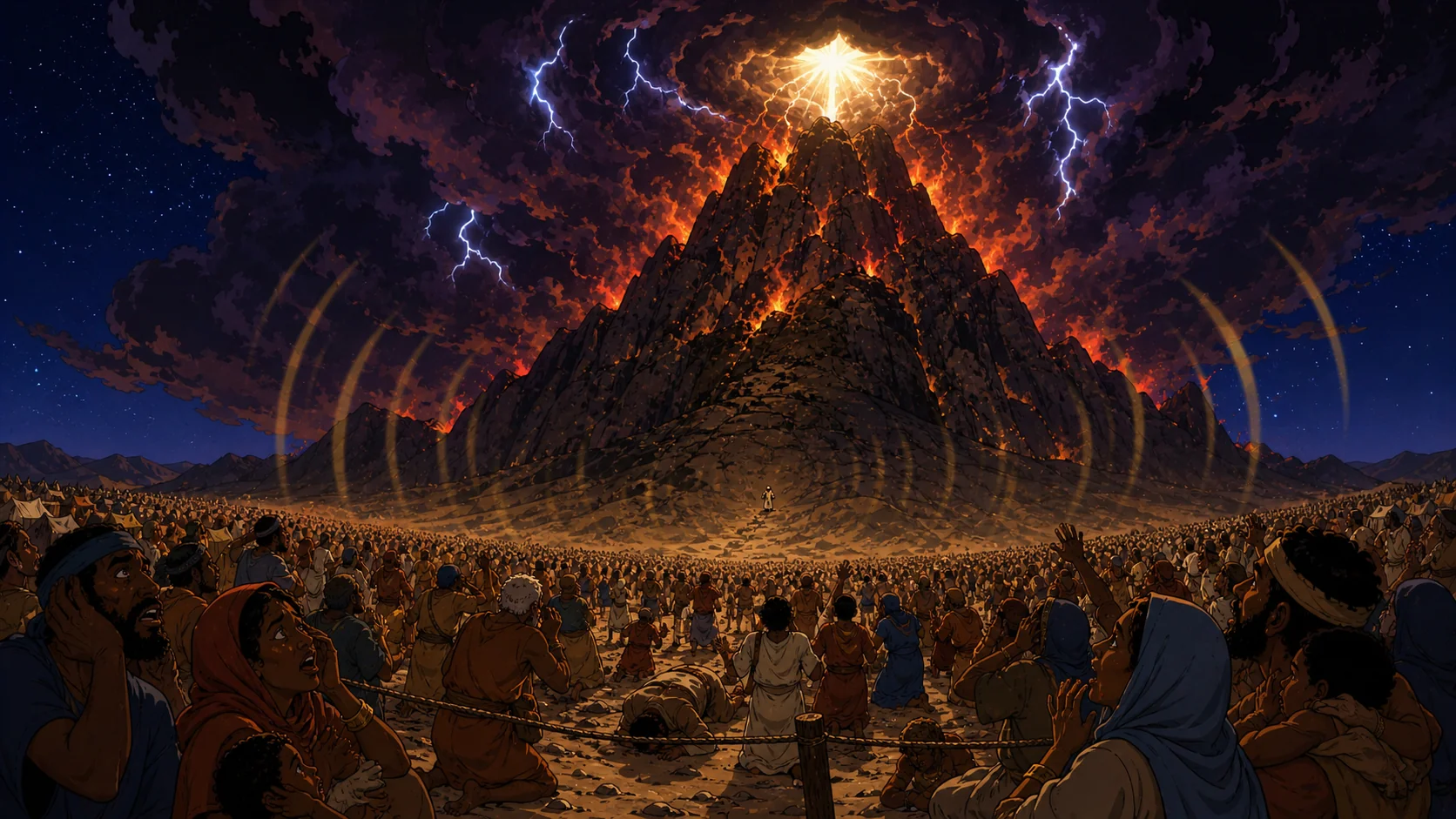
Most people know about the stone tablets. Fewer know that before a single word was carved in stone, the commandments were spoken aloud by God — and heard by the entire nation of Israel at the foot of a mountain on fire. Exodus 19 records what that day looked like. It was nothing like the paintings.
The Chapter Nobody Reads Before the Commandments
Exodus 20 contains the Ten Commandments. Most readings begin there. But Exodus 19 — the chapter immediately before — records something that changes the entire frame of what follows.
Fifty days after the Passover, the nation of Israel arrives at the wilderness of Sinai. They are not wandering. They were always heading here. YHWH had told Moses at the burning bush in Exodus 3:12: "When you have brought the people out of Egypt, you shall worship Elohim on this mountain." The Exodus was never just an escape. It was a journey toward a meeting. Egypt was not the opposite of freedom; Sinai was the destination of freedom.
The preparation takes three days. The people wash their garments. Moses marks a boundary at the base of the mountain: the holy presence cannot be approached casually. Anyone who touches the mountain will be put to death. Even the animals. Then, on the third day, something happens that no generation of human beings had experienced since the garden — an entire nation hears God's voice.
The Mountain That Shook
The Hebrew of Exodus 19:16–18 is dense with sensory detail. This is not reported at a distance. It is recorded as witness testimony:
The word translated "trembled" is חָרַד (charad) — to quake, to tremble violently. Not some of the people: all of the people in the camp. The mountain itself smoked like a furnace. The shofar grew louder, not quieter. Moses spoke, and God answered in thunder.
This is the scene that precedes the Ten Words. Not a quiet lecture hall. Not stone tablets handed to one man alone on a peaceful afternoon. A mountain on fire. A nation on the ground, shaking.
Eagles' Wings — What the Covenant Offer Said
Before the fire and the shofar, before the boundary was set at the mountain's base, YHWH sent a message to Israel through Moses. It is easy to overlook in the drama that follows, but it is the only covenant offer in Exodus 19 — and it begins not with demands but with history:
The destination of the Exodus is contained in two words: אֵלָי — "to myself." Not to freedom. Not to the Promised Land. To God Himself. The eagles' wings imagery is not romantic decoration. Eagles carry their young on their backs — lifting them above predators, above the reach of arrows. God's rescue of Israel from Egypt is described as that: not a military evacuation, but a carrying, a bearing-up, an elevation out of reach.
And the place He brought them to was not a location. It was a Person.
What the Nation Agreed to Before They Heard a Word
In Exodus 19:7–8, Moses brings the covenant offer to the elders. The people's response is unanimous: "All that YHWH has spoken we will do." This is their agreement — before the fire, before the shofar, before the mountain begins to smoke. They have not yet heard a single commandment. They agreed to the relationship before they knew all the terms.
This is the structure of the Sinai covenant, and it echoes throughout the Torah. The Ten Words themselves begin not with a commandment but with a declaration:
The commandments come after the deliverance. Always. They are not the conditions for being rescued; they are the shape of life for a people already redeemed. Sinai does not create the relationship between God and Israel — the covenant with Abraham created it (Genesis 15, Genesis 17). Sinai defines what that relationship looks like lived out.
Spoken First, Then Written
There is a sequence in Exodus 19–20 that is easy to miss: the commandments were spoken aloud by God before they were written on stone. The whole nation heard the voice. Exodus 20:1 says: "And God spoke all these words." The Hebrew verb is דָּבַר (davar) — to speak. The text does not say "God wrote." That comes later, in Exodus 31:18 and 32:15–16, when Moses receives the tablets inscribed by "the finger of God."
The spoken word has priority in the Torah. The oral hearing precedes the written record. And unlike every other covenant transaction in the Torah, this was not delivered privately to one mediator — it was broadcast. Two million people heard the voice of God in the fire at once. The Ten Words are not a secret delivered to an elite. They are a public declaration to a nation.
Exodus 20:18–19 records the response: "All the people perceived the thunder and the lightning flashes and the sound of the trumpet and the mountain smoking; and when the people saw it, they trembled and stood at a distance. Then they said to Moses, 'Speak to us yourself and we will listen; but let not God speak to us, or we will die.'"
This is not unbelief. The Torah presents it as appropriate awe. What was delivered at Sinai was not mild. The nation was not built to sustain direct divine speech without mediation. Moses steps in as the one who goes further up the mountain — into the thick darkness where God was.
God Did Not Leave Just Ten
Here is what is almost always left out of popular tellings of the Sinai story: the Ten Words were the opening of a complete covenant body, not its entire contents.
The Aseret HaDibrot — the Ten — are the headline. The mountain on fire, the shofar, the thunder: all of that was the announcement. What followed across the rest of Exodus, Leviticus, Numbers, and Deuteronomy was the full instruction for how a redeemed people lives before a holy God. Torah scholarship has counted and catalogued 613 commandments in the full five books of Moses — covering worship, justice, diet, agriculture, family, speech, rest, the treatment of strangers and the poor, and the inner posture of the heart.
Ten is not the total. Ten is the foundation. The rest of the Torah is God's answer to the question the Ten raise: What does it look like, in every corner of a human life, to belong to YHWH?
The smoke cleared from Sinai. The mountain cooled. But the instruction did not stop. It expanded into a full vision of a society built on the character of the God who brought His people out of Egypt on eagles' wings — and then told them exactly who He was, and exactly what He asked of the people He had carried to Himself.
The Full 613 Commandments
The Ten spoken at Sinai were the beginning. Explore every commandment God gave through Moses — all 613, categorized by theme and referenced to the Torah text — in Hebroni's full Commandments index.
View All 613 Commandments → Read Exodus 19 in Hebrew →