
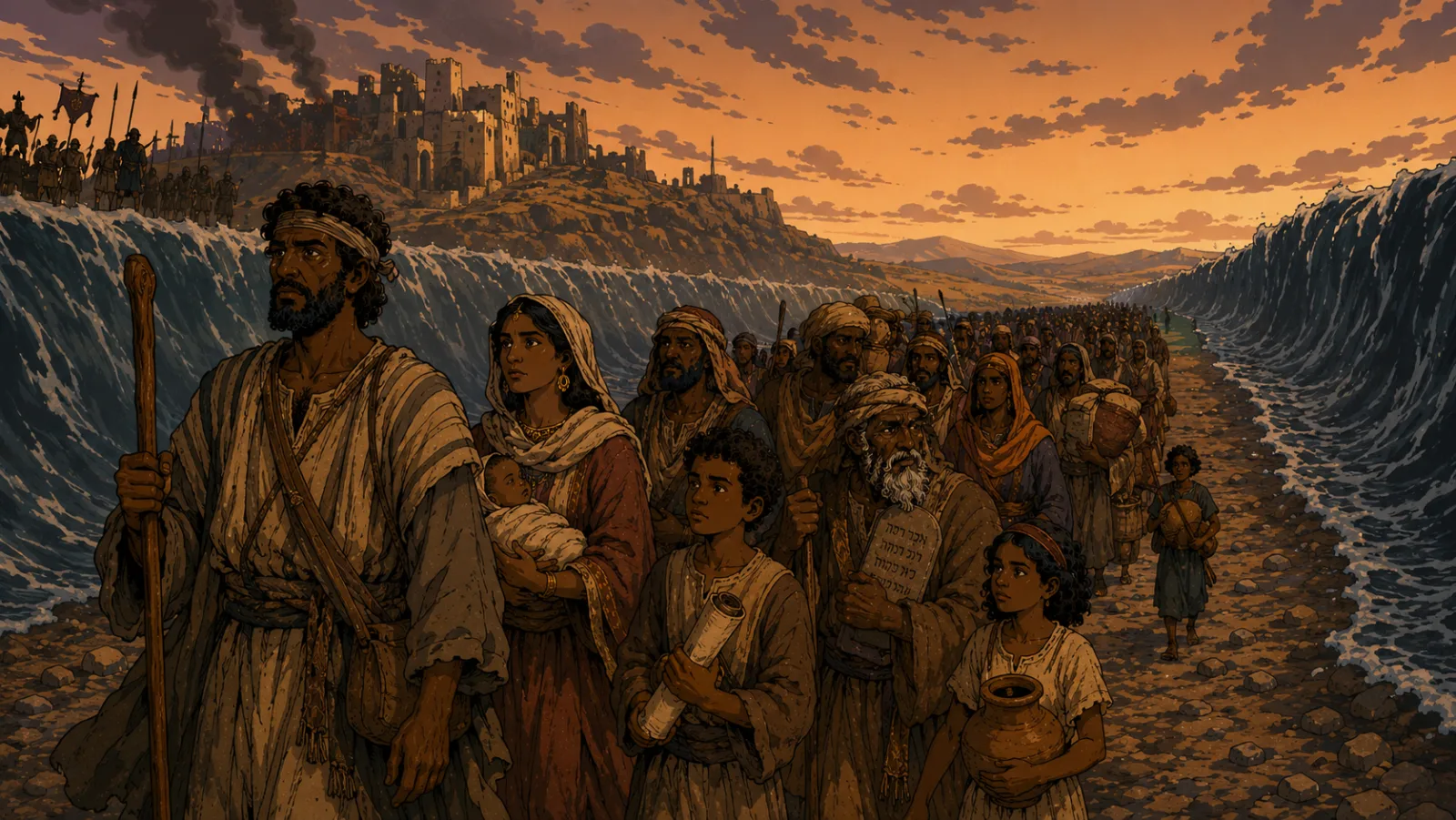
They were carried away by Assyria. They never came back. An apocryphal book says they crossed a river and walked a year and a half into a land where no human being had ever lived, where they could keep the covenant they had broken at home. The book gave that land a name: Arzareth. "Another land." And for nearly two thousand years, people have been trying to find it.
I. The Tribes That Did Not Return
In the year 722 BCE — about a century and a half before Yehudah's own exile to Babylon — the Assyrian Empire under Shalmaneser V and his successor Sargon II completed the conquest of the Northern Kingdom of Israel, the kingdom that had broken from Yehudah after the death of Shlomo and now contained ten of the twelve tribes of Israel. The Assyrians did what Assyrians did to conquered peoples: they deported them. The northern population was carried away into the Assyrian Empire, resettled across its territories, and replaced in the land with peoples from elsewhere in the empire.
The southern kingdom — Yehudah, Binyamin, and the Levites — would later face their own exile to Babylon in 586 BCE, but Yehudah would return. Cyrus's decree in 538 BCE would send them home; the Second Temple would rise; the Yehudim would resume their life in the land. The surviving southern house carried the covenantal life of Israel forward through the centuries — through the Second Temple period, through the destruction of 70 CE, through the rabbinic codification, through two millennia of diaspora — and the tradition of Judaism that developed from that community is real and continuous. That religious tradition is honored on this platform. The house of Yehudah as a bloodline category and the religion of Judaism as a religious identity are distinct things — as the framework of this article makes clear throughout — but the tradition that grew from the southern house is a real part of the Israelite story.
But the northern ten tribes never had that homecoming. They went into Assyria — and from there, they vanish from the continuous historical record as a unified people.
That disappearance is the thing the Bible itself never resolves. Where did they go? Did they assimilate into the Assyrian world and dissolve? Did they migrate further? Did they keep their identity in secret across centuries and continents? The Hebrew Bible doesn't tell us. The prophets promise their eventual return — Yeshayahu, Yirmeyahu, Yechezkel all speak of a future regathering of all Israel, not just Yehudah — but as for where they actually went, the canonical text falls silent.
Into that silence, one ancient book speaks. And it gives the place a name.
II. What 2 Esdras Actually Says
The book is 2 Esdras — also called 4 Ezra in some traditions — an apocalyptic Jewish text composed in its core around 70–100 CE, in the painful generation after the destruction of the Second Temple. It is not in the Hebrew Bible. It is not in the Protestant canon. It sits in the Apocrypha, included in the Latin Vulgate's appendix, in the Slavonic Bible, and in some Orthodox traditions. Within its pages is a vision — interpreted to the prophet Ezra — about a figure rising from the sea, and a peaceable multitude gathered around him. Asked who they are, the angel answers:
Those are the ten tribes, which were carried away prisoners out of their own land in the time of Hoshea the king, whom Shalmaneser the king of Assyria led away captive, and he carried them over the waters, and so came they into another land.
But they took this counsel among themselves, that they would leave the multitude of the heathen, and go forth into a further country, where never mankind dwelt — that they might there keep their statutes, which they never kept in their own land. And they entered into Euphrates by the narrow places of the river. For the Most High then showed signs for them, and held still the flood, till they were passed over. For through that country there was a great way to go, namely, of a year and a half: and the same region is called Arzareth.— 2 Esdras 13:40–45 (KJV / Apocrypha)
Read it slowly, because almost everything that has been said about the lost tribes in the last two thousand years grows from these six verses.
The name itself: Arzareth is generally understood by biblical encyclopedias to render the Hebrew erets achereth — "another land" — the very phrase used in Deuteronomy 29:28 when Moshe warns that disobedient Israel would be uprooted from their land and cast into "another land, as it is this day." The author of 2 Esdras is naming the place of exile with the Torah's own warning-word.
The decision is striking. The tribes don't merely get scattered — the text says they chose to leave the multitude of the nations and travel farther, into a region where no human being had lived, so they could keep the statutes they had broken in their own land. The exile becomes, in 2 Esdras's telling, a kind of teshuvah — a turning back to the covenant by withdrawing from the world that broke it.
The river-crossing miracle echoes the earlier crossings — the Red Sea under Moshe, the Yarden under Yehoshua. The "narrow places of the Euphrates," with the Most High holding back the waters until they have passed, is a deliberate echo of the Exodus pattern, applied to a new northward journey. It frames the lost tribes' wandering as a continuation of the covenant journey, not an abandonment of it.
The duration: a year and a half's journey. That is a very long way. From the eastern frontier of the Assyrian Empire — already far from Israel — another year and a half beyond that. The author is not describing a neighboring province.
The destination: a land called Another Land, where they would keep the law, until the latter time, when the Most High would once more hold back the river and they would return.
III. The Witnesses Across History Who Believed They Were Still Out There
What is most striking about the Arzareth tradition is not that 2 Esdras tells the story — apocryphal books tell many stories. What is striking is that major historical figures in the centuries after, across very different traditions, treated the ten tribes as a living people somewhere beyond the known world.
Josephus, the great Yehudi-Roman historian, writing around 93 CE — only a generation after 2 Esdras was composed — states in his Antiquities of the Jews (Book XI, Chapter 5):
The ten tribes are beyond Euphrates till now, and are an immense multitude, and not to be estimated by numbers.
Josephus, writing as a Yehudi historian to a Roman audience, treats the continued existence of the ten tribes beyond the Euphrates as established knowledge. Not legend. Not hope. An immense multitude.
Medieval Yehudi travelers went looking for them. Eldad ha-Dani in the 9th century claimed to have come from a remote Yehudi kingdom in Africa descended from the ten tribes and brought news of them to the Mediterranean Yehudi world. Benjamin of Tudela in the 12th century, in his famous Itinerary, recorded Yehudi communities in Persia and Central Asia claiming descent from the northern tribes. The European Yehudi world took these accounts seriously enough to circulate, copy, and debate them for centuries.
The Christian world picked up the question too. Medieval Christians believed the lost tribes might be found beyond the known map and would play a role in the end of days. When Europeans began encountering peoples beyond their familiar geography — in Asia, in Africa, and especially in the Americas after 1492 — many of them looked at those peoples and asked: could these be the lost tribes? The question was not an idle one. It shaped how Europeans framed peoples they had never seen, sometimes generously, sometimes destructively.
The point is not that any of these identifications were correct. The point is that the question itself has been alive for two thousand years, asked by serious people in serious traditions, because the silence in the canonical record where the ten tribes should be is genuinely unresolved.
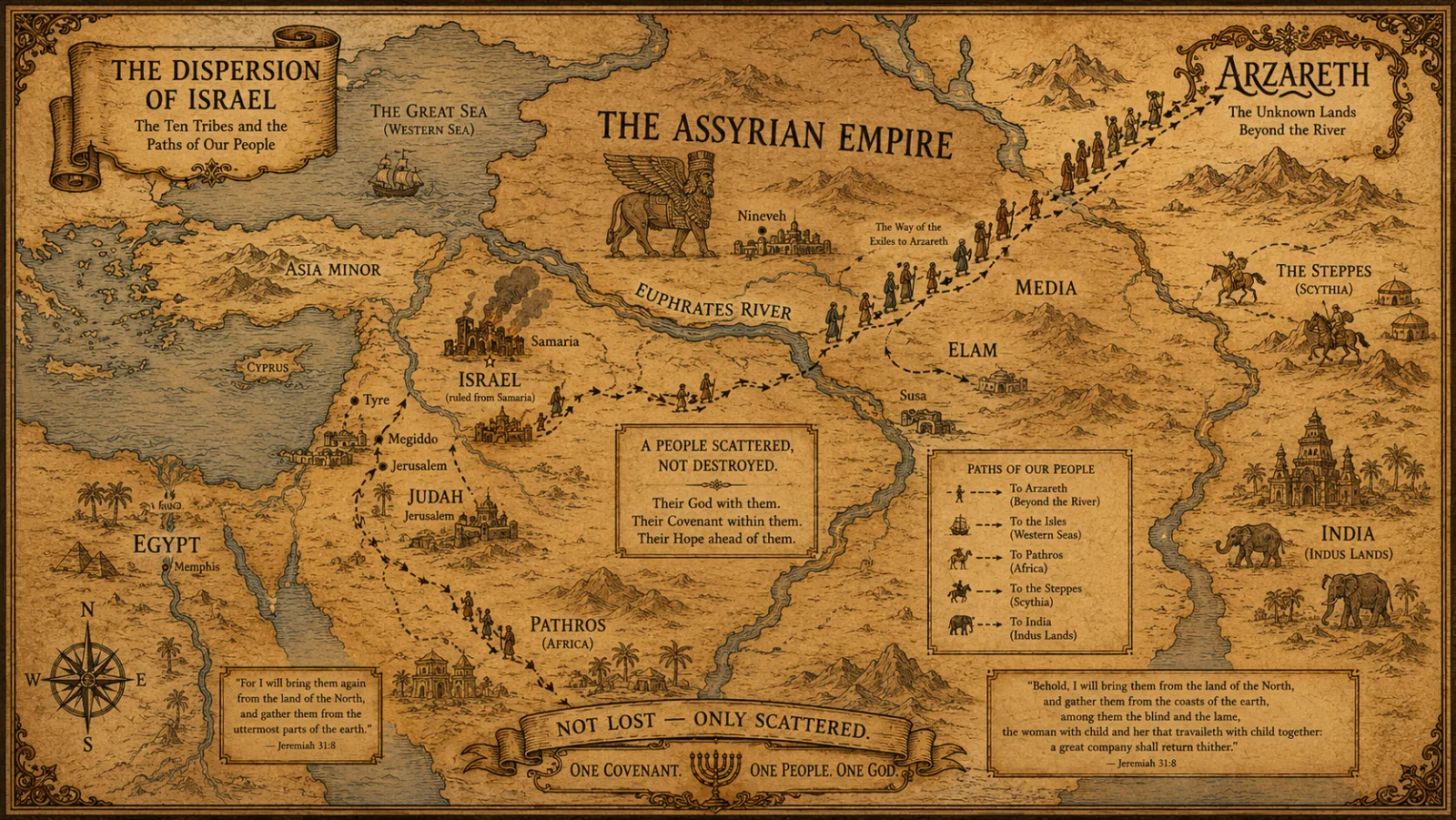
The centuries-long question, drawn as a map · trails of the scattered tribes branching toward Africa, Central Asia, and the western seas, toward a land marked simply Arzareth at the edge of the known world
IV. The Traditions That Tried to Answer
Across the centuries, dozens of identifications have been proposed for where the ten tribes ended up. The major traditions, taken honestly, give a map of where serious people across cultures believed the scattered Israelites went. Before surveying them, one clarification matters for how to weigh what follows: when Jewish rabbinical authorities have "affirmed" a community, that affirmation means acceptance into the religion of Judaism — it is not a confirmation of patrilineal Israelite bloodline descent. The two questions are different, as the broader article makes clear. A community can be welcomed into the religious tradition of Judaism and still be an open question on the bloodline. Conversely, a community can carry demonstrable patrilineal Israelite descent without having been welcomed into the religion of Judaism. Both kinds of evidence matter; they are not the same kind of evidence.
The Hebrew Israelite tradition in the Americas, especially among African Americans, identifies the scattered descendants of Israel — and particularly of the ten northern tribes — with the African peoples carried into slavery in the New World. The argument is a bloodline argument: that the specific pattern of what was done to enslaved African peoples matches the Deuteronomy 28 curses with a precision that other populations do not match, that the forced removal of names, language, culture, and religious identity is precisely what Moshe warned would happen to Israel in disobedience, and that 2 Esdras 13 and the Arzareth tradition describe a journey into distant exile that fits the historical displacement of African peoples. This tradition argues from the biblical patrilineal-tribal framework — the same framework this article uses — and from documented historical patterns. It has millions of adherents, internal theological diversity across many distinct congregations and teachers, and a serious engagement with the biblical text that deserves to be read as what it is: a bloodline claim rooted in the covenantal framework of Deuteronomy 28 and the prophetic tradition.
The Lemba of Southern Africa. A Bantu-speaking people of Zimbabwe and South Africa who maintain Hebrew-rooted practices — circumcision, Sabbath observance, dietary laws, the avoidance of pork — and a tradition of a northern origin and a long journey south. Genetic studies on the Lemba — most notably by David Goldstein and colleagues, published in the late 1990s and 2000s — found that a significant proportion of Lemba men, especially among their priestly Buba clan, carry the Cohen Modal Haplotype on the Y-chromosome — the same Y-chromosome marker associated with the patrilineal Jewish priestly line. This is bloodline evidence in the patrilineal sense the Bible uses — Y-chromosome descent passes father to son, which is the biblical framework. Of all the communities surveyed here, the Lemba have the strongest documented patrilineal evidence of descent from an Israelite priestly line.
The Beta Israel of Ethiopia. The Ethiopian Jewish community holds that they are descended from the tribe of Dan (or from Shlomo and the Queen of Sheba's line, in another tradition). The 16th-century Egyptian rabbi Rabbi David ibn Zimra ruled them halakhically Jewish on the basis of their claim to Danite descent, and the Israeli Chief Rabbi Ovadia Yosef formally affirmed their Jewishness in 1973. Israel airlifted nearly the entire Beta Israel community to Israel under Operations Moses and Solomon (1984–1991). The rabbinical affirmation means they were welcomed into the religion of Judaism and granted Israeli citizenship. Their underlying claim — descent from the tribe of Dan through ancient Ethiopian lineage — remains an open historical question independent of the religious affirmation.
The Bnei Menashe of Northeast India. Communities in Mizoram and Manipur who claim descent from the tribe of Menashe, with oral traditions and practices they trace to ancient migration. The Israeli Chief Rabbinate accepted them as descendants of Israel in 2005, and several thousand have since immigrated to Israel under formal conversion. Again: the rabbinical acceptance is acceptance into the religion of Judaism; the underlying bloodline claim is a separate question the religious affirmation does not settle.
The Pashtuns of Afghanistan and Pakistan. Some Pashtun tribal traditions and certain scholars have pointed to oral histories and tribal names suggesting Israelite descent — a claim discussed since at least the medieval period. The case is contested but has a long documented history.
The Igbo of Nigeria. A West African people, some of whom maintain a tradition of Israelite descent and Hebrew-rooted practices they trace to ancient migration. The tradition is documented and taken seriously by its adherents.
Latter-day Saint tradition holds that some of the lost tribes were carried by divine guidance across the seas to the Americas — the basis of the Book of Mormon's narrative.
British Israelism, prominent in the 19th and early 20th centuries, identified the lost tribes with the peoples of Northern Europe — a tradition now largely abandoned by mainstream scholarship.
None of these traditions has been definitively proven. Several have partial documentary or genetic evidence of varying kinds. What they share is the attempt to answer a real question — where did the ten tribes go? — that the canonical Bible itself leaves open. The framework for weighing them here is the biblical one: patrilineal bloodline evidence is the most relevant kind of evidence for the Israelite question, because that is the framework the Bible uses. Rabbinical affirmation into the religion of Judaism is a separate kind of evidence that answers a different question.
V. The Word Arzareth and What It Asks of Us
Recall what Arzareth means: another land. The Hebrew phrase erets achereth appears in Deuteronomy 29:28 as part of Moshe's farewell warning — that if Israel breaks the covenant, Yah will uproot them from their land in anger, and in wrath, and in great indignation, and cast them into another land, as it is this day.
The author of 2 Esdras knew exactly what he was doing. He was naming the place of northern exile with the same word the Torah uses for covenantal exile itself. Arzareth is not a geographic location waiting to be pinned to a map. Arzareth is the place where Israel goes when Israel has broken the covenant. It is the territory of erets achereth — the another land of Moshe's warning, given a proper name in apocalyptic vision.
That doesn't make the question of where the ten tribes physically went less interesting. It makes it more interesting. Because the text is telling us that the scattering is covenantal, not just historical — that the tribes go to the land of the warning, the place where exile happens when faithfulness breaks down. And the same text holds out the promise that the Most High will once again hold back the river — that the erets achereth will not be the end of the story.
Two thousand years of Yehudi, Christian, African diaspora, and Hebrew Israelite tradition have been wrestling with the implications of those six verses. The wrestling is not over. The book itself says it would not be over until the latter time, when they shall begin to come.
VI. What Remains
So what do we have, when we line it up honestly?
- The biblical record of the Assyrian deportation of the northern tribes in 722 BCE, after which they do not return as a unified people. This is not disputed.
- The canonical silence on where they ultimately went, paired with the prophetic promise of a future regathering of all twelve tribes (Isaiah 11:11–12; Jeremiah 31; Ezekiel 37). This is not disputed.
- The apocryphal narrative in 2 Esdras 13 of a tribal exodus across the Euphrates to a far land called Arzareth, the erets achereth of Deuteronomy 29:28. This is a real ancient text, not modern speculation.
- The witness of Josephus, a generation later, that the ten tribes were still a vast multitude beyond the Euphrates in his time.
- The continuous Yehudi community of the surviving southern house — Yehudah, Binyamin, and Levi — through the Second Temple period, the rabbinic codification, the long diaspora, and the modern Jewish community. Real, continuous, biblically grounded.
- The long tradition of Yehudi travelers, Christian mystics, African diasporic communities, and Hebrew Israelite teachers continuing to ask where Arzareth was and where the descendants are.
- Several modern communities — the Beta Israel, the Lemba, the Bnei Menashe, and others — making claims of Israelite descent supported in varying degrees by patrilineal bloodline evidence, oral tradition, and documented historical patterns.
What the record does not give us is a single, settled answer. There is no map with an X on it. Anyone who tells you definitively where Arzareth is goes beyond what the evidence supports. The honest position is the position 2 Esdras itself takes: the tribes went out, the Most High preserved them, they are out there, and until the latter time, when they shall begin to come, the full answer remains with Yah.
But the pattern that identifies them has been given.
This is where the article must name something the popular reading of the lost-tribes question consistently overlooks. The debate over where the tribes went is secondary to a question the Hebrew Bible already answered: how will they be identified when they are found?
The answer is Deuteronomy 28. Moshe named the curses with precision: Israel would be scattered among all nations from one end of the earth to the other (Deuteronomy 28:64). They would serve other gods — the religion of their captors, gods of wood and stone that neither they nor their fathers knew (Deuteronomy 28:64). They would be a byword, a proverb, an astonishment among the nations (Deuteronomy 28:37). They would be carried into Egypt again with ships, sold as bondmen and bondwomen, and there would be no buyer (Deuteronomy 28:68). The stranger within them would rise above them, and they would fall beneath (Deuteronomy 28:43–44). Their name would be no more in remembrance among the nations — the deliberate erasure Psalm 83:3–4 names as the counsel of their enemies.
Every prophet confirmed the pattern. Hosea spoke it over the northern house directly — "you are not my people, and I will not be your God" (Hosea 1:9) — and then named the restoration: "in the place where it was said unto them, You are not my people, there it shall be said unto them, You are the sons of the living God" (Hosea 1:10). The place of the cutting off becomes the place of the restoration.
And Yeshua confirmed it in his own words, naming exactly what Moshe had warned:
"And they shall fall by the edge of the sword, and shall be led away captive into all nations: and Yerushalayim shall be trodden down of the Gentiles, until the times of the Gentiles be fulfilled."— Luke 21:24
"Led away captive into all nations" — Deuteronomy 28:64 from the mouth of the Messiah. And then the word that changes everything: until. The captivity has a limit. The times of the gentiles have a fulfillment point. The until is the return — the second step of the kinsman-redeemer's work, the gathering that completes what the cross purchased.
The Deuteronomy 28 pattern — matched against documented history — is the identifier Yah gave. Not tribal names, not language, not geography alone. The specific pattern of what was done to a scattered people across centuries of exile: the forced adoption of the captors' religion, the erasure of the name, the ship-borne captivity, the being sold with no buyer, the stranger rising above. The platform that holds this pattern honestly does not need to adjudicate who is an Israelite. The pattern speaks. The reader who encounters it honestly is left to sit with what it means for their own identity and history.
The two-houses gathering is still coming.
The prophets are unanimous: the restoration is not complete until both houses are found and joined. Jeremiah 50:4 — "the children of Israel shall come, they and the children of Yehudah together, going and weeping: they shall go, and seek Yah their God." Ezekiel 37:16–24 — the two sticks, the stick of Yehudah and the stick of Efrayim, made one in Yah's hand under the Davidic prince. Zechariah 10:6 — "I will save the house of Yosef, and I will bring them again to place them... they shall be as though I had not cast them off." Isaiah 11:12–13 — the outcasts of Israel and the dispersed of Yehudah gathered from the four corners of the earth, the Efrayim-Yehudah rivalry ended, one people.
Those who practice Judaism today preserve the religious tradition that developed from the surviving southern house — but the religion of Judaism is not the same as the bloodline house of Yehudah. Jewish identity under the rabbinic halakhic rule passes through the mother; Israelite bloodline under the biblical framework passes through the father. Some practitioners of Judaism may carry the patrilineal bloodline of the house of Yehudah; others, like Herod's family, entered the tradition through conversion with no Israelite descent at all. The house of Yehudah is a bloodline category. Jewish is a religious identity. The platform honors the tradition of Judaism without bestowing the bloodline title of the house of Yehudah on it by virtue of religious practice — especially while the actual bloodline descendants of the scattered northern house have had their identity stripped from them and do not yet know who they are. The house of Efrayim — the scattered northern house, the lost sheep of the ten tribes — is the stick still out in the world, scattered into the kosmos, living under the names the captors gave them, waiting to be found and joined again to the tree they were cut from.
The gathering is underway. Arzareth is not the end of the story. It is the name of the place Israel went when the covenant was broken. The name of the place they return from when the covenant is restored is Yerushalayim.
"Arzareth is the name of a question. The answer is still being written."
The goal of this platform — for the Israelite who does not yet know they are an Israelite: return to the commandments, return to the God of your fathers, return to the name that was taken from you. For the Christian who has been worshipping in the traditions of those who conquered Israel: return to the Hebrew roots, return to what the first believers at Antioch actually practiced, return to the Sabbath and the appointed times and the commandments Yeshua kept and taught. The gathering is for both. The commandments are the path for both. The Messiah who purchased the redemption is coming again to deliver it in full.
A Note on Sources
This article documents what 2 Esdras says and the major traditions that have engaged with it. The traditions are presented as the serious attempts to answer a real question that they are. A clarification on how they are weighed: the framework this article operates in is the biblical patrilineal-tribal one — bloodline evidence through the father's line is the relevant kind of evidence for the Israelite question, because that is the framework the Bible uses. Rabbinical affirmation of a community into the religion of Judaism is a separate kind of evidence answering a separate question; it is noted where it exists but not treated as confirmation of patrilineal Israelite descent. The Hebrew Israelite tradition's argument from Deuteronomy 28 and documented historical patterns is a bloodline argument in the biblical framework — it is engaged here with the same seriousness as any other tradition's claim. None of the traditions surveyed is presented as proven fact; none is dismissed. The question itself — where did the ten tribes go? — remains open by design.
A note on terminology: the article distinguishes between Israelite (the broader biblical category of all twelve tribes, the house of Israel Yeshua himself named in Matthew 15:24), Yehudi (the first-century historical term for an Israelite of the tribe and region of Yehudah, in the surviving southern house), and Jewish (referring to those who practice or identify with the religion and tradition of Judaism — a real and continuing tradition rooted in the surviving southern house of Yehudah, Binyamin, and Levi, but not identical to patrilineal Israelite descent in the biblical-tribal sense, since the halakhic matrilineal definition permits Jewish identity through a Jewish mother regardless of the father's descent). All three terms appear in this article in their proper register. Those who practice Judaism are honored as inheritors of a real and continuing tradition. The broader Israelite category extends beyond them to include the scattered northern tribes, whose story this article documents.
Sources & Further Reading
- The biblical and apocryphal record: 2 Esdras 13:39–47 (also 4 Ezra), King James Version Apocrypha; New Revised Standard Version. Critical edition: Michael E. Stone, Fourth Ezra (Hermeneia, Fortress Press, 1990). Deuteronomy 29:28 (the Hebrew erets achereth, "another land," echoed in Arzareth). 2 Kings 17 — the historical account of the Assyrian deportation.
- Josephus and ancient witnesses: Josephus, Antiquities of the Jews, Book XI, Chapter 5 — "the ten tribes are beyond Euphrates till now, and are an immense multitude."
- Reference and scholarly: International Standard Bible Encyclopedia, entry on "Arzareth." Wikipedia, "Ten Lost Tribes" (well-sourced overview with the major modern claims). Tudor Parfitt, The Lost Tribes of Israel: The History of a Myth (Phoenix, 2003).
- The Beta Israel of Ethiopia: Rabbi Ovadia Yosef's 1973 ruling; Operations Moses (1984) and Solomon (1991). James Quirin, The Evolution of the Ethiopian Jews (University of Pennsylvania Press, 1992).
- The Lemba of Southern Africa: Tudor Parfitt and Yulia Egorova, Genetics, Mass Media and Identity: A Case Study of the Genetic Research on the Lemba and Bene Israel (Routledge, 2006); the Goldstein et al. studies on the Cohen Modal Haplotype.
- The Bnei Menashe: Hillel Halkin, Across the Sabbath River: In Search of a Lost Tribe of Israel (Houghton Mifflin, 2002); the 2005 Chief Rabbinate ruling.
- Medieval travelers: Eldad ha-Dani, Sefer Eldad; Benjamin of Tudela, The Itinerary of Benjamin of Tudela (12th century).
Method note: this article documents an ancient text, the questions it raised, and the traditions that grew up around it. Where evidence is partial, the article says so. Where claims are religious traditions rather than established facts, the article presents them as the traditions they are. The mystery of where the ten tribes went is treated as the open question it has been for two thousand years.
✡ The Bigger Story of Israel
The Israelite story is bigger than the story of Judah. Read the prophets who promised the regathering of all twelve tribes — in the original Hebrew, verse by verse.
Read the Prophets Of the Seed of David →