Paul wrote it plainly: he was born of the seed of David, according to the flesh. The Gospel of Matthew opens with the genealogy: Avraham begat Yitzhak, Yitzhak begat Yaakov, Yaakov begat Yehudah, and on down through forty generations to Yosef, the husband of Miryam, of whom was born Yeshua, called Messiah. That is a paternal line. Every name. Every generation. Father to son.
And yet today, the rule by which one is reckoned Jewish under traditional Jewish law passes through the mother, not the father. How is it that the system the Hebrew Bible uses to trace Yeshua's lineage is not the system Yeshua's own people today use to define their identity? And what does that tell us about who he was?
I. The First Words of the Gospel
Open the New Testament. The first sentence of the first book — Matthew, chapter one, verse one — reads:
The book of the generations of Yeshua Messiah, son of David, son of Avraham.
In Hebrew: Sefer toledot Yeshua Mashiach ben David ben Avraham. It is a deeply Hebraic opening, modeled on the toledot formulas of Genesis ("these are the generations of..."), placing Yeshua not in a biography but in a bloodline. The book that introduces him to the world introduces him as a descendant. And every name in the genealogy that follows — forty-two generations across three groupings of fourteen — passes father to son. Avraham begat Yitzhak. Yitzhak begat Yaakov. Yaakov begat Yehudah and his brothers... The line moves through the men, generation by generation, from the patriarchs through the kings through the exile and back, to a working craftsman in Galilee named Yosef.
Matthew is not making a private theological move here. He is using the standard biblical framework for reckoning tribal and royal lineage — the framework that the Hebrew Bible itself uses everywhere it tracks a person's identity. The framework is patrilineal. Tribe passes through the father. Royal claim passes through the father. Priestly status passes through the father.
This is the framework that makes Yeshua's identity legible in his own time. To his contemporaries, he was Yeshua ben Yosef, an Israelite of the tribe of Yehudah, of the house of David, by patrilineal descent — the framework Matthew 1 documents as a public, scriptural claim.
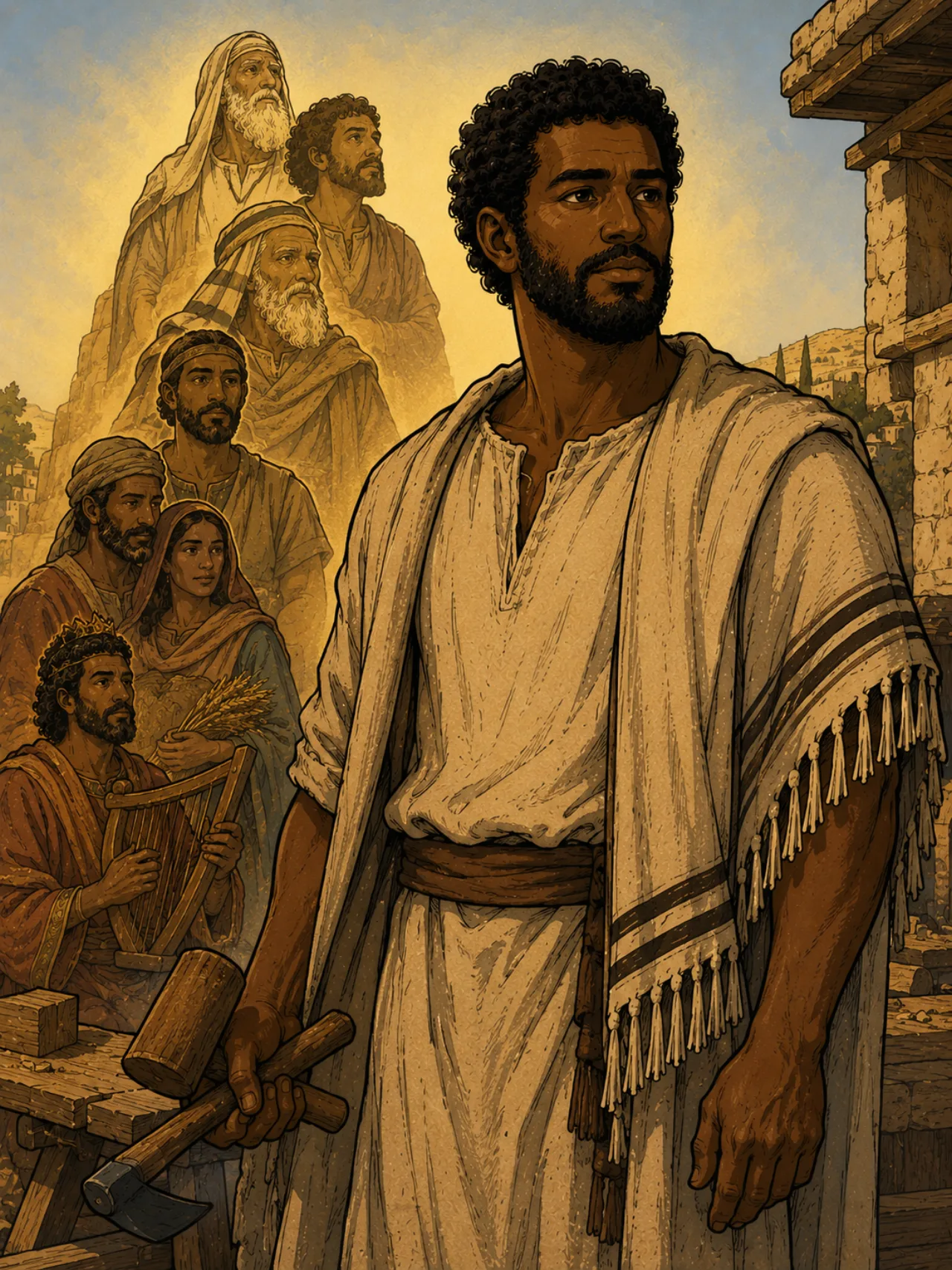
Yosef the craftsman of Galilee, at the front of his paternal line · the present moment of an unbroken inheritance reaching back to Avraham
II. A Note on the Vocabulary — Israelite, Yehudi, Jewish
Before going further, the article needs to be precise about three terms that are often used interchangeably in English but mean distinct things in scripture and in history.
Israelite — the broader biblical category. The descendants of Yaakov, who was renamed Yisrael (Genesis 32:28). The twelve sons of Yaakov became the twelve tribes, and their descendants — through the patrilineal-tribal framework — are the children of Israel. This is the term Yeshua himself uses when he speaks of "the lost sheep of the house of Israel" (Matthew 15:24, Matthew 10:5–6). It includes all twelve tribes, in the land and scattered, the visible-and-named and the lost-and-dispersed.
Yehudi — in the first-century sense, a member of the tribe of Yehudah, or more broadly a person of Yehudah (Judea) — the southern kingdom that survived when the ten northern tribes were dispersed by Assyria in 722 BCE. When the New Testament uses the Greek Ioudaios (translated Jew in English), it most often refers to people of Yehudah in this first-century sense — including the tribes of Yehudah, Binyamin, and Levi who returned from Babylonian exile. A first-century Yehudi was an Israelite of the southern surviving house.
Jewish refers to those who practice or identify with the religion of Judaism. It is of Judaism — a religious identity, belonging to the community and tradition of Judaism — not a transmission through Israelite bloodlines. The distinction matters because the two can exist entirely independently of each other. A person can practice Judaism without any Israelite patrilineal descent. An Israelite by bloodline can have no connection to the practice of Judaism. The religion does not grant the lineage. The lineage does not require the religion.
Herod the Great is the clearest historical proof. He practiced Judaism — publicly, extensively, rebuilding the very Temple. He held the title King of the Jews by Roman appointment. By the definition of Jewish as a religious identity, Herod was Jewish. He was not an Israelite. His patrilineal descent was Idumean — from the people of Esav, not the people of Yaakov. The religion of his practice and the bloodline of his fathers were two different things entirely. The religion did not make him an Israelite. The title did not make him an Israelite. Only the blood of Yaakov's twelve sons makes an Israelite, and Herod did not have it.
The rabbinic tradition that formalized Jewish identity in the centuries after 70 CE — the Mishnah, the Talmuds, the halakhic codification — was written by the surviving southern house's own religious leadership. That tradition is real and it has preserved much. But its halakhic definition of who is Jewish passes through the mother, not through the father, and permits Jewish identity where no Israelite patrilineal descent exists. It is not the framework the Bible uses. The Bible's framework is patrilineal-tribal. These are two different questions answered by two different systems.
These three terms — Israelite, Yehudi, Jewish — are not interchangeable. Israelite is the biblical patrilineal-tribal category: the blood of Yaakov's twelve sons, reckoned through the father. Yehudi is the first-century historical term for an Israelite of the surviving southern house of Yehudah. Jewish is a religious identity — of Judaism — which has its historical roots in that same southern house but is not confined to it and does not carry the patrilineal framework. The article uses each term in its proper register.
III. How the Hebrew Bible Reckons a Tribe
The patrilineal-tribal framework is everywhere in scripture, and it is operating openly throughout the biblical narrative. A few examples, drawn from the text itself:
Yosef married an Egyptian. When Pharaoh elevated Yosef ben Yaakov as second-in-command over Egypt, he gave him Asenath, daughter of Potiphera priest of On — an Egyptian woman — as his wife (Genesis 41:45). She bore him Efrayim and Menashe. And Yaakov, in Genesis 48, lifted those two grandsons from a non-Israelite mother into the full tribal status of his own sons, so that Efrayim and Menashe became two full tribes of Israel. The mother was not Israelite. The sons were Israelite by their father, and they became patriarchs of tribes.
Moshe married a Midianite. Tzipporah, daughter of Yitro priest of Midian (Exodus 2:21). Their sons, Gershom and Eliezer, were reckoned Levites — through Moshe, their father.
Boaz married a Moabite. Ruth, the great-grandmother of King David, was a Moabite woman who joined the covenant by her own declaration ("Your people shall be my people, and your God my God," Ruth 1:16). Her son Oved, born of Boaz of Yehudah, was reckoned to the tribe of Yehudah and stood in the kingly line. Oved begat Yishai, Yishai begat David — the genealogy at the end of Ruth, and again in Matthew 1, traces the line through Boaz the father, not through Ruth the mother. Ruth's covenant joining was honored; the tribal lineage ran through Boaz.
The priesthood passes father to son. A Cohen — a member of the priestly line — inherits his priestly status from his Cohen father. The Levitical service is hereditary through the male line, going back to Aharon.
The Davidic throne passes father to son. The kingly line — David to Shlomo to Rechavam to the line of Yehudah's kings — is traced patrilineally throughout the books of Shmuel and Melachim (Kings).
The twelve tribes are named for twelve sons of Yaakov. Not twelve daughters. Reuven, Shimon, Levi, Yehudah, Dan, Naftali, Gad, Asher, Yissachar, Zevulun, Yosef (Efrayim and Menashe), Binyamin. The framework of Israel as a people of twelve tribes is itself organized around paternal descent.
This is not a theological argument being made about the text. This is what the text does on its own pages, openly and continuously, from Genesis to Chronicles to the Gospels. The biblical framework for reckoning tribe, throne, and priesthood is patrilineal.
What this framework illuminates is that Israelite identity is broader than the surviving and named Jewish community. The patrilineal-tribal framework reaches back to twelve tribes, ten of which were largely dispersed by Assyria in 722 BCE and never returned as a unified people. Those dispersed northern Israelites — the lost sheep Yeshua came to gather — are part of the Israelite family even where the historical record has lost track of them. Those who practice Judaism today are real, continuing Israelites of the surviving southern house (Yehudah, Binyamin, Levi); the lost sheep of the northern house are also real, even where they have become scattered and indistinguishable from the nations among whom they were sown. The biblical framework holds both.
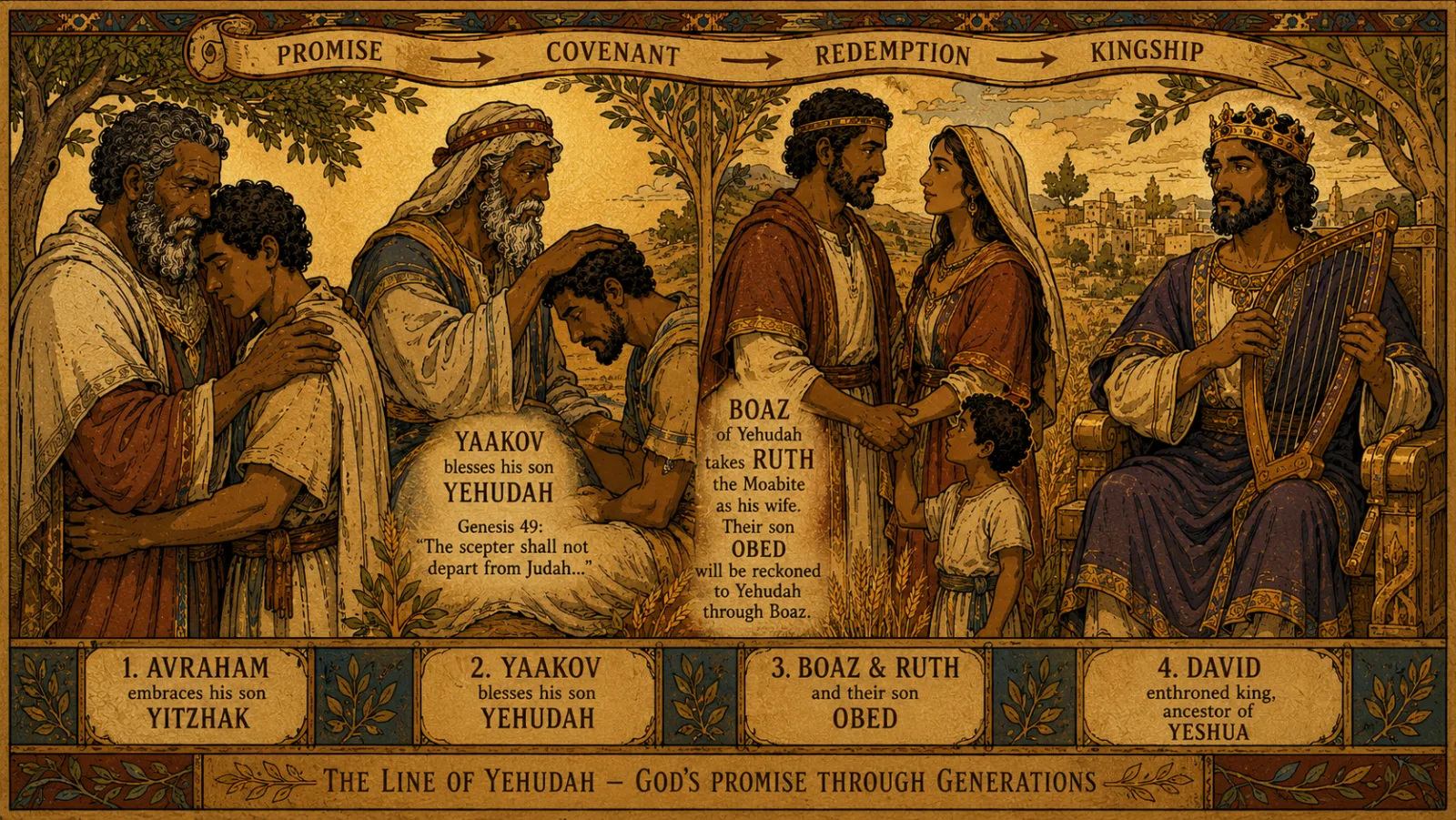
The patrilineal lineage in action · Avraham → Yitzhak → Yaakov → Yehudah → Boaz and Ruth → David · the line flows through the fathers, generation to generation, to the craftsman of Galilee
IV. A Brief Aside on Power and Status — The Case of Herod
The vocabulary section above named Herod as the proof case. It is worth dwelling on the details briefly, because the historical record is precise and the illustration is important.
Herod the Great was an Idumean by patrilineal descent — descended from the Edomites, the people of Esav (Josephus, Antiquities 14.1.3). His father Antipater was Idumean; his mother Cypros was Nabatean Arab. About a century before Herod's birth, the Hasmonean ruler John Hyrcanus I (c. 130 BCE) conquered Idumea and forced its population to convert to Judaism — to be circumcised and to live by Torah (Antiquities 13.9.1). Herod's family became practitioners of Judaism through that forced mass conversion four generations before him.
So when Rome appointed Herod King of the Yehudim in 40 BCE, the arrangement looked like this: Rome gave him the title. His ancestors' forced conversion gave him the religion. Neither gave him the bloodline of Yaakov. He was a practitioner of Judaism — Jewish, by the religious definition. He was not an Israelite — not from any of the twelve tribes, not from the line of David, not from the seed of Avraham through Yitzhak and Yaakov. The Pharisees and the broader observant community of his time rejected him as a legitimate king not because he practiced Judaism poorly, but because the biblical framework for kingship over Israel requires Israelite descent, and he did not have it.
The religion did not grant him the lineage. The title did not grant him the lineage. Power gave his family the religion. The religion gave him the title. Neither gave him what the biblical framework requires. That is the point.
V. Yeshua Under the Biblical Framework
Apply the biblical framework to Yeshua, as Matthew explicitly does:
Avraham begat Yitzhak. Yitzhak begat Yaakov. Yaakov begat Yehudah and his brothers. (Matthew 1:2)
Boaz begat Obed of Ruth; Obed begat Yishai. Yishai begat David the king. (Matthew 1:5–6)
Yaakov begat Yosef the husband of Miryam, of whom was born Yeshua, called Messiah. (Matthew 1:16)
The genealogy moves father to son through forty-two generations. It is a legal patrilineal claim — establishing Yeshua's place in the tribe of Yehudah, in the house of David, in the covenant of Avraham. Paul confirms it in his opening to the Romans:
Concerning his Son Yeshua Messiah our Lord, who was born of the seed of David according to the flesh. — Romans 1:3
Born of the seed of David, according to the flesh. The Greek phrase Paul uses is ek spermatos David kata sarka — literally "of the seed of David according to the flesh." Paul is not speaking spiritually here; he is speaking biologically and legally. The Messiah's claim to David's throne — the promise of 2 Samuel 7 to David that his son would reign forever — passes through the seed, through the paternal line, through Yosef's legal paternity of Yeshua.
By the framework Yeshua's own contemporaries used to reckon identity, Yeshua was an Israelite of the tribe of Yehudah, of the house of David, the legitimate Messianic claimant in the patrilineal line of David's throne. In the first-century sense, he was a Yehudi — a member of the tribe and the region of Yehudah, in the surviving southern house. Romans 1:3 anchors the claim in the flesh. Matthew 1 documents it in the genealogy. The biblical-tribal framework — operative in Yeshua's time and the framework he himself lived under — makes his identity unambiguous: he is a son of Yehudah, in the line of David, in the covenant of Avraham.
VI. The Rabbinic Matrilineal Rule
Centuries after Yeshua's earthly life, a different rule emerges within Jewish law.
The Mishnah Kiddushin 3:12, compiled around 200 CE, lays down the principle that, for the purpose of halakhic Jewish identity — that is, communal membership under rabbinic Jewish law — Jewishness passes through the mother. A child of a Jewish mother is Jewish; a child of a Jewish father and a non-Jewish mother is not Jewish under this rule without formal conversion.
This rule took mature form in the centuries following the destruction of the Second Temple in 70 CE — the same period in which the broader Jewish religious identity, in its modern form, was being codified by the rabbinic sages at Yavneh and in their successors. Shaye J. D. Cohen, in his landmark study The Beginnings of Jewishness, traces it to the post-Second-Temple rabbinic period and locates it within the Jewish legal tradition's internal development. It is a halakhic rule — a rule of Jewish religious law, made by Jewish religious authorities, for purposes of communal membership. It does not displace the patrilineal-tribal framework; it operates alongside it. To this day in traditional Jewish practice:
- Cohen status (priestly lineage) passes father to son.
- Levite status passes father to son.
- Davidic descent claims pass father to son.
- Halakhic Jewish community membership passes mother to child.
Both rules run, in parallel, for different purposes. A modern Orthodox Jewish man can be a Cohen by his father and Jewish-by-halakha by his mother, and both rules apply to him simultaneously.
What this article asks, simply, is: which rule was operative in Yeshua's time? The matrilineal halakhic rule was not yet formalized in his lifetime. The framework operative in first-century Yehudah — the framework Matthew uses, the framework Paul invokes, the framework the Hebrew Bible itself uses — was patrilineal. Yeshua lived, was reckoned, and was understood under the older biblical framework that traces tribe and house through the father.
That is not an attack on the rabbinic matrilineal rule. It is a historical observation about which framework was operative in the time of the man whose lineage these documents trace.
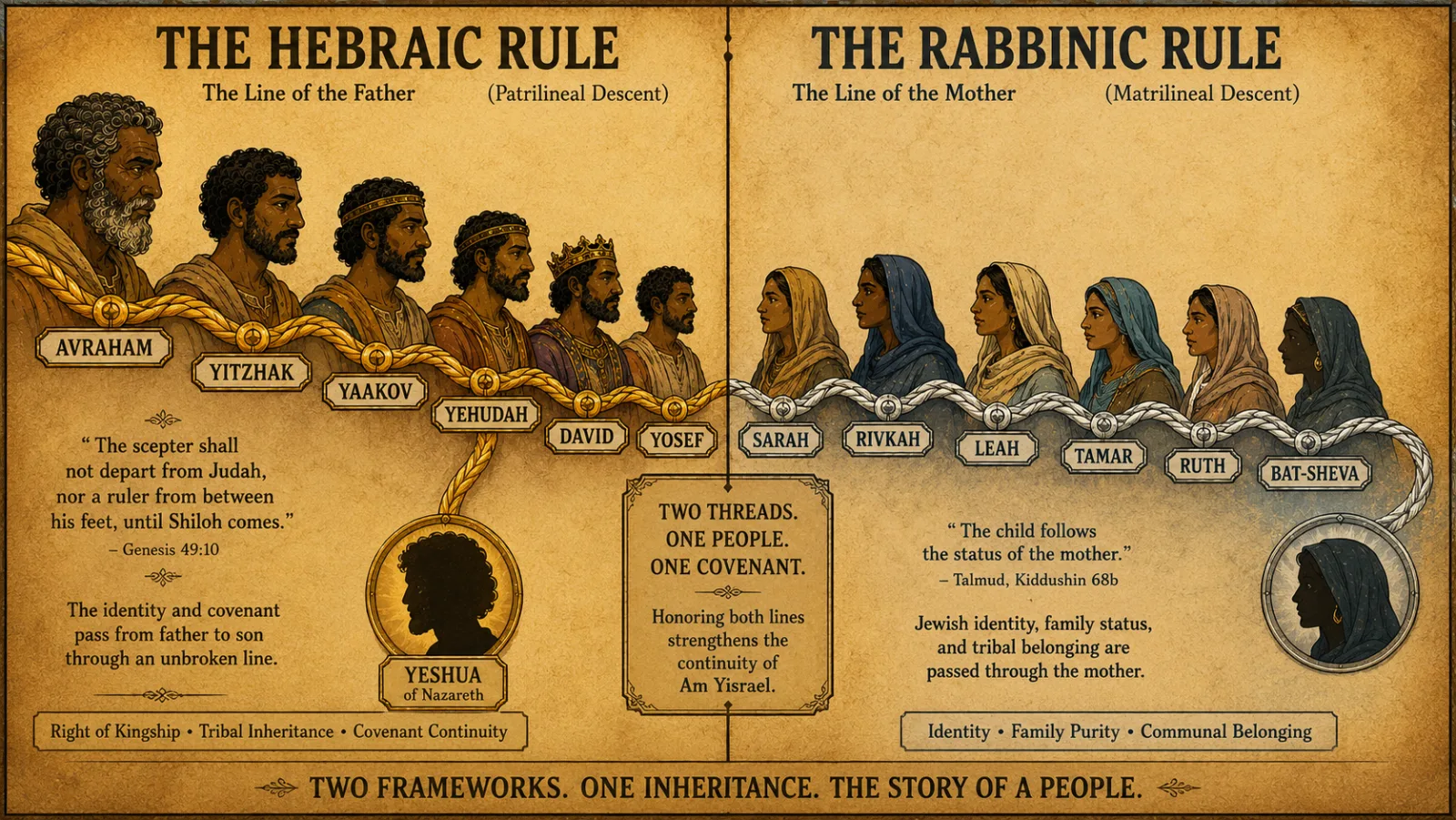
Two real frameworks of the Jewish tradition · the Hebraic patrilineal rule (tribe, throne, priesthood) and the rabbinic matrilineal rule (halakhic membership) · they run in parallel, neither displacing the other
VII. Two Rules, One Continuing People
It would be a mistake to conclude from this distinction that the patrilineal and matrilineal frameworks belong to two different peoples. They do not. They are two rules within the same Jewish tradition, governing different questions:
Tribe / royal line / priesthood — biblical-patrilineal. Still operative today for Cohen, Levite, and Davidic-lineage claims in modern Jewish practice.
Halakhic community membership — rabbinic-matrilineal. Formalized in the post-Second-Temple rabbinic period, operative for the question of who counts as a member of the Jewish religious community under traditional halakha.
Both run, in parallel, in the same Jewish tradition, in the same Jewish communities, today. Neither overrides the other. They answer different questions.
It is also worth noting that not every modern Jewish movement holds the strict matrilineal rule. Reform Judaism, since 1983, has accepted patrilineal descent — meaning that under Reform halakha, a child of a Jewish father and non-Jewish mother who is raised Jewish is considered Jewish. The State of Israel's Law of Return grants citizenship to anyone with one Jewish grandparent on either side. The strict matrilineal rule is the Orthodox and Conservative halakhic standard, but Jewish identity in the broader sense is plural and contested even within Jewish tradition itself.
What is uncontested is the biblical-patrilineal framework under which Yeshua's lineage was reckoned in Matthew 1 and Romans 1:3. That framework was operative in his lifetime, and it still operates today for tribal and royal lineage in Jewish practice. That is the framework these texts use to identify him.
And it is also worth holding clearly: the broader Israelite category that Yeshua himself named is broader still than the surviving Jewish community. When Yeshua spoke of "the lost sheep of the house of Israel" (Matthew 15:24), he was naming the descendants of all twelve tribes — including the ten dispersed by Assyria, scattered among the nations, often indistinguishable from the gentiles among whom they were sown. The modern Jewish community is a real and continuing part of that Israelite family — the visible surviving house of Yehudah, Binyamin, and Levi — but the broader Israelite family includes the scattered northern tribes who were never gathered back, and whose descendants are honored in the biblical record even where the historical record has lost track of them.
VIII. So — Was Yeshua a Yehudi, an Israelite, or Jewish?
The article opened with a version of this question, and it returns to it now, with the frameworks laid out.
Under the Hebraic patrilineal-tribal framework — the framework of the Hebrew Bible, the framework operative in his lifetime, the framework Matthew uses to open his Gospel and Paul uses to open his Letter to the Romans — Yeshua is an Israelite of the tribe of Yehudah, of the house of David, of the seed of Avraham. In the first-century sense, he is a Yehudi — a member of the tribe and people and region of Yehudah, in the surviving southern house. Patrilineally. Legally. By the framework of his own time. Romans 1:3: born of the seed of David, according to the flesh.
Under the rabbinic matrilineal-halakhic framework — formalized centuries after his earthly life, in the period following the Second Temple's destruction in 70 CE, and operative for halakhic community membership in traditional Jewish practice today — Yeshua would also be reckoned Jewish through Miryam his mother, who was herself of Israelite descent. By either framework, applied honestly, he belongs to Israel.
But notice what each framework foregrounds. The patrilineal framework foregrounds the kingly claim — Yeshua as son of David, the inheritor of the royal promise, the Messianic claimant in the tribal line of Yehudah. The matrilineal framework foregrounds the communal membership — Yeshua as a member of the Jewish religious community as that community came to be defined in the centuries after his earthly life. They are not the same emphasis. They highlight different things about who he was.
What this article holds out for the reader is this: the Bible itself uses the patrilineal framework when it tells us who Yeshua is. It does not introduce him as Miryam's son, though Miryam is honored and named. It introduces him as son of David, son of Avraham, through forty-two generations of fathers, ending in Yosef the husband of Miryam, of whom was born Yeshua. That is a Hebraic patrilineal claim. The royal claim. The covenantal claim. The claim to the throne of Israel.
Is Yeshua a Yehudi, an Israelite, or Jewish? Under the framework his Bible uses, he is an Israelite of the tribe of Yehudah, of the house of David — a Yehudi in the first-century sense. Under the framework that came later, he is also Jewish by his mother. The Israelite category — the one Yeshua himself used when he spoke of the lost sheep of the house of Israel — is the broadest of the three, and it is the framework that holds his mission together: Israel first, the lost sheep first, the scattered house first, and through that mission the nations grafted in to the same olive tree.
What the reader is invited to consider — and this is where the article ends — is which framework Hebroni, as a Hebraic-rooted platform, finds itself most at home in. We are not the rabbis of 200 CE. We are not Orthodox halakhic authorities. We are readers of the Hebrew Bible and the Gospels in their own Hebraic vocabulary. And in that vocabulary, the Messiah comes of the seed of David, according to the flesh. The fathers carry the line. The fathers carry the throne. The fathers carry the covenant of Avraham forward, generation by generation, until the genealogy reaches a working craftsman in Galilee whose legal son is called Yeshua — Israelite of the tribe of Yehudah, of the house of David, sent first to the lost sheep of the house of Israel.
That is the framework we live in here.
A Note on Method
This article documents what the biblical texts say about how lineage is reckoned and what the rabbinic tradition later developed for religious community membership — two different frameworks answering two different questions. The key distinction the article holds throughout: Jewish is a religious identity, of Judaism, belonging to the community and practice of the religion. Israelite is a bloodline category, reckoned patrilineally through the twelve sons of Yaakov. The two can overlap; they are not the same thing, and the religion of Judaism does not confer or confirm Israelite bloodline. The rabbinic tradition that defined Jewish identity was written in the centuries after 70 CE, by the surviving southern house's own religious leadership — it is engaged carefully and honestly here, but it is not treated as the final word on who is and is not an Israelite, because that is a question the Bible answers by a different framework than the one the rabbis used.
A note on terminology: this article uses Yeshua (Hebrew: ישוע) rather than the Greek/English "Jesus." The terms Israelite, Yehudi, and Jewish are used in their distinct senses as laid out in Section II — not interchangeably.
Sources & Further Reading
- The biblical genealogies: Matthew 1:1–17 — the sefer toledot of Yeshua, forty-two generations father to son. Luke 3:23–38 — a second genealogy, traced back to Adam. 1 Chronicles 1–9 — the long genealogical chapters of the Hebrew Bible, all patrilineal. Ruth 4:18–22 — the line from Peretz to David, through Boaz. Genesis 48 — Yaakov blessing Efrayim and Menashe into full tribal status, through Yosef their father, despite their Egyptian mother Asenat.
- Paul on the Davidic lineage: Romans 1:3 — "born of the seed of David according to the flesh" (ek spermatos David kata sarka). 2 Timothy 2:8 — "Yeshua Messiah of the seed of David."
- On Herod's Idumean descent and the Hasmonean forced conversion: Josephus, Antiquities of the Jews 13.9.1 (the forced conversion of the Idumeans under John Hyrcanus I, c. 130 BCE). Josephus, Antiquities of the Jews 14.1.3 (Herod's Idumean paternal descent through Antipater).
- The rabbinic matrilineal rule: Mishnah Kiddushin 3:12 (the foundational text for matrilineal descent in halakha). Shaye J. D. Cohen, The Beginnings of Jewishness: Boundaries, Varieties, Uncertainties (University of California Press, 1999) — the standard scholarly study of when and how the matrilineal rule emerged within rabbinic Judaism in the period following the Second Temple's destruction.
- Modern Jewish positions: Reform Judaism's 1983 acceptance of patrilineal descent (Central Conference of American Rabbis resolution). The State of Israel's Law of Return (1970 amendment, granting citizenship to those with one Jewish grandparent on either side). Orthodox and Conservative halakhic positions affirming the matrilineal rule.
A note on terminology: this article uses Yeshua (Hebrew: ישוע) rather than the Greek/English "Jesus" to honor the Hebraic context of his name and identity. The terms Yehudim, Yehudah, Israelite, and Jewish are used in their distinct biblical, first-century historical, and modern religious-tradition senses respectively, as laid out in Section II. The distinctions are linguistic and historical, not personal.
✡ Trace the Line for Yourself
From Avraham to David to the craftsman of Galilee — the whole genealogy runs through the Hebrew Bible. Read the text of that lineage in the original language.
Torah Reader The Arzareth Question →