Of all the peoples named in scripture — Egyptians, Babylonians, Assyrians, Persians, Greeks, Romans, Canaanites, Hittites, Philistines, Edomites, Moabites, Ammonites, Arameans, and dozens more — one people stands at the center of the entire story. Their name appears more than two and a half thousand times across the Hebrew Bible. The covenant is made with them. The Torah is given to them. The prophets are sent to them. The kings reign over them. The Messiah is born of them. They are the Israelites — Yisrael — the descendants of Yaakov who was renamed by Yah at the river Yabok, the people through whom Yah purposed to bless all the families of the earth.
This article walks through who the Israelites are: where they came from, how they are reckoned in scripture, what their story has been, and why every reader of the Bible — whatever their own background — eventually has to come to terms with the fact that the Bible is not the story of humanity in general. It is the story of one specific people, called by Yah out of all the nations, set in covenant with him, scattered and gathered across millennia, and central to everything else the Bible has to say.
I. The People at the Center of the Story
Open the Bible to almost any page and the same people are there.
Genesis traces them from Avraham through Yitzhak through Yaakov, naming the twelve sons who become the twelve tribes. Exodus is the story of their deliverance from Egyptian slavery and the giving of the Torah at Sinai. Leviticus is the priestly law for their worship. Numbers is the wilderness wandering of their generation. Deuteronomy is Moshe's final speeches to them before they enter the land. Joshua records their conquest of the land. Judges, the cycles of their faithfulness and falling away. Samuel and Kings, the establishment of their monarchy and its eventual division and destruction. The Psalms are their hymnal. The Proverbs are their wisdom. The Prophets — Isaiah, Jeremiah, Ezekiel, the Twelve — are sent to them, by Yah, calling them back when they wandered and naming the redemption when they could not see it.
When the New Testament opens, the same people are still at the center. "The book of the generations of Yeshua Messiah, son of David, son of Avraham" (Matthew 1:1). The Messiah is born of them. The apostles are of them. The good news goes out "to the Yehudi first, and also to the Greek" (Romans 1:16), and the nations who would believe are grafted into their olive tree (Romans 11:17–24), made fellow citizens of the commonwealth of Israel (Ephesians 2:19).
The Bible is, by the simplest measure, the story of this people. More than 2,500 times the word Yisrael (Israel) appears in the Hebrew Bible. B'nei Yisrael (children of Israel) appears more than 600 times on its own. Yehudah (Judah) appears more than 800 times. The references compound and reinforce, on page after page, until the reader cannot honestly miss what the Bible itself is signaling: this is who the book is about.
Other peoples are present. They are not the focus. Egypt is frequently named because Egypt was the backdrop of Israel's slavery and the first display of Yah's deliverance. Babylon and Assyria and Rome are frequently named because they conquered, exiled, and oppressed Israel — and the prophets named them in relation to what they did to Yah's covenant people. The nations are real and biblically present. They are not the central thread. The central thread is Israel.
The Torah is given to Israel. The covenant is with Israel. The Messiah is born of Israel. The gospel goes out from Israel to the nations who would be grafted into Israel's tree. If a reader does not see this, the reader has missed the architecture of the entire Bible.
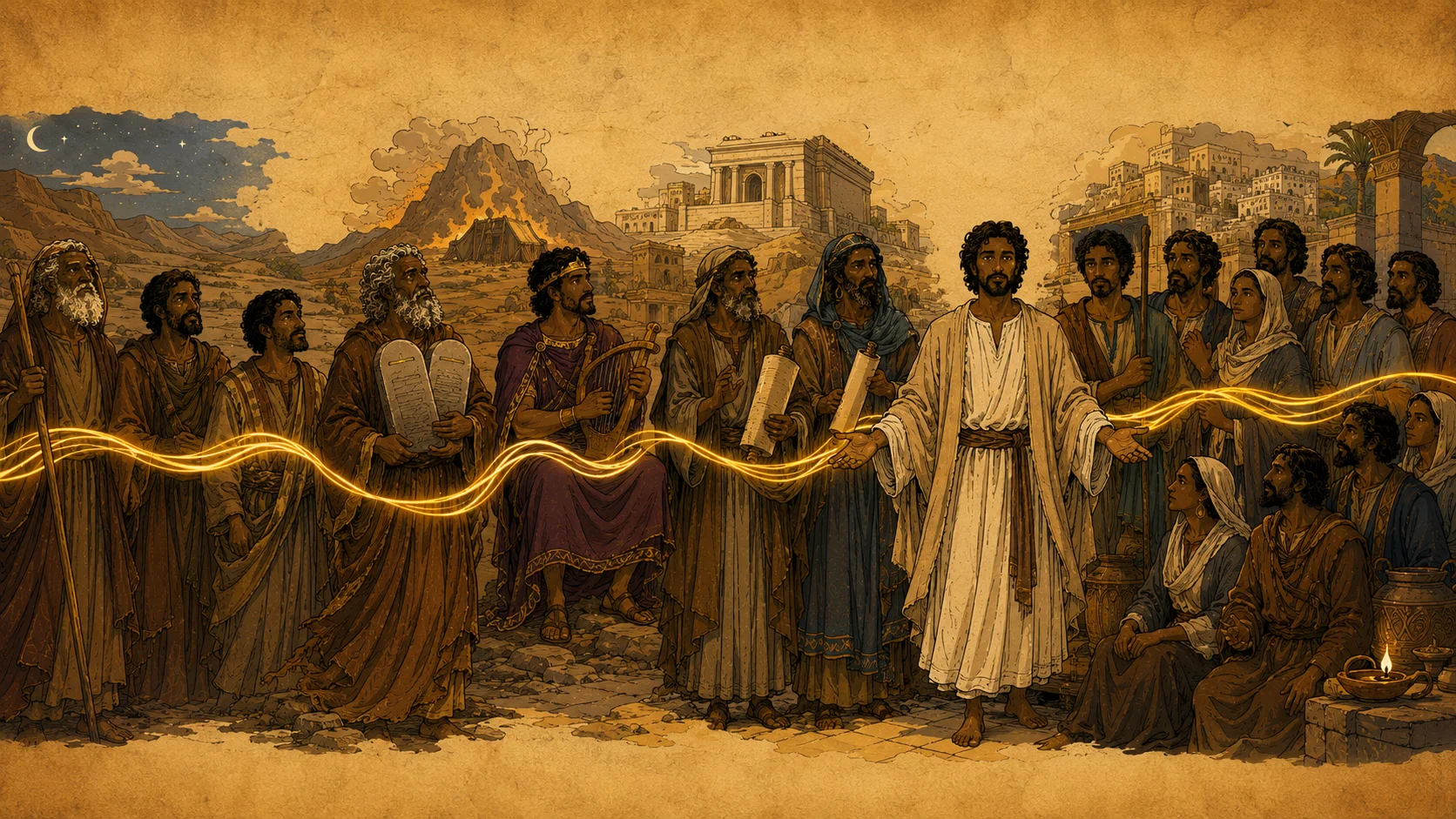
The unbroken chain of Israel across scripture · from Avraham through Moshe, David, the prophets, Yeshua, and the apostles · one people, one covenant, one golden thread
II. Where the Name Came From — Yaakov to Yisrael
The name Israel has a moment of origin in scripture, and it is one of the most dramatic moments in the Hebrew Bible.
In Genesis 32, Yaakov — son of Yitzhak, grandson of Avraham, returning from his long sojourn with Lavan in Aram — comes to the river Yabok the night before he is to meet his estranged brother Esav. He sends his family and his flocks across the river, and he is left alone on the near bank. And there, in the dark, a man wrestles with him until the breaking of the day.
The wrestler is no ordinary man. Yaakov perceives, by morning, that he has wrestled with God. The wrestler touches the hollow of Yaakov's thigh and dislocates it. Yaakov refuses to let go without a blessing. And the wrestler says to him:
"Your name shall no more be called Yaakov, but Yisrael: for you have striven with God and with men, and have prevailed." — Genesis 32:28
In Hebrew: Yisrael — from the root sara (to strive, to wrestle, to contend) and El (God). One who wrestles with God. Or, in another reading, God strives. The name carries both senses: Israel is the people whose patriarch wrestled with Yah and was renamed by him, and Israel is the people through whom Yah strives.
From that night forward, Yaakov's name is also Yisrael. His twelve sons become the twelve tribes. The twelve tribes become b'nei Yisrael — the children of Israel. Israel is, first and most precisely, the descendants of Yaakov-renamed-Yisrael — the patrilineal-tribal family that grew from his twelve sons.
III. The Patrilineal-Tribal Framework
The framework by which Israelite identity is reckoned in scripture is patrilineal-tribal. Tribe passes through the father. This is not a theological argument; it is what the text does on its own pages, openly and continuously.
The twelve tribes are named for the twelve sons of Yaakov. Not the twelve daughters. When Yosef ben Yaakov married the Egyptian Asenat (Genesis 41:45) and had two sons by her, those sons were reckoned fully Israelite by their father, and Yaakov adopted them into full tribal status (Genesis 48). The mother was Egyptian; the sons were Israelite. The tribe ran through the father.
When Moshe married the Midianite Tzipporah (Exodus 2:21), their sons were reckoned Levites by their father. The mother was Midianite; the sons were Levite.
When Boaz of Yehudah married the Moabite Ruth, their son Oved was reckoned of the tribe of Yehudah, in the kingly line that ran to David (Ruth 4:18–22). The mother was Moabite; the son was Yehudah's, in the line of David and Yeshua.
The priesthood — the Cohen line — passes father to son. The Levitical service is hereditary through the male line. The Davidic throne passes father to son. The genealogies of 1 Chronicles 1–9, of Matthew 1 and Luke 3, of Ezra and Nehemiah — all of them, organized father to son. This is the biblical framework for reckoning who is an Israelite. The Bible is unambiguous on this.
Modern Jewish religious law developed a different rule — the matrilineal halakhic rule of Mishnah Kiddushin 3:12 — for the purpose of halakhic community membership. Both rules continue to operate in modern Jewish practice today: Cohen and Levite status still pass father to son; halakhic Jewish community membership passes mother to child. The two rules do different things. Neither displaces the other. For a deeper look at this, see the companion article Of the Seed of David.
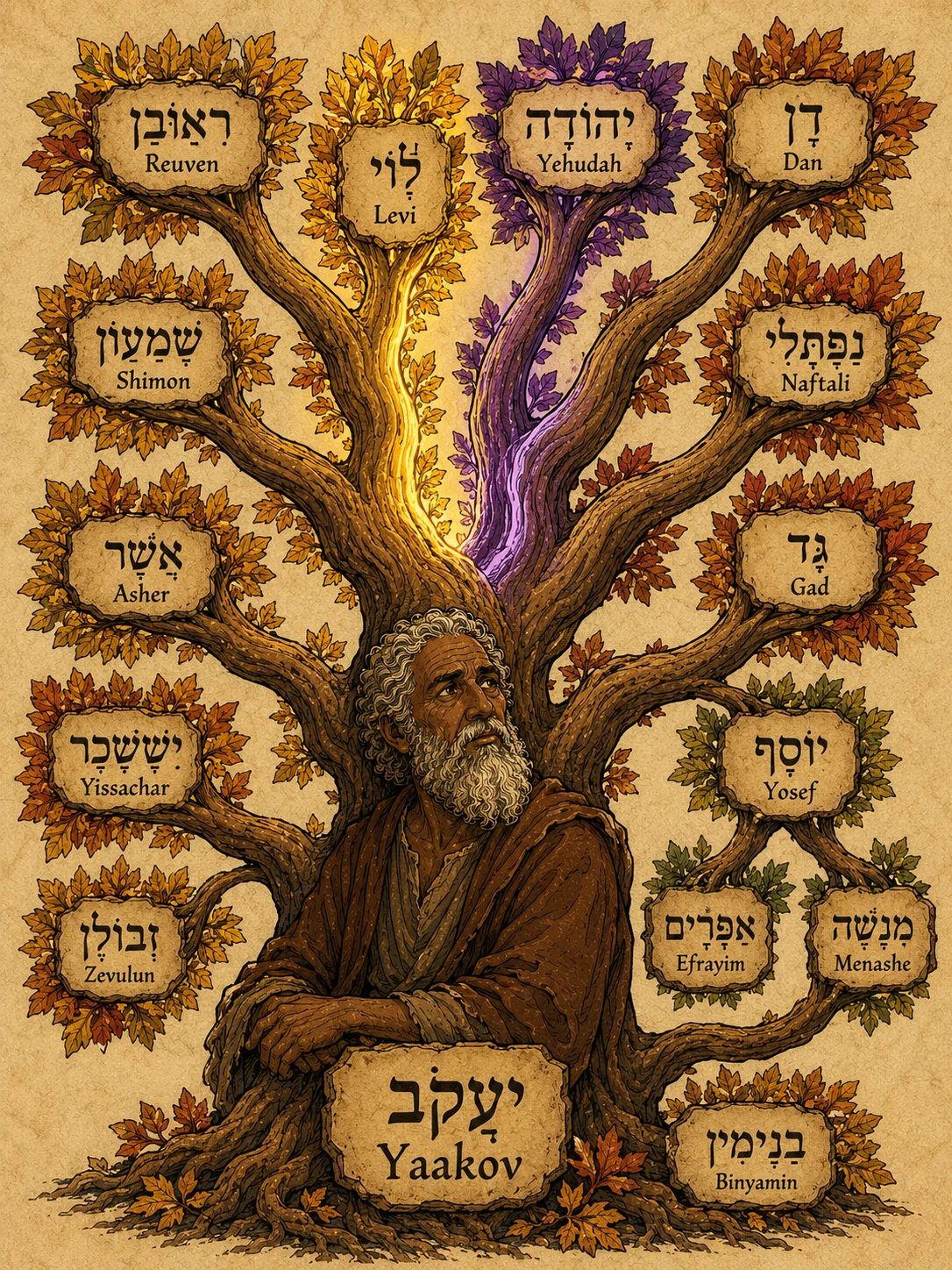
The twelve sons of Yaakov — the founding branches of the twelve tribes of Israel · the Levi line (priestly) and Yehudah line (kingly) highlighted · Yosef's branch splitting to Efrayim and Menashe (Genesis 48)
IV. The History — From Avraham to Today
The Israelite story has a long arc. Let me trace it briefly, because the scope of it is part of what reveals who Israel is.
The patriarchs (c. 2000–1500 BCE, traditional dating). Avraham is called by Yah out of Ur of the Chaldees (Genesis 12), given the covenant of land and descendants. From Avraham to Yitzhak to Yaakov, the family is small — three generations of patriarchs in the land of promise but not yet possessing it. Yaakov goes down to Egypt with seventy souls in the famine (Genesis 46:27).
Egypt and the Exodus (c. 1500–1300 BCE, traditional dating). Over four centuries, the seventy souls become a multitude. They are enslaved by Pharaoh, oppressed, and finally delivered by Moshe and Aharon through the ten plagues, the Passover, and the crossing of the Sea. The Torah is given at Sinai. The wilderness generation dies; the next generation enters the land.
Conquest and Judges (c. 1300–1050 BCE, traditional dating). Under Yehoshua bin Nun, the children of Israel enter and take possession of the land Yah promised to Avraham. The twelve tribes are settled into their tribal territories. For about two and a half centuries, the people are governed by the shoftim — the judges — through cycles of faithfulness and apostasy.
The United Monarchy (c. 1050–931 BCE). Israel asks for a king "like all the nations" (1 Samuel 8:5). Shmuel anoints Shaul of the tribe of Binyamin as first king. Shaul fails; David of the tribe of Yehudah is anointed and becomes the great king. David's son Shlomo builds the First Temple in Yerushalayim.
The Divided Kingdom (931–722 BCE). After Shlomo's death, the kingdom splits. The ten northern tribes break away under Yarov'am (Jeroboam I) and become the Northern Kingdom of Israel (capital: Shomron / Samaria). The southern kingdom — Yehudah, Binyamin, and the Levitical line — remains under David's house with capital at Yerushalayim.
The Assyrian deportation of the northern tribes (722 BCE). The Assyrian Empire under Shalmaneser V and Sargon II conquers the Northern Kingdom and deports the ten tribes across its territories. They never return as a unified people. (For more on what became of them, see the companion article The Arzareth Question.)
The Babylonian exile of Yehudah (586 BCE). The Babylonian Empire under Nebuchadnezzar destroys the First Temple and takes Yehudah into exile. Daniel, Yechezkel, and others prophesy from Babylon. After seventy years, under the Persian Cyrus's decree (538 BCE), a portion of Yehudah returns. The Second Temple is built under Zerubavel and Yehoshua ben Yehotzadak (completed 516 BCE). Yehudah resumes life in the land, smaller than before.
The Hellenization crisis (167 BCE). The Greek Seleucid ruler Antiochus IV Epiphanes conquered Yerushalayim and launched a systematic campaign to erase Israelite identity. Torah observance was outlawed under penalty of death. Sabbath-keeping was forbidden. Circumcision was forbidden. The Temple was defiled with the sacrifice of swine on the altar. Israelites were compelled to take Greek names, speak Greek, eat swine's flesh, and observe Greek festivals. The Maccabean revolt (1 Maccabees 1:41–64) was the resistance of those who refused. But many did not resist — the Hellenized Yehudim, Israelites now bearing Greek names, speaking Greek, operating entirely in Greek cultural frameworks, carrying Israelite blood under a Greek identity imposed by conquest.
The Assyrian deportation had done this to the northern house in 722 BCE. The Hellenization was now doing it to the southern house. The same pattern Moshe had named in Deuteronomy 28:64: "you shall serve other gods, which neither you nor your fathers have known, even wood and stone." Not the religion Israel chose — the religion of the conqueror, forced on the conquered.
The Roman conquest (63 BCE onward). Israelites now operating in the Roman imperial framework — Roman citizenship, Roman names, Roman legal identity, Roman language. Paul himself is the example: Sha'ul the Binyaminite Pharisee, operating as Paul the Roman citizen, writing in Greek, moving through the Roman world. The Israelite identity carried on inside; the Roman identity was what the empire saw on the outside.
The slave trade is the fullest and most complete expression of the Deuteronomy 28 pattern. African Israelite descendants carried into the Americas, the Caribbean, the Atlantic world — their names taken, their languages taken, their Sabbath forbidden (the enslaved were forced to work Saturdays under penalty), their Hebrew calendar erased, their tribal identities destroyed, their family structures deliberately broken, their children separated from parents, replaced entirely with the names and religion and practices and holidays of the captors. Deuteronomy 28:68 — "Yah shall bring you into Egypt again with ships... and there you shall be sold unto your enemies as bondmen and bondwomen, and no man shall buy you" — fulfilled in its most complete form across the Atlantic slave trade.
The result across all of these: Israelites living as Greeks, Romans, Americans — carrying the blood of Yaakov while bearing none of the name, none of the language, none of the Sabbath, none of the appointed times, none of the visible identity. These are the outcasts of Israel of Isaiah 11:12. The Deuteronomy 28 pattern — matched against documented history — is the identifier Yah gave. The platform does not need to adjudicate who is an Israelite. The curses do. The reader who encounters the pattern honestly is left to sit with what it means for their own history.
The coming of Yeshua (c. 4 BCE – c. 30 CE). The Messiah is born in Beit-Lechem of Yehudah, of the line of David, in the days of Herod the Idumean (who had been placed on the Jewish throne by Rome — see the discussion in Of the Seed of David). Yeshua's earthly ministry is "to the lost sheep of the house of Israel" (Matthew 15:24). He is crucified in Yerushalayim under Pontius Pilate the Roman governor and rises on the third day. And in his final days, on the Mount of Olives, he confirmed in his own words exactly what Moshe had named: "they shall fall by the edge of the sword, and shall be led away captive into all nations: and Yerushalayim shall be trodden down of the Gentiles, until the times of the Gentiles be fulfilled" (Luke 21:24). The Messiah's confirmation of the curse pattern — and the until that bounds it.
The Roman destruction (70 CE) and the rabbinic codification. The Romans under Titus destroy Yerushalayim and the Second Temple in 70 CE. The Sanhedrin reconstitutes at Yavneh. The Mishnah is compiled c. 200 CE, the Talmuds in the centuries following. The mature form of modern Jewish religious tradition takes shape in this period — what we now call Jewish in the modern sense.
The long diaspora (70 CE – 1948). Yehudah is scattered across the world. The visible continuing Israel of the surviving southern house preserves Torah, develops the Talmud, suffers expulsions and pogroms, builds and rebuilds across every continent. Other communities — the Beta Israel of Ethiopia, the Lemba of Southern Africa, the Bnei Menashe of India — preserve their own traditions of Israelite identity across the centuries.
The State of Israel (1948 – today). After two thousand years of dispersion, a Jewish state is re-established in the land — established primarily by practitioners of Judaism through the Zionist movement. Whether those who returned carry the patrilineal bloodline of the house of Yehudah is a question the framework of this platform does not adjudicate individually. What is documented historically is that the land of the covenant is being resettled and that this is the beginning of what the prophets described. But the prophets did not describe only one house returning. They described both houses — the stick of Yehudah and the stick of Efrayim — made one in Yah's hand (Ezekiel 37:16–24). Whatever the bloodline composition of those who have returned, the house of Efrayim — the scattered northern house — is still out.
And the lost sheep still scattered. The ten northern tribes that went into Assyrian exile in 722 BCE — and their descendants across centuries of further scattering — were never gathered back as a unified people. The prophets promised the full gathering: Jeremiah 50:4 — both houses together, weeping, seeking Yah. Ezekiel 37 — the two sticks made one. Zechariah 10:6 — "I will save the house of Yosef... they shall be as though I had not cast them off." Isaiah 11:12 — the outcasts of Israel and the dispersed of Yehudah from the four corners of the earth. Yeshua said he was sent to them: "the lost sheep of the house of Israel." The broader Israelite family — beyond the visible Jewish community — remains a real biblical category, a real ongoing question, a real part of the unfolding covenantal story. The gathering is underway. It is not finished until both sticks are in Yah's hand.
One people, called by Yah, descended from Yaakov, organized through twelve tribes, scattered across four thousand years, and being gathered back from the four corners — still at the center of the story scripture tells.
V. Three Words That Are Not Identical — Israelite, Yehudi, Jewish
A precise understanding of who the Israelites are requires distinguishing three terms that often get used interchangeably in English but mean distinct things in scripture and history.
Israelite — the broadest term. The descendants of Yaakov-renamed-Yisrael through his twelve sons. The whole covenantal family, reckoned by the patrilineal-tribal framework, including the surviving southern house (Yehudah, Binyamin, Levi) and the scattered northern house (the ten tribes dispersed by Assyria) and any other descendants of Yaakov dispersed across the centuries. This is the term Yeshua himself uses when he speaks of "the lost sheep of the house of Israel" (Matthew 15:24, Matthew 10:5–6).
Yehudi — in the first-century sense, a member of the tribe of Yehudah, or more broadly a person of the people and region of Yehudah (Judea). When the New Testament uses the Greek Ioudaios (translated Jew in English), it most often refers to a person of Yehudah in this first-century sense — the surviving tribes of Yehudah, Binyamin, and the Levitical line. Yeshua himself was a Yehudi in this sense — an Israelite of the tribe of Yehudah, in the kingly line of David. The Samaritan woman at the well says to him in John 4:9, "How is it that you, being a Yehudi, ask drink of me, who am a woman of Samaria?"
Jewish — those who practice or identify with the religion of Judaism. The rabbinic halakhic definition, formalized in the centuries after the Second Temple's destruction, passes Jewish identity through the mother. The tradition of Judaism is real and it has preserved much across two millennia. It is not treated here as synonymous with the Israelite category the Bible uses.
These three terms are not interchangeable. Israelite is the biblical blood-and-lineage category — patrilineal, through the twelve sons of Yaakov. Yehudi is the first-century historical term for an Israelite of the surviving southern house. Jewish is a religious identity with historical roots in that same southern house but not identical to Israelite patrilineal descent. The Bible's framework leads with Israelite. Yeshua's framework leads with Israelite. Hebroni's framework leads with Israelite — without dismissing the tradition of Judaism, which carries real and continuing roots in the surviving southern house.
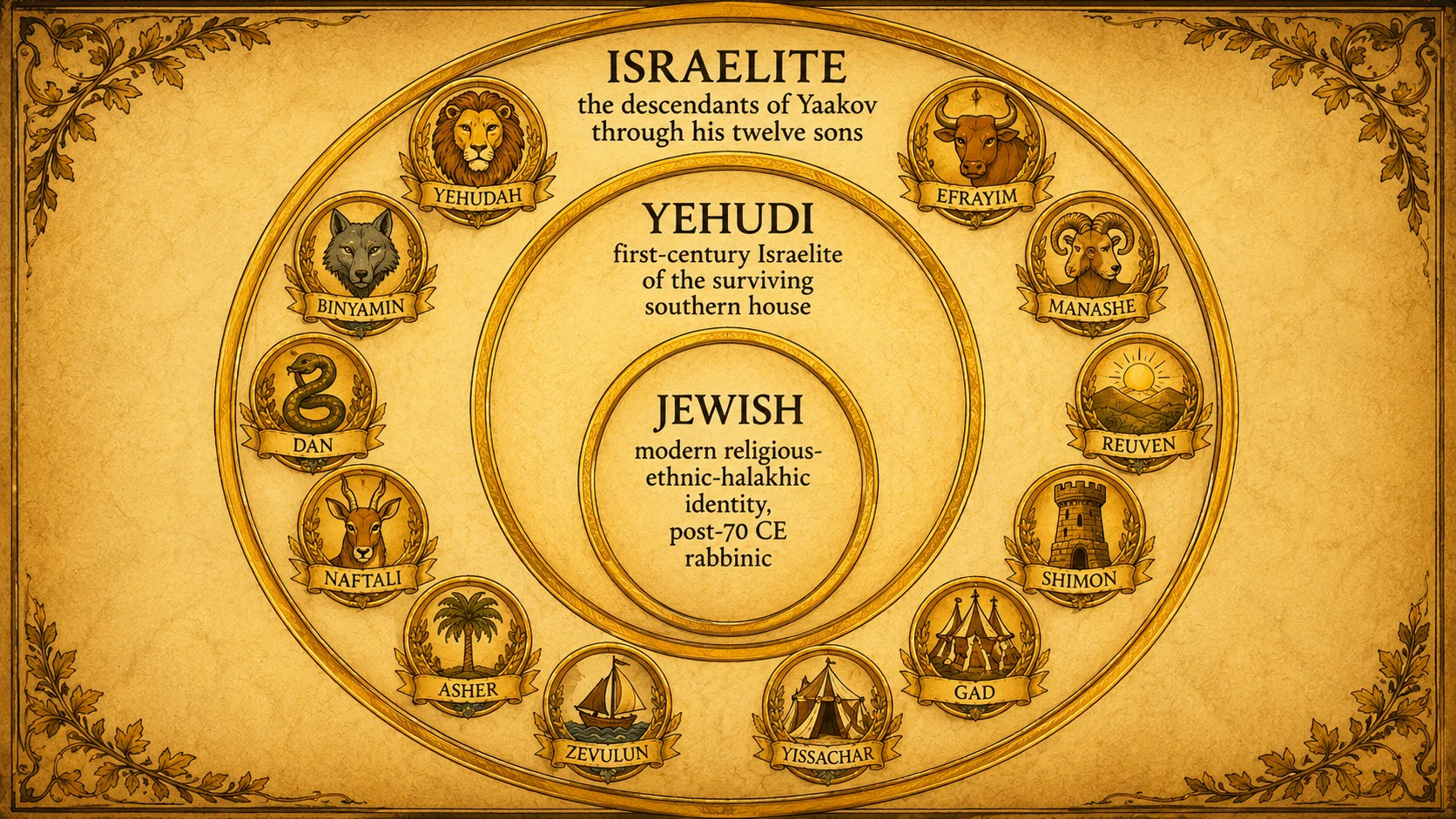
Three nested categories · Israelite is the broadest — the whole twelve-tribe family · Yehudi is the first-century surviving southern house · Jewish is the modern religious identity of Judaism · each smaller category is fully inside the larger one
VI. The Lost Sheep and the Gathering
There is a part of the Israelite story that the modern Western reader often misses, and it matters: the lost sheep of the house of Israel are a real biblical category, broader than the visible Jewish community.
The Hebrew prophets — Jeremiah, Ezekiel, Isaiah, Hosea — repeatedly use the language of scattered sheep and lost flock to describe what happened to the children of Israel after the Assyrian deportation of 722 BCE. Yah himself, in Ezekiel 34, declares that he himself will come and seek out his scattered flock:
"I will seek that which was lost, and bring again that which was driven away, and will bind up that which was broken, and will strengthen that which was sick." — Ezekiel 34:16
Yeshua takes up this exact prophetic vocabulary when he names his mission:
"I am not sent but unto the lost sheep of the house of Israel." — Matthew 15:24
The Hebrew prophets had said Yah himself would come for his scattered flock. Yeshua applies that promise to his own mission — and identifies himself, by implication, as the shepherd of Ezekiel 34 come in the flesh.
The lost sheep he came for include the scattered descendants of the ten northern tribes who never returned from Assyrian exile, the diaspora communities living among the nations, and any of the broader Israelite family whose identity had been blurred or hidden by the long centuries of dispersion. Many of them were never part of the religious tradition of Judaism to begin with — the northern tribes were dispersed in 722 BCE, more than seven centuries before the rabbinic codification began. They are Israelites by bloodline whose culture, name, language, and memory were stripped from them across generations of exile — precisely as Moshe had warned in Deuteronomy 28.
The apocryphal book of 2 Esdras names this directly. Written in the generation after the Second Temple's destruction, it records the ten tribes' voluntary journey deeper into exile — across the Euphrates to a land called Arzareth, the Hebrew erets achereth, another land — specifically so they could keep the covenant they had broken at home. For the fuller treatment, see the companion article The Arzareth Question.
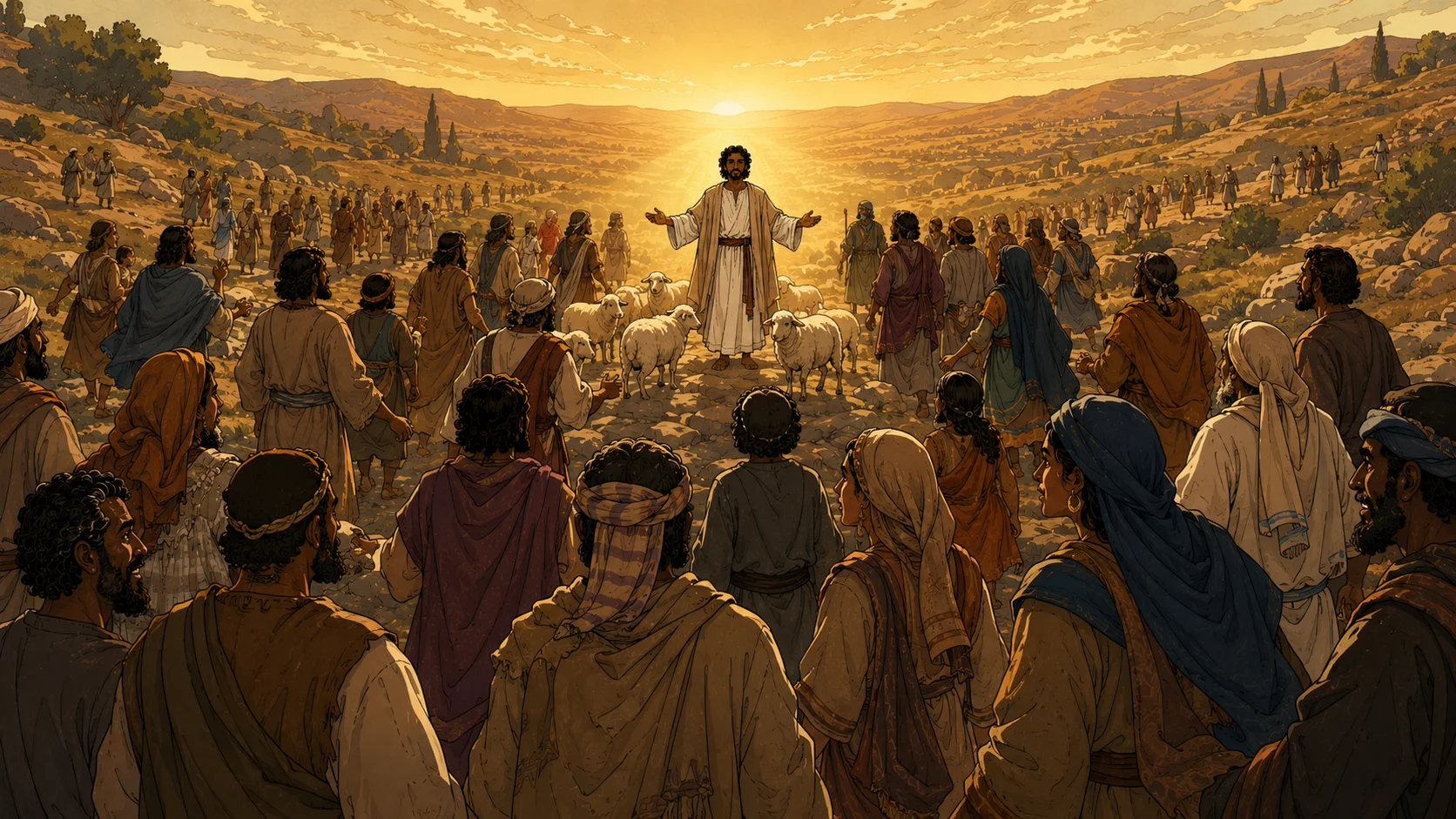
The gathering of the lost sheep · scattered Israelites from every direction moving toward the shepherd of Ezekiel 34 come in the flesh · the mood is reunion, not condemnation
VII. The Nations — Real, Present, Gathered In
The Bible names Israel as the central people of the covenant — but it does not erase the nations. The nations are real, present in scripture, and brought into the story by Yah's own design.
The covenant with Avraham itself contains both threads:
"I will bless them that bless you, and curse him that curses you: and in you shall all families of the earth be blessed." — Genesis 12:3
Israel is chosen not instead of the nations but for the sake of the nations — a covenantal vocation, a priestly people for the world. Exodus 19:6 names it at Sinai: "You shall be unto me a kingdom of priests, and a holy nation." A priesthood implies a people to be served. Israel's priesthood is for the nations.
The prophets carry the same theme. Isaiah 2 and Micah 4 describe a future when all nations flow up to the mountain of Yah, learning Torah and walking in his ways. The New Testament continues this exact framework. Paul says the gentile believers are grafted into Israel's olive tree (Romans 11:17–24), made fellow citizens of the commonwealth of Israel (Ephesians 2:19), partakers of the covenants of promise (Ephesians 2:12–13). The grafted-in branches are real branches; the olive tree is Israel's; the family is one.
The Israelite story is at the center. The nations are gathered in. Both are real. The covenant of Avraham held both from the beginning.
VIII. Why This Matters
Before any argument is made about why the Israelite-centered framework matters for reading the Bible — before any appeal to the reader's logic or scholarship — Yah himself answered the question. He answered it in Deuteronomy 7, in words that have never been superseded:
"For you are a holy people unto Yah your God: Yah your God has chosen you to be a special people unto himself, above all people that are upon the face of the earth. Yah did not set his love upon you, nor choose you, because you were more in number than any people; for you were the fewest of all people: But because Yah loved you, and because he would keep the oath which he had sworn unto your fathers, has Yah brought you out with a mighty hand, and redeemed you out of the house of bondmen, from the hand of Pharaoh king of Egypt. Know therefore that Yah your God, he is God, the faithful God, which keeps covenant and mercy with them that love him and keep his commandments to a thousand generations." — Deuteronomy 7:6–9
Three words in verse 6 carry everything:
Am kadosh — holy people. Set apart. Separated unto Yah by his own declaration. The holiness is not earned; it is declared over the people by Yah himself.
Bachar — chosen. An active verb. Yah actively chose Israel. Not passively, not circumstantially — Yah chose you.
Segulah — treasured possession. A king's personal treasury. Something set aside because of its specific and irreplaceable value — not because it earns its place daily but because of what it is. Israel is Yah's segulah.
And then verse 7 answers the question before anyone can ask it: not because of size or greatness — "for you were the fewest of all people." The reason is Yah's love and the oath sworn to Avraham, Yitzhak, and Yaakov. The covenant runs back to the patriarchs. And verse 11 completes it: "You shall therefore keep the commandments, and the statutes, and the judgments, which I command you this day, to do them."
The therefore is the word that matters. It points all the way back to verse 6. The reason to keep the commandments is the election. You are Yah's segulah — therefore you keep the commandments. The commandments are not a ladder you climb to earn the choosing. The choosing already happened at Sinai, and at Avraham's call, and at Yaakov's river. The commandments are the covenantal response of the am kadosh to the God who chose them and loves them.
This is why Israel is at the center of the Bible. Not because scholars decided it. Not because any human tradition established it. Because Yah declared it — to the fewest of all peoples, out of love, because of an oath sworn to the fathers, confirmed at Sinai, carried through every exile and every dispersion and every attempt to cut off the name of Israel from remembrance. The covenant holds. The segulah does not stop being segulah because the exile scattered them. Zechariah 2:8 names what Israel is to Yah in the plainest possible terms: "he that touches you touches the apple of his eye." The pupil. The most sensitive and most instinctively-protected part. That is the register of Yah's feeling about his people.
If a reader of the Bible misses that the book is the story of Israel — if they read scripture as a generic religious text about God-and-humanity — they have missed the architecture of the entire book. They will misread the Torah, misread the prophets, misread the Gospels, misread the apostles' letters. The Torah is given to Israel. The covenant is with Israel. The Messiah is born of Israel. The gospel goes to the Yehudi first. This is not a side detail. It is what Yah himself declared in Deuteronomy 7:6.
The Hebroni platform exists to recover and teach this framework — not as an argument but as a return to what Yah already said.
IX. The Call
This article speaks to two groups.
To the Israelite — the bloodline descendant of Yaakov's twelve tribes, scattered among the nations, living under the name and the customs and the religion of those who conquered and displaced your ancestors: the pattern Moshe named in Deuteronomy 28 is the pattern of your history. The name of Israel was taken from you not by accident but by the deliberate counsel Psalm 83:4 named — "let us cut them off from being a nation, that the name of Israel may be no more in remembrance." The gathering Jeremiah 50:4, Ezekiel 37, Zechariah 10:6, and Isaiah 11:12 promised is underway. The Messiah came for the lost sheep of your house. The until of Luke 21:24 has a fulfillment. The times of the Gentiles are numbered. The path back is the commandments — the Torah Moshe gave, the covenant Yah made with your fathers, the way Yeshua walked.
To the Christian — the one who has been following the Messiah of Israel in the traditions that developed after the Hebrew roots were removed: the figure at the center of your faith is a Hebrew Israelite of the tribe of Yehudah. His name was Yeshua. His disciples were Israelites. The first community called Christian at Antioch kept the seventh-day Sabbath, observed the Hebrew calendar, walked in the commandments. What Hebroni offers is not a different Messiah — it is the same Messiah in his actual Hebraic identity, the one the prophets named and the Gospels recorded. Return to the Hebrew roots is return to him.
The covenant of Avraham reaches into your generation. The gathering is underway. Walk in the way Moshe gave, walk in the way Yeshua walked, walk in the way the prophets called Israel back to. The commandments are the road.
At hebroni.com/en/commandments/ the commandments are gathered, broken down in their Hebrew and in their English, given the dignity of the source language they were spoken in.
A Note on Method
This article documents who the Israelites are in the framework the Bible itself uses — the patrilineal-tribal descendants of Yaakov-renamed-Yisrael, organized through twelve tribes, scattered and gathered across four thousand years. Three terms are kept distinct throughout: Israelite (the biblical bloodline category), Yehudi (the first-century historical-tribal term), and Jewish (a religious identity of Judaism, with historical roots in the surviving southern house but not identical to Israelite patrilineal descent). The tradition of Judaism is not dismissed here; it is simply not treated as the same thing as Israelite bloodline identity, because the Bible uses a different framework for that question than the rabbinic tradition does. The article does not adjudicate which modern peoples descend from the lost northern tribes; that question is treated in the companion article The Arzareth Question.
Sources & Further Reading
- The naming of Israel: Genesis 32:28 — the wrestling at the Yabok and the renaming of Yaakov to Yisrael; Genesis 48 — Yaakov adopting Efrayim and Menashe into full tribal status through Yosef their father.
- The lost sheep: Matthew 15:24 — "I am not sent but unto the lost sheep of the house of Israel"; Ezekiel 34:16 — Yah's promise to seek his scattered flock.
- The grafting in of the nations: Romans 11:17–24 — the olive tree and the grafted branches; Ephesians 2:12–13, 19 — "fellow citizens of the commonwealth of Israel."
- The Yehudi-first order: Romans 1:16 — "to the Yehudi first, and also to the Greek."
- The Assyrian deportation: 2 Kings 17 — the historical account of the northern kingdom's fall; Josephus, Antiquities of the Jews, Book XI, Chapter 5 — "the ten tribes are beyond Euphrates till now, and are an immense multitude."
- The patrilineal framework: See the companion article Of the Seed of David for a detailed examination of the patrilineal-tribal framework and the Rabbinic matrilineal rule.
- The lost tribes: See the companion article The Arzareth Question for 2 Esdras, the Arzareth tradition, and the communities that have claimed descent from the northern tribes.
✡ Start with the Covenant
The Israelite story is the framework every reader needs. Begin with the commandments given to Israel at Sinai — broken down in their Hebrew, in their English, in the source language they were spoken in.
The 613 Commandments The Arzareth Question →