"He found him in a desert land, and in the waste howling wilderness; he led him about, he instructed him, he kept him as the apple of his eye."
The phrase has passed so thoroughly into English that most people no longer ask what it means. The apple of my eye. Someone precious. Someone beloved. A term of endearment picked up from the King James translation and carried forward into greeting cards and love songs until the original force of the image was lost entirely.
The original image is not about apples. It is about the pupil of the eye. And once you understand that, the verse stops being a term of endearment and becomes something far more precise — a covenantal declaration about what Yah says Israel is to him, and what that means for the history of the world.
I. What the Image Actually Says — אִישׁוֹן עֵינוֹ
The Hebrew phrase in Deuteronomy 32:10 is כְּאִישׁוֹן עֵינוֹ — ke-ishon eino. Ke- means "as" or "like." Eino means "his eye." The word ishon is the key.
Ishon (אִישׁוֹן) comes from the root ish (אִישׁ), meaning "man" — with a diminutive suffix. The full word means something like "the little man." In ancient Hebrew, when you looked into someone's eye you saw a tiny reflection of yourself in their pupil — a little figure looking back at you. That reflected image gave the pupil its name in Hebrew: the little man of the eye.
English arrived at "apple" through Old English æppel, which in Old English referred to the pupil of the eye as well as the fruit — the two senses overlapped before they split. The King James translators were not wrong to use "apple" in the idiom of their day; the word carried the right meaning. But in modern English "apple" brings to mind a piece of fruit, and the force of the image is gone.
The force of the image is this: the pupil is the most protected point on the human body. It is surrounded by the white of the eye, the eyelid, the lashes, the brow, the reflexive blink mechanism — every defense the body has organized itself around protecting this one point, because without it you cannot see. Harm the pupil and you harm vision itself.
Yah says: Israel is this to me. The nation I gathered in the desert, the nation I led through the waste howling wilderness, the nation I instructed in my Torah — this nation is what I protect as the pupil of my eye.
II. The Context: The Song of Moshe, Deuteronomy 32
Deuteronomy 32 is the Song of Moshe — the second song in the Torah (the first is the Song at the Sea, Exodus 15). Yah commanded Moshe to write this song and teach it to the children of Israel as a witness against them (Deuteronomy 31:19), because Yah knew the nation would turn away after entering the land. The song is not a praise song in the conventional sense. It is a witness — a legal testimony that Yah's faithfulness is established, that Israel's failure when it comes is not attributable to Yah's abandonment.
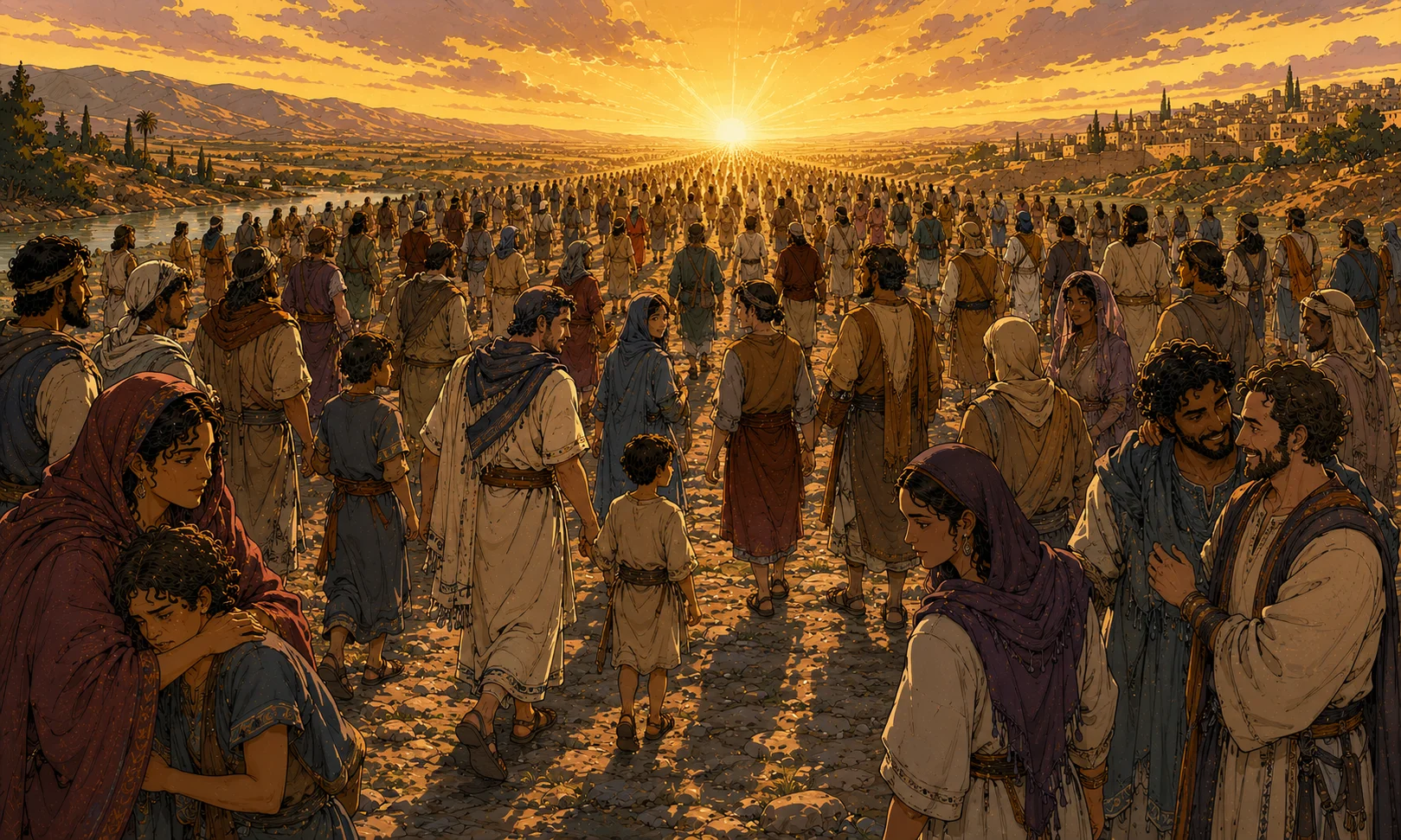
Verse 10 sits in the section of the song that describes what Yah did for the nation before they entered the land. He found them in a desert (midbar), in a howling waste (tohu yilelei yeshimon). He led them around. He instructed them. He kept them. And the image for "kept them" is the pupil of his eye.
The desert context is deliberate. The generation that came out of Egypt spent forty years in a landscape of pure dependency. There was no food except what Yah provided. No water except what Yah brought from the rock. No direction except the pillar of cloud and fire. In that wilderness — a howling empty waste where any normal nation would have died — Yah kept this nation alive as a man keeps his own vision: as something too precious to lose, too central to let slip, too vital to the whole enterprise to allow even minor harm.
III. Who the Verse Is Speaking To
The verse is speaking to the nation of Israel — the twelve tribes descended from Yaakov. This is not a general statement about humanity. It is a specific statement about a specific covenant people in a specific historical relationship with the Creator.
Deuteronomy is not addressed to the nations. It is Moshe's final address to the children of Israel before they cross the Yarden. The entire book — from the retelling of the journey to the covenant renewal at Moav to the list of blessings and curses (Deuteronomy 28) to the Song of Moshe — is addressed to this specific nation. Chapter 32 verse 10 sits in that address. It is not a verse about all human beings equally. It is a verse about what Yah did for the nation he chose — the nation descended from the twelve sons of Yaakov — in the wilderness period.
This is not a small point. The temptation to universalize the verse — to read it as "Yah loves everyone as the apple of his eye" — is a reading that evacuates its actual content. If everyone is equally the apple of his eye, the image communicates nothing particular about Israel. But the verse is embedded in a song that is specifically and deliberately about the covenant relationship between Yah and Israel. The particular meaning is the point.
IV. Why This Language Was Chosen
The image of the pupil — ishon — is used elsewhere in the Hebrew scriptures in the context of protection. Psalm 17:8 uses it: "Keep me as the apple of the eye, hide me under the shadow of your wings." Proverbs 7:2 uses it: "Keep my commandments and live, and my Torah as the apple of your eye."
The common thread across these uses is the urgency and intimacy of protection. The pupil is not kept safe because it is important in the abstract. It is kept safe because it is necessary to function, necessary to navigate, necessary to see where you are going. Harm to the pupil is not a peripheral injury — it strikes at orientation itself.
Yah chose this image for his relationship to Israel because the relationship is not peripheral. It is the axis around which the rest of the biblical narrative turns. The rescue from Egypt, the giving of the Torah at Sinai, the inheritance of the land, the scattering in judgment, the promise of the ingathering — all of this is organized around this one nation and its covenant with its Creator. The pupil image captures the centrality and the intimacy simultaneously: this is the point around which everything else is organized, and it is the point that cannot be touched without striking at the whole.
V. The Apple and the Diaspora — Zechariah 2:8
The most direct statement about what the pupil-image means in practice comes not in Deuteronomy but in Zechariah. Zechariah 2:8 reads:
"For thus says Yah of hosts: After glory he has sent me to the nations which plundered you — for whoever touches you touches the apple of his eye." — Zechariah 2:8
The context of Zechariah 2 is the return from Babylonian exile and the prophetic vision of the final ingathering of the scattered. Yah sends his messenger to the nations that plundered Israel — and the reason given is the pupil of the eye. Whoever touches you touches the apple of his eye.
The implication is stark. The nations that scattered Israel, that oppressed Israel, that plundered Israel — they touched the pupil of Yah's eye. Not a finger or a limb. The pupil. The point around which everything else is oriented. And Yah sends his messenger to those nations after glory — in the time of his vindication — because of what they did.
Read alongside Deuteronomy 28 — the curses that would come upon Israel for disobedience, including the scattering among all nations — Zechariah 2:8 is not a contradiction. Yah could scatter the nation in judgment through the agency of other nations, and those same nations could still be accountable for how they treated the nation during the scattering. The judge who hands down a sentence is not endorsing every cruelty of the jailer.
VI. What This Demands of the Nation
The image carries weight in both directions. Yah's protection of Israel as his pupil is real and documented in the historical record — Pharaoh's army drowned, Babylon fell, every nation that was used to scatter Israel ultimately passed from dominance. But the pupil image also carries a demand on the nation itself.
If you are the apple of Yah's eye — the point around which his purposes are organized, the nation he chose out of all nations to be a mamlechet kohanim (kingdom of priests, Exodus 19:6), the people he kept alive in the desert when any other outcome was possible — then the standard applied to you is not lower than the standard applied to those who never received the Torah. It is higher.
This is the sharp edge of election. Israel did not receive the covenant because the nation was better than other nations. Deuteronomy 7:7–8 is explicit: "Yah did not set his love on you nor choose you because you were greater in number than any other people — for you were the least of all peoples. But because Yah loved you, and because he would keep the oath which he had sworn to your fathers." The election is not a reward for merit. It is a covenant — with obligations.
Proverbs 7:2 extends the pupil image to the commandments themselves: "Keep my commandments and live, and my Torah as the apple of your eye." If Yah keeps Israel as his pupil, Israel is to keep the Torah as its own pupil — with the same reflex-guarded urgency with which a body protects vision itself. The commandments are not optional decoration on top of the covenant life. They are the pupil of the covenant.
VII. The Call
The image in Deuteronomy 32:10 is not nostalgia. The Song of Moshe was written as a witness — something that would be sung after the scattering and the return, a document of what Yah said before any of it happened. Yah knew the nation would turn away. He wrote the song to be there when they came back.
For a nation scattered among all peoples — a nation that in the fullness of the Deuteronomy 28 curses has been brought to the four corners of the earth, stripped of its identity, renamed, sold, dispersed — the image in verse 10 is not simply a historical memory. It is a statement about what has not changed in the structure of the covenant. The pupil does not stop being the pupil because a hand covered the eye for a season.
The call that comes out of this image is the same one that comes out of the entire Torah: return. Shuv — the Hebrew word for repentance and return, which has its root in the simple physical act of turning around and going back the way you came. Deuteronomy 30:1–4 describes it: even from the ends of the earth, even from the farthest point of the scattering, the return is possible — and Yah says he will gather the scattered from there.
The apple of his eye is not lost. It is being gathered.
Continue the Series
- Who Are the Israelites? The People at the Center of the Entire Bible — the foundational pillar on which this article rests
- Deuteronomy 28: The Curses, the Prophecy, and the Way Back — the full weight of what the scattering meant, and the road home
- Jesus's Last Days: The Prophecies, the Crucifixion, and the Warnings He Gave
- Lost Sheep and Grafted Branches: Who Did Yeshua Come to Save?
✡ Read Deuteronomy 32 in Hebrew
The Song of Moshe — in Hebrew and English side by side, with verse-by-verse navigation.
Read Deuteronomy 32 → Read Zechariah 2 →A Note on Method
The Hebrew philology in this article — the derivation of ishon from ish, the "little man" meaning, the comparison with Psalm 17:8 and Proverbs 7:2 — is drawn from standard Hebrew lexica (BDB, HALOT) and the plain reading of the text. The claim about Old English æppel referring to the pupil as well as the fruit is standard historical linguistics. The theological argument about election and its obligations is drawn from the plain reading of Deuteronomy 7:7–8 and Deuteronomy 30. All verses cited are from the King James Version unless otherwise noted, cross-referenced against the Hebrew text.