
"But he was wounded for our transgressions; he was bruised for our iniquities: the chastisement of our peace was upon him; and with his stripes we are healed."
Isaiah wrote these words approximately 700 years before the crucifixion. Psalm 22 was written by Dawid, perhaps 1,000 years before. Daniel's prophecy of the cutting off of the Anointed One was set down in Babylon, roughly 570 years before it happened. None of these texts were written after the fact. They were written before it, and they name it with precision that has no natural explanation.
I. The Prophecies That Named What Would Happen
The death of Yeshua is the most prophesied event in the Hebrew scriptures. Not prophesied in vague, retrospectively-malleable terms — but with specific, independently verifiable details that could only be confirmed after the fact.
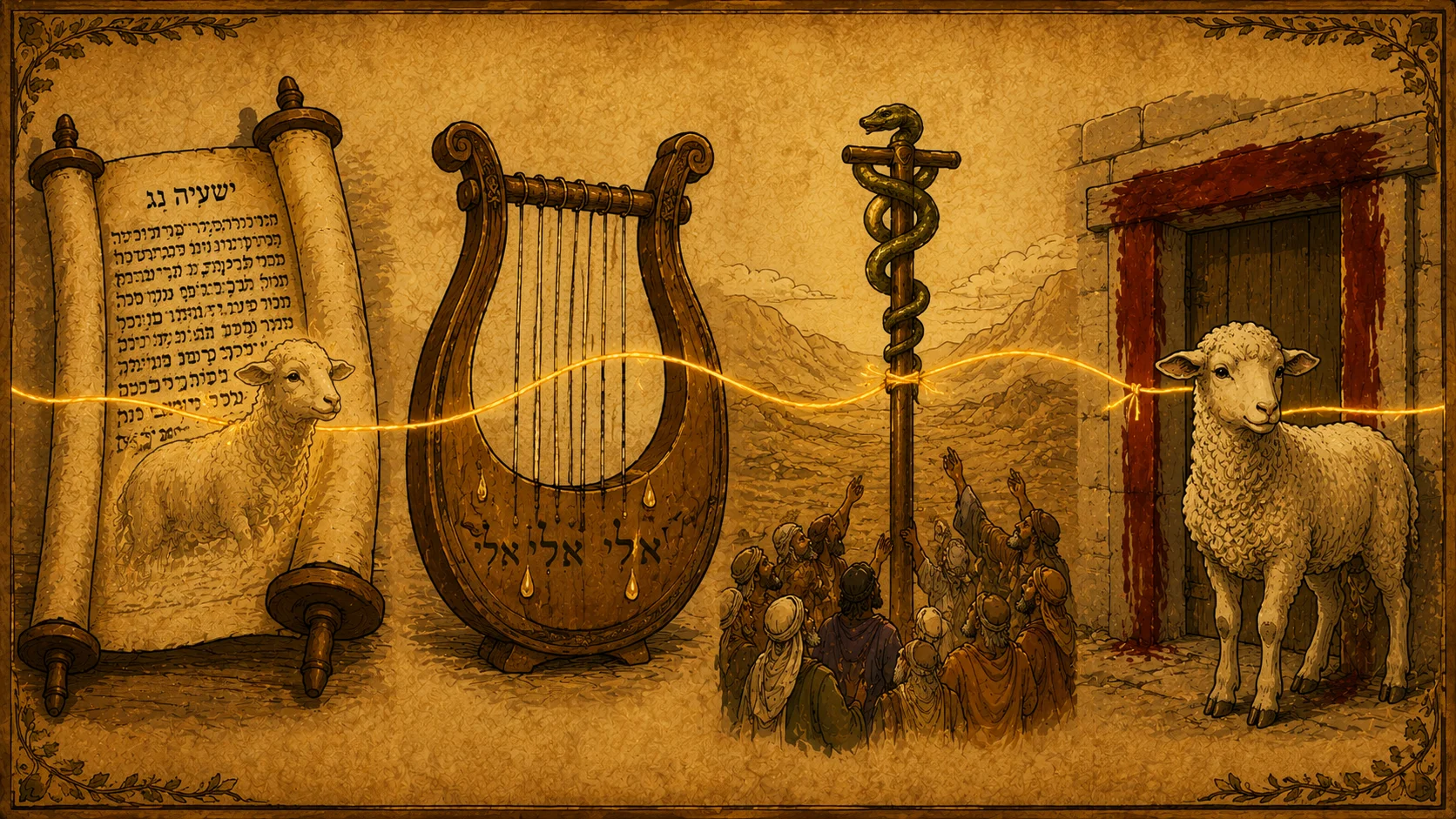
Isaiah 53 is the defining text. Written by the prophet Yeshayahu (Isaiah) around 700 BCE, during the reign of Hezekiah, it describes the suffering servant: despised and rejected, a man of sorrows, bearing the nation's griefs, wounded for transgressions, bruised for iniquities, led as a lamb to slaughter, making his grave with the wicked and with the rich in his death. The prophecy was written in Hebrew and preserved in the Dead Sea Scrolls — physically verified copies that predate the crucifixion. The Isaiah Scroll (1QIsa^a), found at Qumran in 1947, dates to approximately 125 BCE — more than a century before Yeshua's birth. Isaiah 53 is in it, unchanged.
Psalm 22 is Dawid's psalm that begins "My El, my El, why have you forsaken me?" — the exact words Yeshua cried from the cross in Hebrew: "Eli, Eli, lama sabachthani" (Matthew 27:46). Psalm 22 describes in detail: the mockers who say "he trusted in Yah, let him deliver him" (verse 8), the bones out of joint (verse 14), the heart melted like wax (verse 14), the parching of the throat (verse 15), the piercing of hands and feet (verse 16), the garments divided by lot among those present (verse 18). Roman crucifixion was not invented until after Dawid wrote this psalm. The casting of lots for the garment is recorded in all four Gospels (Matthew 27:35, Mark 15:24, Luke 23:34, John 19:24). John specifically notes the detail as fulfillment of scripture.
Zechariah 12:10 is the prophetic text that describes the response of the house of David and the inhabitants of Yerushalayim when they see "the one whom they have pierced": "they shall look upon me whom they have pierced, and they shall mourn for him, as one mourns for an only son." Zechariah wrote this around 520 BCE.
Daniel 9:26 is the most precise of all: "And after the sixty-two weeks, Mashiach (the Anointed One) shall be cut off, but not for himself." The seventy-weeks prophecy of Daniel 9 gives a timeline from the decree to restore and rebuild Yerushalayim to the cutting off of the Anointed One. The decree of Artaxerxes to Nehemiah is dated to 444 BCE. The calculation points to the Passover week of approximately 30 CE. Daniel's prophecy was written in Babylon, around 536 BCE — nearly 600 years before the crucifixion.
II. The Trial and the Cross
The historical sequence of Yeshua's last days is recorded in all four Gospels with remarkable agreement on the main events, and remarkable specificity of detail.
The week begins with the triumphal entry into Yerushalayim — Yeshua entering the city on a young donkey, fulfilling Zechariah 9:9: "Behold, your king is coming to you, lowly and riding on a donkey." He enters as a Passover pilgrim, teaches in the Temple courts, and on Wednesday night reclines at table with his disciples for the Passover seder.
The Passover meal is the last supper of the Gospels. Yeshua uses the bread and the cup — already established elements of the Passover seder — to speak about what is about to happen to his body and his blood. "This cup is the new covenant in my blood, which is poured out for you" (Luke 22:20). He is reframing the seder in terms of himself as the Passover lamb. The Passover lamb's blood protected the houses of Israel on the night of the first Passover (Exodus 12). He is claiming his blood does the same work — covenantally, for the nation he came to.
After the meal, he goes to Gat Shmanim (Gethsemane) on the Mount of Olives. He is arrested there by a crowd from the chief priests and elders, led there by Yehudah (Judas), one of the twelve. The arrest happens at night — Passover eve, by the Hebrew calendar.
The trial before Pilatus (Pilate) is the pivot. Pilate finds no fault in him (John 18:38, 19:4, 19:6). He offers to release one prisoner at Passover — as was the custom — and the crowd chooses Bar-Abba (Barabbas). Pilate washes his hands. The crowd cries "His blood be on us and on our children" (Matthew 27:25). Yeshua is flogged and handed over to be crucified.
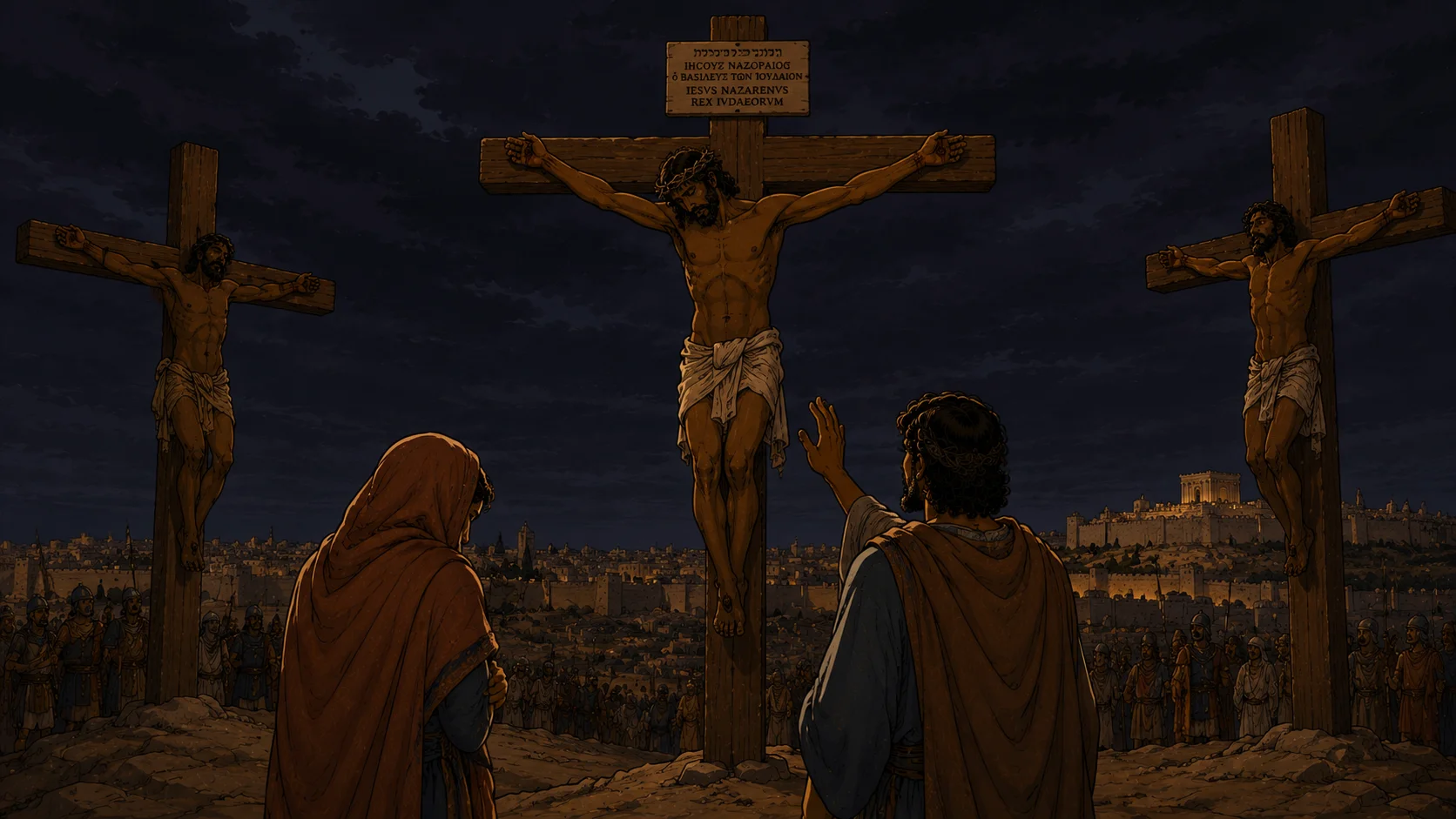
He is taken to Golgotha — Gulgolta in Aramaic, the Place of the Skull. He is crucified between two criminals. The placard above his head reads in Hebrew, Greek, and Latin: Yeshua of Nazareth, King of the Jews — Yeshua Ha-Notzri Melech Ha-Yehudim, YHNH in Hebrew initials. It is the third hour (9 AM) when they crucify him.
At the sixth hour (noon), darkness covers the land until the ninth hour (3 PM). At the ninth hour, Yeshua cries from Psalm 22: "Eli, Eli, lama sabachthani." He is offered sour wine on a hyssop branch — hyssop, the same plant used to apply the Passover blood in Egypt (Exodus 12:22). He says: "It is finished." He bows his head and gives up his spirit.
III. What the Signs Said
At the moment of his death, three things happen simultaneously: the veil of the Temple tears from top to bottom, the earth quakes, and rocks split. The tombs of many saints who had fallen asleep are opened (Matthew 27:51–53).
The tearing of the Temple veil is not a minor detail. The veil separated the outer courts of the Temple from the Holy of Holies — the innermost chamber where Yah's presence was said to dwell, into which only the High Priest entered, once a year on Yom Kippur. The veil tore from top to bottom — not from the bottom up, as a man would tear it, but from top down, indicating the action is initiated from above.
What the sign communicates is that the mediating structure of the Temple priesthood — which had become corrupt under the Herodian appointment system that purchased the High Priesthood from Rome — is now rent. The access that the veil regulated is now direct. The sacrifice is made. The atonement is complete. The barrier is torn.
The earthquake and the opened tombs are signs given specifically to Yerushalayim — witnessed by the city that had cried "His blood be on us and on our children." The Roman centurion watching at Golgotha says: "Truly this was the Son of God" (Matthew 27:54). The soldiers who came to break the legs of the crucified, to hasten their deaths before the Sabbath, find Yeshua already dead — and instead pierce his side with a spear (John 19:32–34). Not a bone is broken. This fulfills the Passover lamb requirement explicitly: "Not one of his bones shall be broken" (John 19:36, citing Exodus 12:46 and Psalm 34:20).
He is buried in the tomb of Yosef of Arimathea — a rich man. He made his grave with the rich in his death (Isaiah 53:9).
IV. The Warnings He Gave — Matthew 23 and Luke 21
During the final week, before his arrest, Yeshua speaks two extended warnings that are specific enough to be confirmed by history.
The first is in Matthew 23, the denunciation of the scribes and Pharisees. It ends with: "Therefore I send you prophets, wise men, and scribes, some of whom you will kill and crucify... so that on you may come all the righteous blood shed on earth, from the blood of righteous Abel to the blood of Zechariah the son of Barachiah... Truly, I say to you, all these things will come upon this generation."
Then the famous lament: "O Yerushalayim, Yerushalayim, the city that kills the prophets and stones those who are sent to it! How often would I have gathered your children together as a hen gathers her brood under her wings, and you were not willing! See, your house is left to you desolate." (Matthew 23:37–38)
The second warning is in Luke 21 (and its parallel in Matthew 24). The disciples point to the Temple stones. Yeshua says: "As for these things that you see, the days will come when there will not be left here one stone upon another that will not be thrown down."
V. What He Said About 70 CE
Luke 21:20–24 is the clearest of the three synoptic accounts. The others in Matthew 24 and Mark 13 contain language with dual reference — both to 70 CE and to the end of the age. Luke's version is the most historically specific:
"But when you see Yerushalayim surrounded by armies, then know that its desolation has come near. Then let those who are in Yehudah flee to the mountains, and let those who are inside the city depart, and let not those who are out in the country enter it, for these are days of vengeance, to fulfill all that is written. Alas for women who are pregnant and for those who are nursing infants in those days! For there will be great distress upon the earth and wrath against this people. They will fall by the edge of the sword and be led captive among all nations, and Yerushalayim will be trampled underfoot by the Gentiles, until the times of the Gentiles are fulfilled." — Luke 21:20–24
The historical record confirms every detail. In 66 CE, the Great Revolt against Rome began. In 70 CE, the Roman general Titus (son of Emperor Vespasian) laid siege to Yerushalayim with four legions. The historian Yosef ben Mattityahu (Josephus), an eyewitness and participant, estimates that 1.1 million Yehudim died in the siege and its aftermath, and 97,000 were taken captive. The Temple was burned to the ground on the ninth of Av. When the site was cleared, not one stone of the Temple complex was left standing on another — the stones were thrown down to reach the gold that had melted between them in the fire.
The Christian community in Yerushalayim, according to the Church historian Eusebius, fled to the city of Pella in the Decapolis before the siege — fulfilling the warning to "flee to the mountains." The ones who heeded the warning left. The ones who did not were inside the city when the legions closed around it.
Yeshua gave this warning with enough specificity that it could be acted on, and with enough lead time (40 years from 30 CE to 70 CE) for those who received it to act. The warning was not opaque. It was precise.
VI. What This Means
The last days of Yeshua are not just the most documented week in ancient history. They are the event around which the entire Hebrew prophetic tradition pointed. Isaiah 53 is the suffering servant who bears the iniquities of many. Daniel 9 is the Anointed One cut off after sixty-two weeks. Psalm 22 is the righteous one forsaken in his hour of extremity who is vindicated by Yah. Zechariah 12 is the pierced one whom the nation will one day look upon and mourn.
These are Israelite prophecies about an Israelite Messiah, fulfilled in an Israelite context, watched by Israelite witnesses, and interpreted by the apostles through the Israelite scriptures. The event does not belong to a religion called Christianity that detached itself from its Israelite root. It happened in Yerushalayim. It happened at Passover — the appointed time when Yah first showed his power over death for the sake of Israel in Egypt. It happened to a man from the tribe of Yehudah, of the line of Dawid, who said he was sent specifically to the lost sheep of the house of Israel.
What it means is a question each person must reckon with directly. But the record of what happened — what was prophesied, what was witnessed, what was signed in the tearing of the veil and the opening of the tombs and the 40-year warning before the fall of the Temple — that record is available to read.
Continue the Series
- Deuteronomy 28: The Curses, the Prophecy, and the Way Back — the covenant judgments that preceded and followed the crucifixion
- Lost Sheep and Grafted Branches: Who Did Yeshua Come to Save? — Yeshua's own words about his mission
- John 3:16 Explained — what Yah so loved the world actually means in the Israelite covenantal context
- Who Are the Israelites? — the people these prophecies were written to
✡ Read Isaiah 53 in Hebrew
The suffering servant prophecy — written 700 years before the crucifixion — in Hebrew and English at hebroni.com.
Read Isaiah 53 → Read Psalm 22 →A Note on Method
The dates and historical context in this article — the Isaiah Scroll (1QIsa^a) at Qumran, the Daniel 9 calculation, the account of Josephus on the siege of 70 CE, the Eusebius account of the Pella flight — are drawn from standard historical sources that are publicly available. The Gospel quotations are from the King James Version cross-referenced against the Greek New Testament. The claim that the prophecies were written before the event is verified by the manuscript evidence: the Dead Sea Scrolls predate the first century CE and contain the prophetic texts cited. This article does not treat the Gospels as infallible in historical detail but does treat them as primary source documents of the first century, to be compared with other primary source documents of the same period.