"I was not sent except to the lost sheep of the house of Israel." — Matthew 15:24
Yeshua said this himself, in response to a Canaanite woman seeking healing for her daughter. It is one of the most direct statements about the purpose of his mission in all four Gospels. And it is one of the most rarely taught.
This article takes the verse seriously. It asks who the lost sheep of the house of Israel are, what it means that they are lost, and then how Romans 11 completes the picture — showing how the nations who are not of Israel can be grafted in, and what being grafted in actually means.
I. The Mission Statement — Matthew 15:24
Matthew 15:24 is not an isolated statement. It is consistent with everything else Yeshua says about his mission in the synoptic Gospels.
In Matthew 10:5–6, when he sends out the twelve disciples on their first mission, his instructions are explicit: "Do not go into the way of the Gentiles, and do not enter a city of the Samaritans. But go rather to the lost sheep of the house of Israel." This is a direct command. Not a suggestion or a contextual preference — a command that defines the scope of the first mission.
In Matthew 15:24, the Canaanite woman asks him to heal her daughter. He answers: "I was not sent except to the lost sheep of the house of Israel." When she persists, he eventually heals her daughter — and commends her faith. But his initial statement about his mission is not retracted. The exception of her faith does not redefine the rule.
In Luke 19:10, he says: "For the Son of Man came to seek and to save what was lost." Read alongside Matthew 15:24, what was lost has a specific referent: the lost sheep of the house of Israel.
Paul, writing in Romans 15:8, confirms this reading: "For I say that Yeshua the Messiah became a servant to the circumcised on behalf of the truth of Yah, to confirm the promises given to the fathers." The promises given to the fathers — to Avraham, Yitzchak, and Yaakov — were promises to Israel. Yeshua came to confirm them.
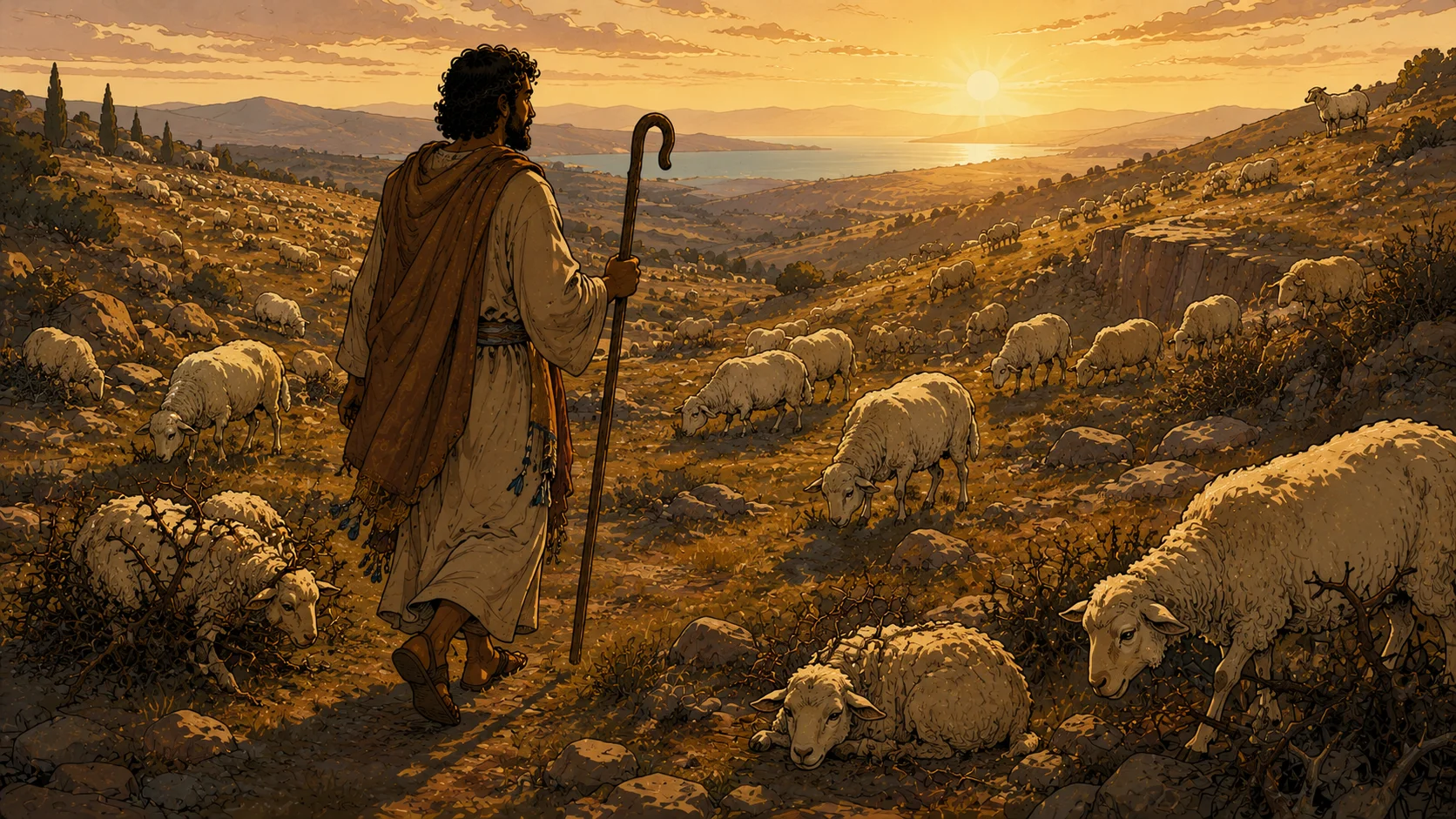
II. Who Are the Lost Sheep of the House of Israel?
The phrase house of Israel has a specific meaning in the Hebrew scriptures. It refers to the twelve-tribe nation descended from the twelve sons of Yaakov — the covenant people of the Torah. By the time of Yeshua's ministry, the situation of this nation was complex in ways that are rarely explained.
In 722 BCE, the Assyrian Empire conquered the northern kingdom of Israel — the ten tribes that had split from the southern kingdom (Yehudah and Binyamin) at the division of the kingdom after Shlomo. These ten tribes — the house of Israel proper — were carried into Assyrian captivity and dispersed. They did not return as a recognizable national body. They were the scattered tribes, the lost sheep, who had lost their national identity, their Torah practice, and in many cases their awareness of who they were.
The prophet Hosea, writing to the northern kingdom, described their condition in terms that Yeshua's language directly echoes: "You are not my people" (Hosea 1:9). But the same prophecy includes the restoration promise: "In the place where it was said to them, 'You are not my people,' it shall be said to them, 'Sons of the living El'" (Hosea 1:10). The dispersed tribes who lost their identity — the scattered, the lost — are the ones to whom the restoration promise applies.
Yehezkel (Ezekiel 34) is the most extended use of the shepherd-and-lost-sheep image in the Hebrew prophets. Yah speaks directly: "I myself will search for my sheep and seek them out... I will seek the lost and bring back the strayed." (Ezekiel 34:11, 16). This is Yah's own declaration that he will do the searching. The Good Shepherd language of John 10 draws directly on Ezekiel 34.
The lost sheep of the house of Israel are therefore not a theological abstraction. They are a specific historical reality: the scattered tribes of the ten-tribe northern kingdom and their descendants, dispersed among the nations, their identity submerged, but not erased from Yah's covenant memory.
III. What "Lost" Actually Means
The Greek word for lost in Matthew 15:24 is apolōlos — the same word used in the parable of the lost sheep (Luke 15:4–6), the lost coin (Luke 15:8–10), and the lost son (Luke 15:11–32). The word does not mean destroyed or ceased to exist. It means missing from where it belongs — lost to the one who owns it, separated from the flock.
This is the key. Lost does not mean gone. The lost sheep is still a sheep. The lost coin is still a coin. The lost son is still a son. The condition of being lost is a condition of location and identity, not of nature. The sheep is outside the fold. The coin is under the dust. The son is in the far country eating pig food. None of them have stopped being what they are. They have been separated from the context that would make that identity legible and functional.
For the scattered tribes of Israel, this is the precise description. Dispersed into nations, their Israelite identity submerged under slave names, colonial languages, and the forcible erasure of the Deuteronomy 28 exile — they are still the people they were. The covenant does not depend on their awareness of it. Yah does not forget the covenant because the covenant people were stripped of the memory of it.
Deuteronomy 30:1–4 describes the return: "And it shall come to pass, when all these things have come upon you, the blessing and the curse which I have set before you, and you call them to mind among all the nations to which Yah your God has driven you, and return to Yah your God... then Yah your God will restore your fortunes and have mercy on you, and he will gather you again from all the peoples where Yah your God has scattered you."
The gathering begins with memory. When you call to mind. When the scattered begin to remember who they are — and return to the Torah that belongs to them.
IV. The Grafting In — Romans 11
Romans 11 is Paul's extended treatment of what happens when the good news goes to the nations. It is the most detailed explanation of how someone who is not of natural Israel enters into the covenant community — and the metaphor Paul uses is specific and unambiguous: grafting.
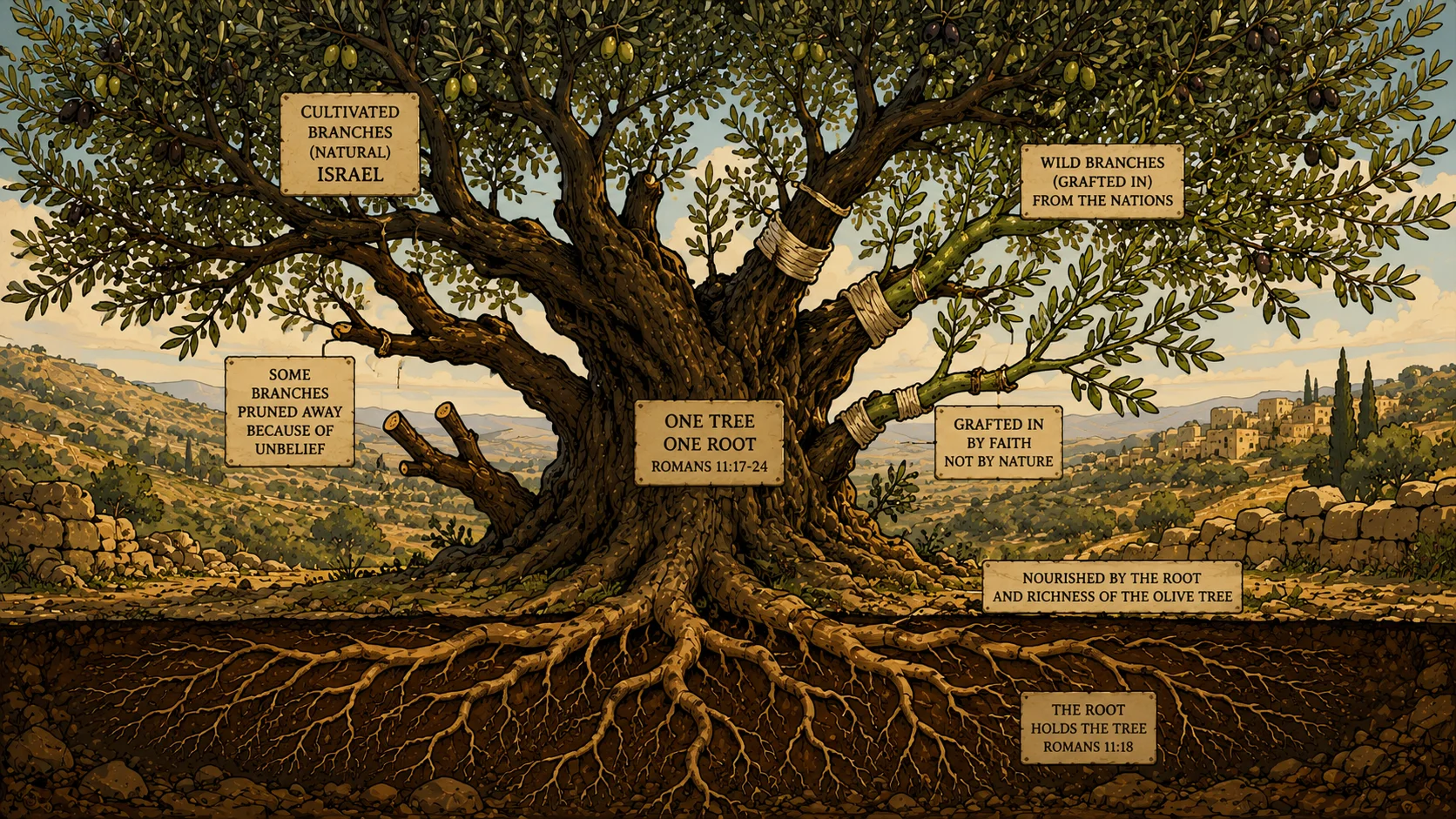
"But if some of the branches were broken off, and you, although a wild olive shoot, were grafted in among the others and now share in the nourishing root of the olive tree, do not be arrogant toward the branches." — Romans 11:17–18
The olive tree in the metaphor is Israel. The root is Avraham, Yitzchak, and Yaakov — the patriarchal covenant from which the tree grows. The natural branches are the physical descendants of Yaakov. Some natural branches — those Israelites who did not receive Yeshua as Messiah — have been broken off from the cultivated tree. The wild olive shoot — the nations, the Gentiles — are grafted into this same tree.
Paul is explicit about the direction of the process: "you were grafted in among the others and now share in the nourishing root of the olive tree." The wild shoot does not become a new tree. It does not replace the old tree. It is grafted into the existing tree, at the existing root, drawing nourishment from the same root that sustained Israel from the beginning.
V. What Grafting Into the Olive Tree Means
The grafting metaphor carries several implications that are rarely drawn out.
The tree determines the branch, not the other way around. When a wild shoot is grafted into a cultivated tree, the shoot takes on the character of the cultivated tree. The fruit that grows from the graft is the fruit of the cultivated tree, not of the wild rootstock. In Paul's metaphor, this means that when a person from the nations is grafted into the olive tree of Israel, they share in the Israelite covenant — they are not Israel by blood, but they are connected to the same root, drawing from the same covenant nourishment.
The root supports the graft — not the reverse. Romans 11:18 is explicit: "do not be arrogant toward the branches. If you are arrogant, remember it is not you who support the root, but the root that supports you." The direction of support is unambiguous. The graft does not sustain the tree. The tree sustains the graft. For people from the nations who have entered the covenant through Yeshua, the covenantal root — the Torah, the prophets, the promises to Avraham, the covenant at Sinai — is what supports them. Not the other way around.
The broken-off branches can be re-grafted. Romans 11:23–24 addresses the natural branches that were broken off: "And even they, if they do not continue in their unbelief, will be grafted back in, for Yah has the power to graft them in again." The covenant relationship is not permanently severed by the rejection of Yeshua. The natural branches — the physical descendants of Yaakov who currently do not receive Yeshua — can be grafted back in. Their grafting back in, says Paul, will be like "life from the dead" (Romans 11:15).
The nations enter Israel's covenant — they do not create a new covenant. This is perhaps the most radical implication of the metaphor, and the one most completely erased by later Christian theology. When a person from the nations is grafted into the olive tree, they do not enter a new religion called Christianity. They enter the Israelite covenant community — the community gathered around the Torah, the prophets, and the Messiah of Israel. They observe the Sabbath. They keep the appointed times. They live by the commandments. They are fellow citizens with the saints and members of the household of God (Ephesians 2:19) — a household that is the house of Israel.
VI. The Return of Both
Isaiah 56 is the prophetic passage that Paul's Romans 11 draws from — the gathering of both the scattered Israelites and the nations into the covenant community of Israel:
"Also the sons of the foreigner who join themselves to Yah, to serve him, and to love the name of Yah, to be his servants — everyone who keeps the Sabbath, and does not profane it, and holds fast to my covenant — even them I will bring to my holy mountain, and make them joyful in my house of prayer." — Isaiah 56:6–7
The conditions for the foreigner are specific: joining themselves to Yah, serving him, loving his name, keeping the Sabbath, holding fast to the covenant. The same conditions that apply to Israel. The foreigner who comes in on these terms is gathered to the same holy mountain, the same house of prayer. Not a separate house. The same one.
The picture that emerges from Matthew 15:24, Romans 11, and Isaiah 56 together is not the one that most modern Christianity presents. It is not a picture of Yeshua coming to start a new religion for all humanity. It is a picture of Yeshua coming first to find the lost sheep of the house of Israel — the scattered, identity-stripped descendants of the twelve tribes — and restore them to the covenant. And alongside that restoration, and because of it, the nations who choose to join themselves to Yah enter the same covenant community, grafted into Israel's own tree, at Israel's own root.
The lost sheep are found. The wild branches are grafted in. And both are gathered to the same mountain.
Continue the Series
- Who Are the Israelites? The People at the Center of the Entire Bible — who the lost sheep are, in full detail
- Jesus's Last Days: The Prophecies, the Crucifixion, and the Warnings He Gave — the death that the mission was accomplished through
- John 3:16 Explained — the most-cited verse, in its Israelite covenantal context
- Deuteronomy 28: The Curses, the Prophecy, and the Way Back — the exile and the road home
✡ Read Romans 11 in English
The grafting passage — Paul's fullest treatment of how the nations enter Israel's covenant — and the tree image that explains it.
Read Romans 11 → Read Isaiah 56 →A Note on Method
The interpretive framework in this article — that the lost sheep of Matthew 15:24 refers to the scattered ten tribes, and that Romans 11's olive tree is Israel — is not a novel interpretation. It is the plain reading of the texts cited, set in the context of the Hebrew prophetic tradition (Hosea 1, Ezekiel 34, Isaiah 56) from which Paul explicitly draws. The article does not claim that people from the nations cannot enter the covenant community — Romans 11 explicitly says they can and describes how. It claims that the process is grafting into Israel's covenant, not the creation of a separate religion. The theological implications of this reading — for Sabbath-keeping, for the Hebrew calendar, for the commandments — are left for the reader to draw. The task of this article is to present the textual evidence, not to mandate conclusions.