"For God so loved the world, that he gave his only begotten Son, that whosoever believes in him should not perish, but have everlasting life." — John 3:16
It is the most-quoted verse in the New Testament. It appears on signs at football games, on church marquees, on bumper stickers, on the cover of pocket Bibles handed out on street corners. For many Christians and former Christians and not-Christians alike, it is the verse — the gospel-in-a-sentence, the single line that summarizes everything the New Testament has to say.
And yet most of the people who quote it have never read the conversation it sits inside. They do not know who Yeshua was speaking to, what the rest of the passage actually says, or what specific Hebrew imagery he was drawing from in the verse just before it. The verse has been pulled out of its own paragraph so thoroughly that the paragraph has become invisible. And when you put John 3:16 back into John 3, the verse reads in a way that is fuller, richer, and significantly more specific than the popular version suggests.
This article reads John 3:16 in its own context. The verse is real. The promise is real. The whosoever-believes is real. But the verse does not say what it has often been used to say — and what it actually says is better.
I. The Setting — Who Was Yeshua Talking To?
The first thing the popular reading misses is the conversation the verse sits inside. John 3:16 is not a free-floating universal statement. It is the climax of a specific dialogue between Yeshua and a specific man, on a specific night, in a specific city, about a specific subject. Let me reset it.
The Gospel of John, chapter 3, opens like this:
"There was a man of the Pharisees, named Nikodemos, a ruler of the Yehudim: the same came to Yeshua by night, and said unto him, Rabbi, we know that you are a teacher come from God: for no man can do these miracles that you do, except God be with him." — John 3:1–2
Yeshua's conversation partner is Nikodemos — a leading Pharisee, a member of the Sanhedrin, a teacher of Israel. He comes to Yeshua at night, addressing him as Rabbi — the Hebrew honorific for teacher — and acknowledges that Yeshua is a teacher come from God. This is a private, learned conversation between two Israelites about Hebrew covenantal categories — before a single word of John 3:16 is spoken. The speaker is an Israelite of the tribe of Yehudah, of the house of David; his audience is a ruler of the Yehudim. The framework is Israelite.
The dialogue that follows uses Hebrew covenantal categories throughout. Yeshua tells Nikodemos that a man must be born again to see the kingdom of God (John 3:3). Nikodemos asks how a man can be born again when he is old. Yeshua clarifies:
"Except a man be born of water and of the Spirit, he cannot enter into the kingdom of God." — John 3:5
This born of water and of the Spirit is not generic religious language. It echoes Ezekiel 36:25–27, where Yah promises Israel through the prophet: "Then will I sprinkle clean water upon you, and you shall be clean... A new heart also will I give you, and a new spirit will I put within you... and I will put my Spirit within you, and cause you to walk in my statutes." Yeshua is invoking the Hebrew prophet's promise of Israel's covenantal renewal — clean water, new heart, new Spirit. He even says so explicitly:
"Are you a master of Israel, and know not these things?" — John 3:10
The whole conversation is between two Hebrew teachers about Hebrew covenantal categories. It is not abstract Western theology; it is a midnight teaching dialogue between a Pharisee of the Sanhedrin and the rabbi from Galilee whose miracles he has witnessed.
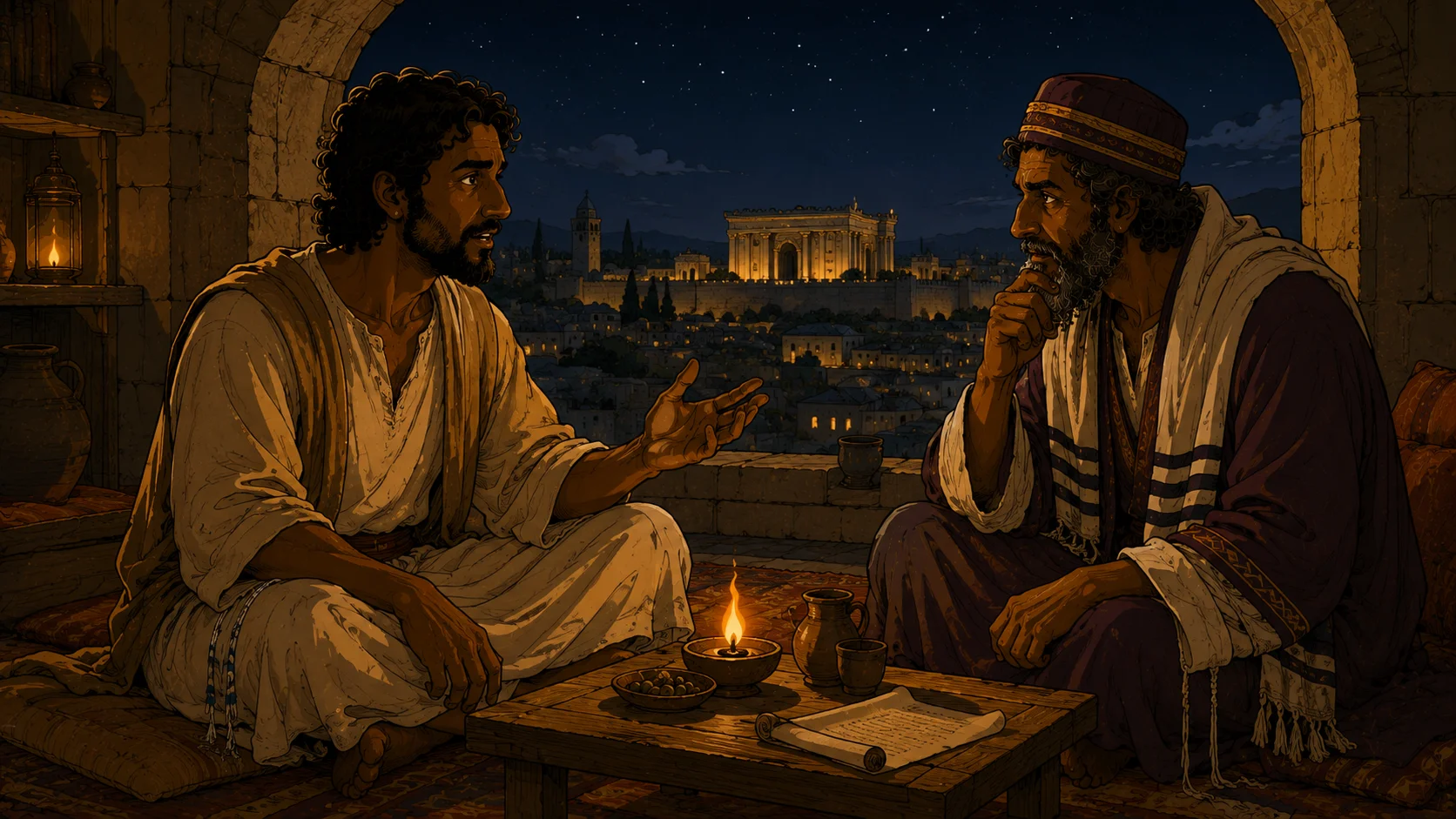
Yeshua and Nikodemos · a private midnight teaching dialogue between two Hebrew teachers · John 3:1–21
II. The Verse Right Before — The Bronze Serpent
The verse immediately before John 3:16 is where the popular reading most often loses the thread. John 3:14:
"And as Moshe lifted up the serpent in the wilderness, even so must the Son of Man be lifted up: that whosoever believes in him should not perish, but have eternal life." — John 3:14–15
This references Numbers 21:4–9 — the bronze serpent of the wilderness. In that passage, the people of Israel speak against Yah and against Moshe in the wilderness. Yah sends fiery serpents among the people; many are bitten and die. The people repent. Yah tells Moshe to make a serpent of bronze and set it on a pole; everyone who has been bitten and looks at the bronze serpent lives.
The bronze serpent was not magic; the looking was an act of faith — those who turned their gaze toward what Yah had given were healed. The serpent was later destroyed by King Chizkiyahu (2 Kings 18:4) when the people had begun to worship it as an idol. The story is preserved in Israel's memory as a moment when Yah provided healing-by-looking to a people under judgment in the wilderness.
Yeshua, in John 3:14, applies this story to himself: as Moshe lifted up the serpent in the wilderness — even so must the Son of Man be lifted up. The being lifted up is the cross. But the image is precise: the serpent in the wilderness was given for Israel — for the children of Israel in the wilderness, bitten and dying under judgment, who needed only to look to live.
John 3:16 comes directly after this. It is the explanation of why the Son of Man, like the bronze serpent, would be lifted up. Read the two together, as they were given:
"And as Moshe lifted up the serpent in the wilderness, even so must the Son of Man be lifted up: that whosoever believes in him should not perish, but have eternal life. For God so loved the world, that he gave his only begotten Son, that whosoever believes in him should not perish, but have everlasting life." — John 3:14–16
Verse 16 is not a stand-alone universal statement. It is the why of verse 14. The bronze serpent in the wilderness was given because Yah, in his love for his people under judgment, provided a way to look and live. In the same way — Yeshua is saying — the Son of Man is being lifted up because God loved the world enough to give him. The covenantal love in the wilderness — Yah's faithfulness to a complaining and judged Israel — is the love John 3:16 names, now extended outward through the Son to all who would look.
III. The Word Kosmos — What "World" Actually Means in John
The word translated world in John 3:16 is the Greek kosmos. It is one of John's most frequently used words — more than seventy times across his Gospel, his letters, and Revelation. And its meaning is contextual — it does not mean the same thing every time it appears.
A few of John's uses:
"The light shines in darkness; and the darkness comprehended it not. He was in the world (kosmos), and the world (kosmos) was made by him, and the world (kosmos) knew him not." — John 1:5, 10
Here kosmos means the created order, the inhabited world, the place where the Logos came and was not received.
"If the world (kosmos) hates you, you know that it hated me before it hated you. If you were of the world (kosmos), the world (kosmos) would love its own: but because you are not of the world (kosmos), but I have chosen you out of the world (kosmos), therefore the world (kosmos) hates you." — John 15:18–19
Here kosmos means the fallen world-system that stands against Yah's purposes. And in John 17:9: "I pray not for the world (kosmos), but for them which you have given me" — again, the world that stands outside, distinguished from the disciples Yeshua specifically prays for.
John's kosmos is not a uniform universal-humanity term. It carries different shades depending on context. The most defensible reading of John 3:16's kosmos, in its specific context, is the world of humanity that the gift of the Son reaches outward toward — beginning with Israel and extending to the nations beyond. The verse is not a departure from Yeshua's consistent self-identification as the one sent to the lost sheep of the house of Israel (Matthew 15:24). It is the scope of what the bronze serpent's healing ultimately extends to: from Israel outward. Paul makes the order explicit in Romans 1:16 — "to the Yehudi first, and also to the Greek."
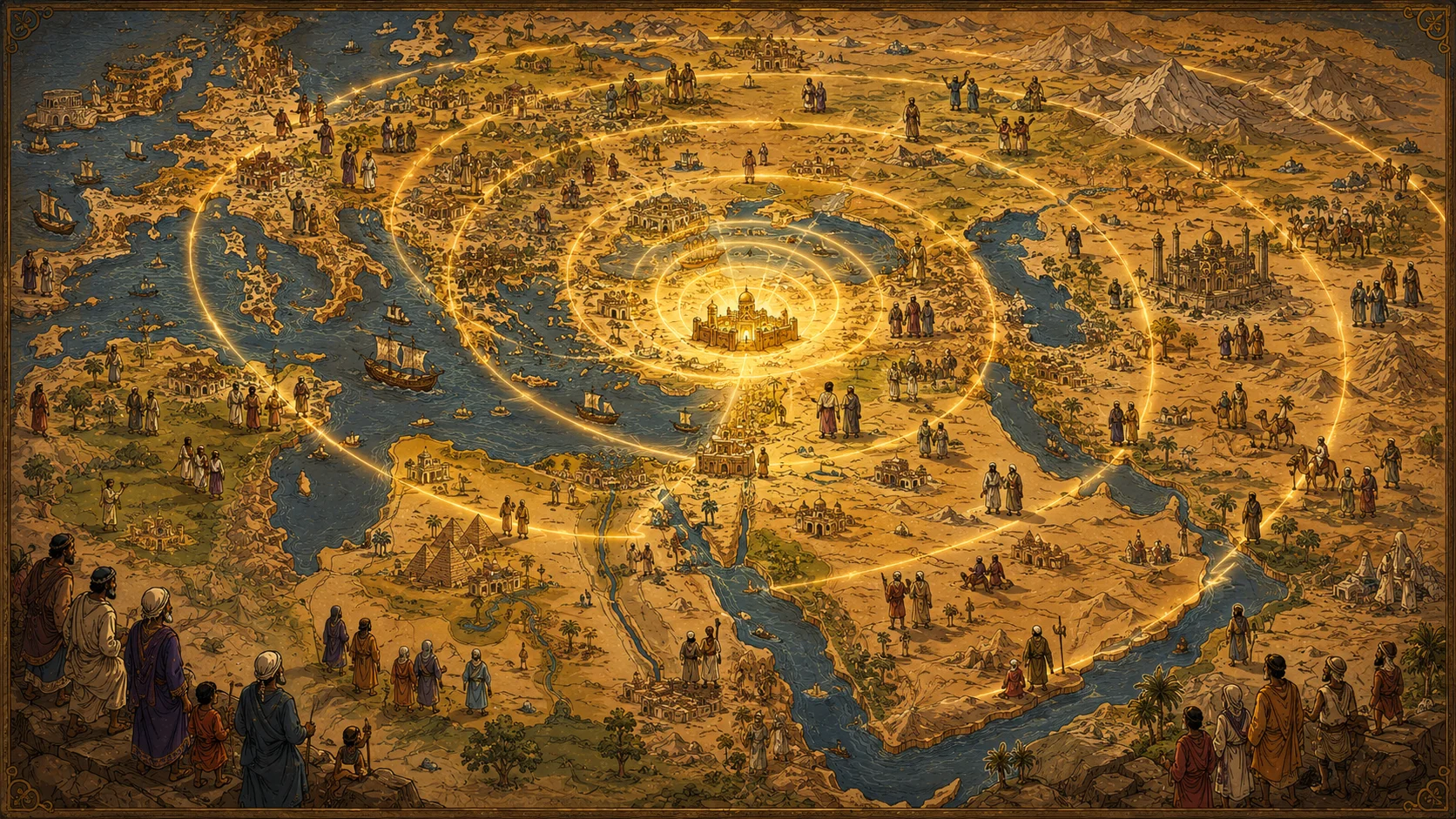
The kosmos of John 3:16 — covenantal love radiating outward from Yerushalayim to all the families of the earth · the light goes out from Israel, not away from it
IV. The Word Monogenes — "Only Begotten"
The phrase translated only begotten Son is the Greek monogenes huios. The word monogenes is a compound of monos (only, single) and genos (kind, sort, family): one of a kind, unique in its category, the only one of its family.
The same word is used in Hebrews 11:17 for Yitzhak — Avraham's monogenes son — even though Avraham also had Yishmael by Hagar before Yitzhak. The point is that Yitzhak was the unique covenant son, the only son of the promise — not merely the only son biologically. Monogenes is unique-in-his-role, not just only-born.
When John 3:16 calls Yeshua the monogenes Son, the meaning is: the unique Son, the one-of-a-kind Son, the Son in a category by himself. Not one teacher among many. Not one prophet among the prophets. The gift Yah gives in John 3:16 is not a general gift; it is the gift of the unique Son — and the whosoever believes in him is the response to that specific, unrepeatable, singular giving.
V. The Verse Right After — What Yeshua Said Next
The popular reading of John 3:16 almost always stops at verse 16. But Yeshua's teaching to Nikodemos continues, and the verses that follow are essential context for what verse 16 actually means.
"For God sent not his Son into the world (kosmos) to condemn the world (kosmos); but that the world (kosmos) through him might be saved. He that believes on him is not condemned: but he that believes not is condemned already, because he has not believed in the name of the only begotten Son of God." — John 3:17–18
Verse 17 deepens verse 16: God sent not his Son into the world to condemn the world. The purpose is salvation, not judgment — consistent with the wilderness serpent, which was given for healing, for those who would look. But verse 18 introduces the response dimension: those who believe are not condemned; those who do not believe are condemned already. The salvation is genuinely offered — and the response of belief is what receives it.
And verses 19–21 sharpen further:
"And this is the condemnation, that light is come into the world (kosmos), and men loved darkness rather than light, because their deeds were evil. For every one that does evil hates the light, neither comes to the light, lest his deeds should be reproved. But he that does truth comes to the light, that his deeds may be made manifest, that they are wrought in God." — John 3:19–21
The passage closes with a moral dimension to belief. Those who do evil hate the light. Those who do truth come to the light. In John's framework, belief is not merely intellectual assent — it is moral response, coming into the light, walking in truth, having one's deeds made manifest as wrought in God. This is the whole context John 3:16 sits inside.
VI. Harmony with the Rest of John
John 4:22 — Yeshua to the Samaritan woman at the well: "You worship you know not what: we know what we worship: for salvation is of the Yehudim." The salvation that comes through Yeshua is of the Yehudim — it comes from Israel, through Israel's covenantal story, to the world. Same framework as John 3:16 read carefully.
John 10:14–16 — Yeshua as the Good Shepherd: "I am the good shepherd, and know my sheep, and am known of mine... And other sheep I have, which are not of this fold: them also I must bring, and they shall hear my voice; and there shall be one flock, and one shepherd." The other sheep — broader than the immediate Yehudim — are still his sheep. The gathering is real, but into one flock, one shepherd.
John 11:51–52 — Caiaphas's unintended prophecy: "He prophesied that Yeshua should die for that nation; and not for that nation only, but that also he should gather together in one the children of God that were scattered abroad." The death is for that nation (the Yehudim) and for the scattered children of God in the broader world. The gathering brings them into one — into the same Israel-centered framework.
The whole Gospel of John works inside this framework. John 3:16 sits comfortably inside it. It does not float free of it.
VII. What the Verse Actually Says, Reread
So what does John 3:16 actually say, read in its own context?
"For God so loved the world, that he gave his only begotten Son, that whosoever believes in him should not perish, but have everlasting life." — John 3:16
"For God so loved the world" — Yah, the God of Israel, the Father of Yeshua, in continuity with the covenant he made with Avraham — loved the world of humanity, broader than Israel alone, broad enough to encompass the nations Avraham was promised would be blessed through his seed (Genesis 12:3).
"that he gave his only begotten Son" — that he gave his unique, one-of-a-kind Son — the Son of Man who would be lifted up like Moshe lifted the bronze serpent — the Messiah of Israel sent to gather the lost sheep and to extend his gathering to the nations who would believe.
"that whosoever believes in him" — that any person who looks to the lifted-up Son and trusts in him — whether of the surviving southern house, of the scattered lost sheep, or of the nations grafted in — in the same way that any wilderness Israelite who looked at the bronze serpent received healing.
"should not perish, but have everlasting life" — will not remain in the condemnation that sin produces, but will receive the eternal life of the kingdom of God — born again of water and the Spirit, brought into the covenant family.
That is the verse in its actual paragraph, in its actual conversation, in the framework of Yeshua's actual mission. The whosoever believes remains. The love of God remains. The eternal life remains. What is added back is the Hebrew anchor — the wilderness serpent, the covenantal framework, the Israel-first-then-the-nations order, the moral response dimension. The popular John 3:16 is the verse in summary. The biblical John 3:16 is the verse in its fullness. The fullness reads better.
VIII. The Call
If you have heard John 3:16 your whole life as a flat universal claim, the invitation of this article is to read it again — and to read the verses around it. Read John 3 in its entirety. Read the conversation with Nikodemos. Read the bronze serpent of Numbers 21 that John 3:14 quotes. Read Ezekiel 36 that born of water and the Spirit echoes. Read Romans 1:16 where Paul writes to the Yehudi first, and also to the Greek. Read Romans 11 where Paul names the gentile believers as wild branches grafted into Israel's olive tree.
The verse will not be diminished. Whosoever believes remains. The love of God remains. The eternal life remains. What is added back is the framework that gives the verse its actual meaning — the Hebrew covenantal story the verse is part of, the Messiah of Israel sent first to the lost sheep and through them to the world. The same Yeshua of John 3:16 said in John 14:15, "If you love me, keep my commandments." The believing of John 3:16 and the keeping of the commandments are the same path — the path of the one who has looked at the lifted-up Son and received the life he gives.
A Note on Method
This article reads John 3:16 in its own immediate context (John 3:1–21), in the broader context of the Gospel of John, in the framework of the Hebrew Bible that Yeshua draws from (Numbers 21, Ezekiel 36), and in harmony with the rest of the New Testament's covenantal framework (Romans 1:16, Romans 11, Ephesians 2:19). The article does not attack the popular reading of John 3:16 or criticize believers who have read it that way; it re-grounds the verse in its biblical context. The popular kernel — God loves the world, the Son is given for the world, whosoever believes will live — is preserved and honored. What is added back is the Hebrew anchor, the bronze-serpent imagery, the Hebrew covenantal categories of the conversation with Nikodemos, the Yehudi first, also Greek order of the gospel's going out, and the moral-response dimension that John 3:17–21 spells out. The article treats the verse as the rich thing it actually is, rather than the flat slogan it has too often become.
Sources & Further Reading
- The passage in full: John 3:1–21 — the dialogue of Yeshua and Nikodemos in full, from which John 3:16 is drawn.
- The bronze serpent of Numbers 21: Numbers 21:4–9 — the wilderness story Yeshua quotes in John 3:14–15; 2 Kings 18:4 — Chizkiyahu's destruction of the Nechushtan.
- Ezekiel's water-and-spirit promise: Ezekiel 36:25–27 — the Hebrew covenantal renewal Yeshua invokes in John 3:5.
- The Yehudi-first order: Romans 1:16 — "to the Yehudi first, and also to the Greek"; Romans 11:17–24 — the grafting of gentiles into Israel's olive tree; Ephesians 2:12, 19 — gentile believers as "fellow citizens of the commonwealth of Israel."
- On kosmos in John: D. A. Carson, The Gospel According to John (Pillar New Testament Commentary, Eerdmans, 1991) — detailed analysis of kosmos usage across the Fourth Gospel.
- On monogenes: Hebrews 11:17 — the same word applied to Yitzhak as Avraham's "only begotten son."
✡ Read the Full Conversation
The dialogue of Yeshua and Nikodemos — John 3:1–21 — is the context in which John 3:16 lives. Read it in full in the Torah reader alongside the Hebrew scriptures Yeshua draws from.
The 613 Commandments Who Are the Israelites? →