"And the disciples were first called Christians in Antioch." — Acts 11:26
Before the cathedrals. Before Constantine. Before the Sunday laws, the Nicene Creed, and the European paintings of a pale-skinned Messiah. Before the name became the property of Western civilization — there was Antioch, around 43 CE, where a diverse community of Israelites and nations gathered around the teaching of Yeshua of Nazareth, and where outsiders looking in gave them a name that stuck.
I. Where the Name Came From — Antioch, Acts 11:26
The word Christian does not appear in the Gospels. Yeshua never used it. Neither did the earliest communities, who called themselves the Way (ha-derech — Acts 9:2, 19:9, 19:23, 24:14), the disciples, the brethren, or followers of Yeshua. The name Christian (Christianoi in Greek) was applied by people outside the community, in Antioch, around 43 CE.
This matters for two reasons. First, it was almost certainly a label applied by observers rather than a self-designation the community chose. The Greek suffix -ianoi (from which we get -ians) was used in the Roman world to designate partisans or followers — in the same register as Herodians (partisans of Herod) or Caesariani (partisans of Caesar). It was a way of saying: these people belong to this Christos.
Second, the community it was given to was specific. Acts 11 describes how Antioch came to have this community: after the persecution following the stoning of Stephanos, scattered believers traveled to Antioch and began sharing the message — first with Yehudim, then with Greeks also (Acts 11:19–21). Barnabas was sent from Yerushalayim, went to Tarsus to find Paul, and brought him back. They taught there for a whole year. "And the disciples were first called Christians in Antioch" (Acts 11:26).
The name was born in a Levantine city, among a Levantine community, in the middle of the first century CE.
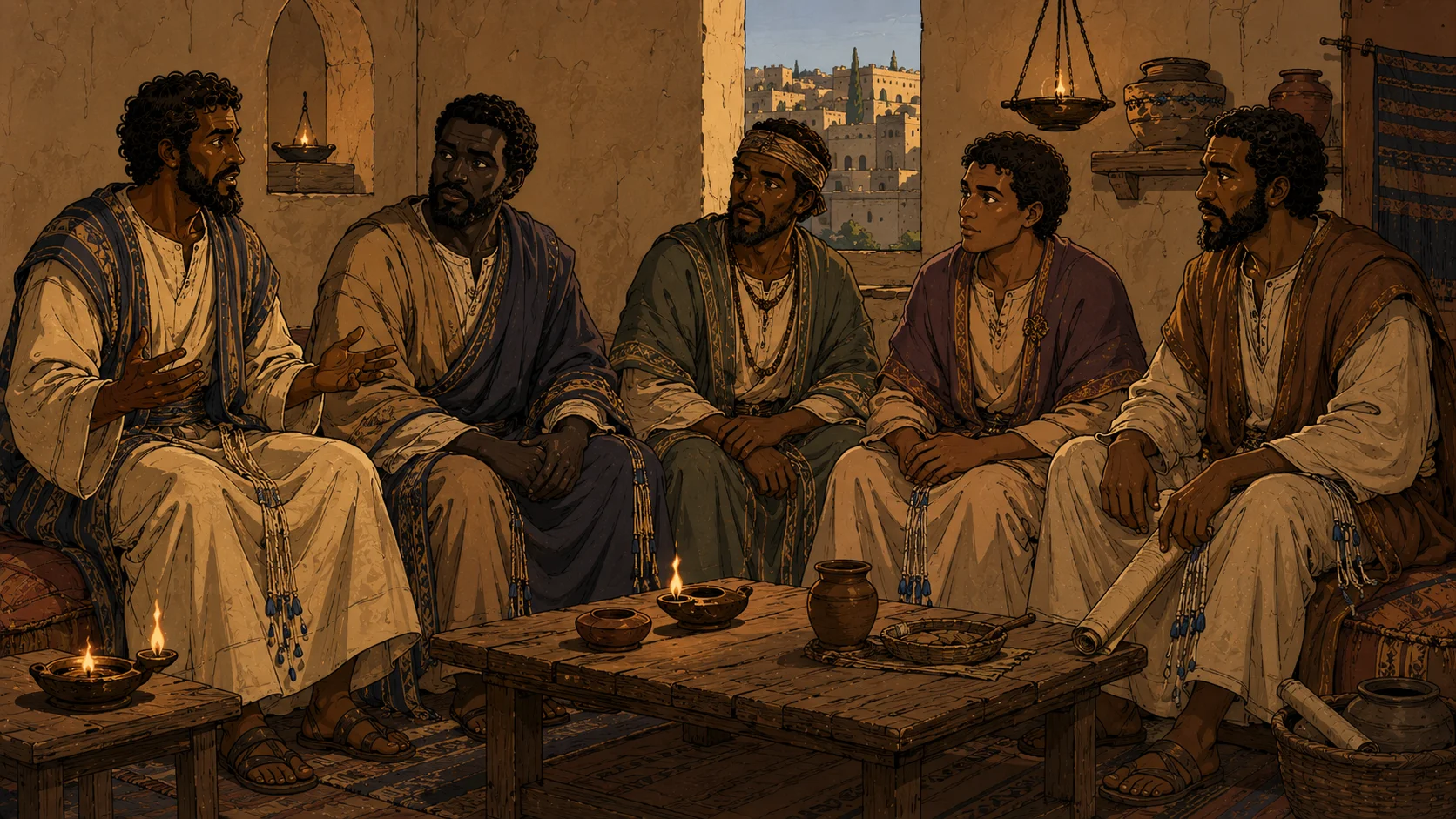
II. Who Was in the Room — Acts 13:1
Less than two chapters later, Acts 13:1 gives us the actual names of the leadership of the Antioch community. This is one of the most quietly significant verses in the New Testament, and one of the least taught:
"Now there were in the church that was at Antioch certain prophets and teachers; as Barnabas, and Simeon that was called Niger, and Lucius of Cyrene, and Manaen, which had been brought up with Herod the tetrarch, and Saul." — Acts 13:1
Five names. Five leaders of the community that was first called Christian.
Barnabas — a Levite, born in Cyprus (Acts 4:36), whose given name was Yosef, renamed Barnabas ("son of encouragement") by the apostles. He vouched for Paul to the Yerushalayim apostles when no one else trusted him (Acts 9:27). A Levitical Israelite.
Shimon — whom the Roman world called Niger — his Hebrew name is Shimon (שִׁמְעוֹן — the second son of Yaakov, one of the twelve patriarchs). That is his name. The text records that the surrounding Roman-Greek world called him Niger — Latin for black or dark — which tells us how outsiders categorized him by appearance. To his community he was Shimon — a prophet and teacher of the Antioch assembly. Some traditions identify him with Shimon of Cyrene, the man from North Africa who was compelled to carry Yeshua's cross (Matthew 27:32), whose sons Alexander and Rufus appear to have been known in the early community.
Lucius of Cyrene — Cyrene was a city in what is now northeastern Libya, North Africa. The Cyrenian Jewish community was large enough to have its own synagogue in Yerushalayim (Acts 6:9). Lucius was African by origin — from the same North African city that produced Shimon of Cyrene.
Manaen — described as suntrophos (foster-brother, or brought up with) Herod the tetrarch — Herod Antipas, the ruler who beheaded Yochanan the Immerser. Manaen had been raised in Herod's household and was now a prophet and teacher in the Antioch community.
Saul — Sha'ul of Tarsus, of the tribe of Binyamin, Pharisee-trained, former persecutor, now the community's most prolific teacher and letter-writer.
Five leaders: a Levitical Cypriot, a Black African prophet, a Cyrenaian African, a former royal court companion, and a Binyaminite Pharisee. This is the leadership of the community first called Christian. It was not Roman. It was not European. It was an Israelite and African and Near Eastern movement rooted in the Hebrew scriptures.
III. What They Actually Practiced
The community first called Christian at Antioch was not practicing what most people today would recognize as Christianity. It was a Hebraic, Torah-rooted, Sabbath-keeping, Hebrew-calendar-following community that had received Yeshua as the Messiah of Israel.
The Sabbath. The first believers kept the seventh-day Sabbath — Friday sunset to Saturday night. Yeshua himself kept the Sabbath (Luke 4:16 — "as his custom was, he went into the synagogue on the Sabbath day"). Paul consistently went to the synagogue on the Sabbath (Acts 13:14, 13:42, 16:13, 17:2, 18:4) — not merely as a missionary strategy, but as a Sabbath-keeper going where Sabbath-keepers gathered.
The Hebrew calendar. The first community followed the Hebrew calendar — the appointed times (moedim) of Leviticus 23: Passover, Unleavened Bread, Firstfruits, Shavuot, Yom Teruah, Yom Kippur, Sukkot. The Spirit came at Shavuot (Acts 2:1). Paul urged the Corinthian community to keep the Passover with sincerity (1 Corinthians 5:7–8). The early community was not meeting on Easter Sunday or celebrating Christmas.
The commandments. The first believers understood the commandments as the path of covenant life — not as a mechanism for earning salvation but as the walk of the redeemed. Yeshua said "If you love me, keep my commandments" (John 14:15). The apostle Yochanan said "Whoever says 'I know him' but does not keep his commandments is a liar" (1 John 2:4).
Hebrew names and language. Yeshua was Yeshua — not Jesus. Miryam was Miryam — not Mary. The first community operated in Hebrew and Aramaic, with Greek as the trade language. The shift to Greek and Latin names was a later cultural translation — not the original.
The Torah and the prophets as foundation. The first believers did not have a New Testament. The Gospels were written decades after the Antioch community of Acts 13. What they had was the Hebrew scriptures — the Torah, the Prophets, the Writings — and the oral teaching of the apostles.
IV. What Changed and When
The historical record on this is clear. Ignatius of Antioch, writing around 108 CE, was the first writer to articulate a theological preference for Sunday over the Sabbath, contrasting "living according to the Sabbath" with "living according to the Lord's Day."
Justin Martyr, writing around 155 CE, made the Sunday-is-our-day argument more explicitly, offering it as the day of the sun — aligning with Roman solar symbolism — on which Christians gathered. He explicitly distinguished the Christian community from those who still observed Sabbath.
Constantine's Sunday Law, 321 CE, was not the origin of Sunday worship but its formal imperial institutionalization. The Edict required rest on "the venerable day of the sun" throughout the Roman Empire. This aligned the Christian community's practice with the solar calendar and Roman civil religion, making the Hebrew Sabbath increasingly foreign.
The Council of Nicaea, 325 CE, addressed the Passover question. A letter from Constantine following the council states the position plainly: it was unfit "to follow the custom of the Jews" in calculating the date of the resurrection celebration. The Easter date was separated from the Passover calculation. The solar calendar displaced the lunar-solar Hebrew calendar.
The de-Hebraization of names was gradual but thoroughgoing. Yeshua became Iesous in Greek, Iesus in Latin, Jesus in English — a name with no meaning in its own right, having lost the Hebrew Yeshua (which means Yah saves). Yaakov became Jacobus then James — an entirely different name.
V. What the First Community and Modern Christianity Look Like Side by Side
| Original community (Acts 11–13, c. 43 CE) | Modern mainstream Christianity |
|---|---|
| Sabbath — seventh day, Friday sunset to Saturday night | Sunday worship — first day of the week |
| Hebrew calendar — Passover, Shavuot, Sukkot, the moedim | Gregorian calendar — Easter, Christmas |
| Torah observance — commandments as the covenant walk | Range from commandment-keeping to commandment-dismissal |
| Hebrew names — Yeshua, Miryam, Moshe, Yochanan | Greek/Latin/English translations — Jesus, Mary, Moses, John |
| Levantine and African leadership — Shimon called Niger, Lucius of Cyrene | European-dominated visual and institutional tradition |
| The Hebrew scriptures as the foundation | The New Testament as the primary text |
| Yeshua as the Messiah of Israel sent first to the lost sheep | Yeshua as the savior of generic humanity |
This table is a historical comparison between what the record shows was there at the beginning and what the record shows came after. The reader can see the distance and draw their own conclusions.
VI. What Remains — And the Invitation
It would be wrong to say that nothing of the original survived. The Hebrew scriptures remained in the canon. The Gospel accounts remained. Yeshua himself remained at the center of the tradition, even where his Hebraic identity was obscured. The message of his death and resurrection remained. The call to faith remained.
And across two thousand years, believers in every generation have found in the texts something that the institutional drift did not fully succeed in erasing — the Hebrew root. The Sabbatarians who kept Saturday through centuries when it was legally dangerous. The communities in Ethiopia and Armenia who maintained the Hebrew calendar. The movements that went back to Acts 11 and Acts 13 and asked: who were these people, really, and what did they do?
The invitation of this article is the same question. You do not need to condemn the tradition you came from to ask it. Most people who practice modern Christianity have no idea that Sunday replaced the Sabbath in the fourth century, or that the Easter date was formally separated from Passover in 325 CE, or that Simeon called Niger was a Black African prophet in the leadership of the community first called Christian. That is not their fault. The information was not given to them.
Now it is being given.
"And the disciples were first called Christians in Antioch." — Acts 11:26
A Note on Method
This article documents what Acts 11 and Acts 13 record about the first community called Christian, and what the historical record shows about the documented shifts that followed. The historical claims — Ignatius, Justin Martyr, Constantine's Sunday Law, the Council of Nicaea's explicit anti-Judaic language — are drawn from documents in the public historical record. The comparison table reflects the documented practices of the Acts-era community against the documented practices of modern mainstream Christianity. This article does not attack the faith of people who practice modern Christianity. It presents the historical comparison and extends the invitation to return to the original.
Continue the Series
- Who Are the Israelites? The People at the Center of the Entire Bible — the foundational pillar
- Lost Sheep and Grafted Branches: Who Did Yeshua Come to Save? — Yeshua's mission and the nations grafted in
- John 3:16 Explained — the most-cited verse, in its Israelite covenantal context
- Deuteronomy 28: The Curses, the Prophecy, and the Way Back
✡ The Commandments of the Original Community
The commandments Yeshua said to keep, the Hebrew calendar the first community observed — in Hebrew and English at hebroni.com.
View All 613 Commandments → Read the Ten Words in Hebrew →