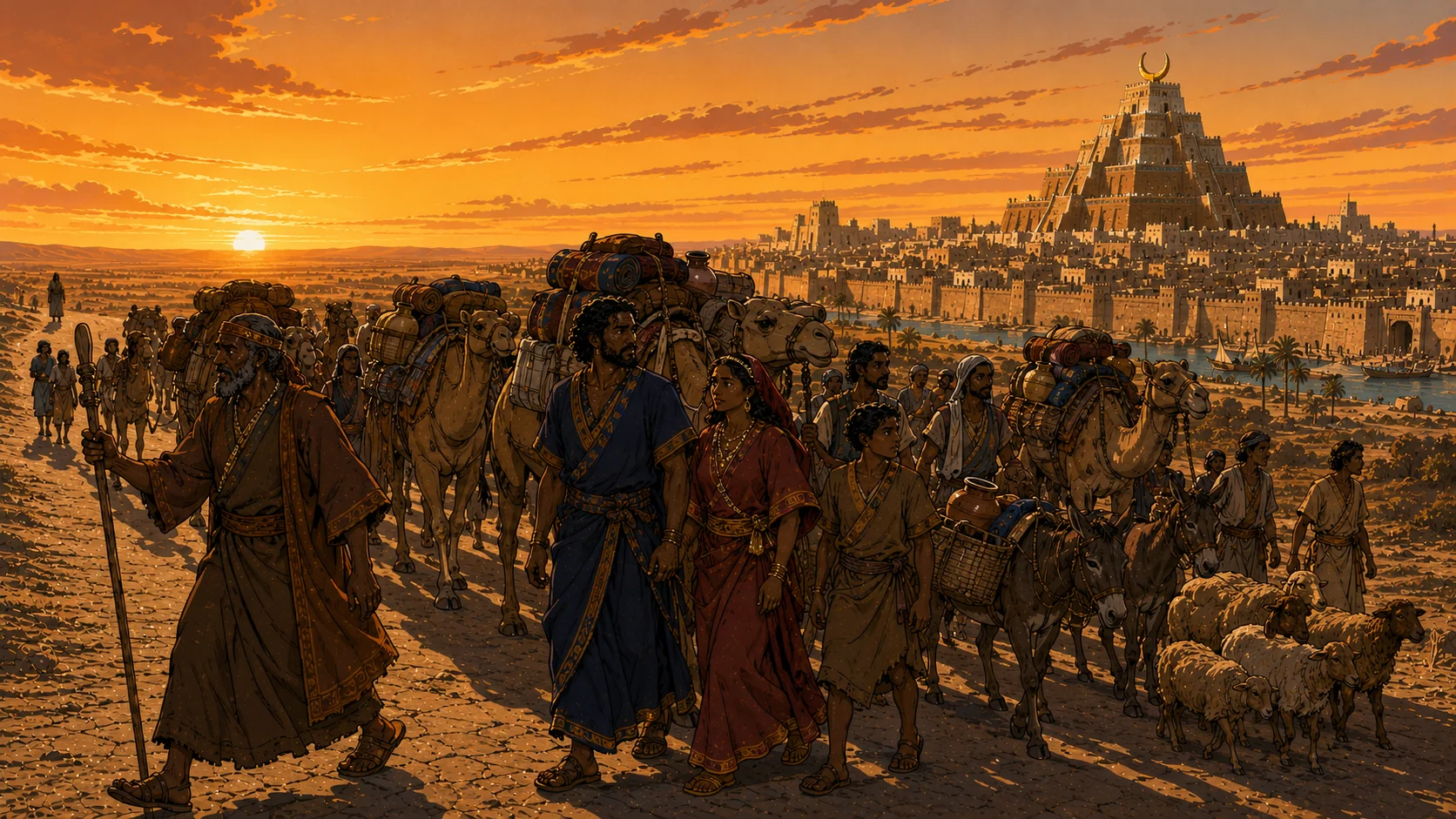
It is Terah, not Abram, who initiates the departure from Ur. The text is precise: Terah took his family and set out for the land of Canaan. The destination is named — not Haran, not somewhere else, but Canaan. They were going somewhere specific. They knew where they were supposed to arrive. And then — they stopped. "They came as far as Haran and they settled there." The verb וַיֵּשְׁבוּ (vayeshvu, they settled) carries the weight of finality. Settling is what you do when the journey is over.
The rabbis wrestled with why Terah began and then stopped. Nachmanides suggests that Terah was responding to a preliminary divine prompting — a whisper toward Canaan that he lacked the faith to follow all the way. His son would hear the call explicitly and obey it completely. Stephen, in the Acts of the Apostles (7:2–4), says YHWH appeared to Avram in Mesopotamia before he left Ur — meaning Avram received the call while still in Ur and the journey was already his obedience. Terah was swept along by a purpose that was not centered on him.
There is a pattern in the Torah that the patriarch's father begins something the patriarch must complete. Terah leaves Ur but cannot enter Canaan. The land requires a man who will trust the call completely — not the man who moves partway and settles for the road. When the call does come to Avram explicitly, its first words are "Leave your land, your birthplace, and your father's house" (12:1). The father's house is the last and deepest attachment. The journey cannot be completed while sheltering under it. Terah's stopping in Haran is not a failure of logistics; it is a portrait of faith that went to the edge of the familiar and would not cross over.