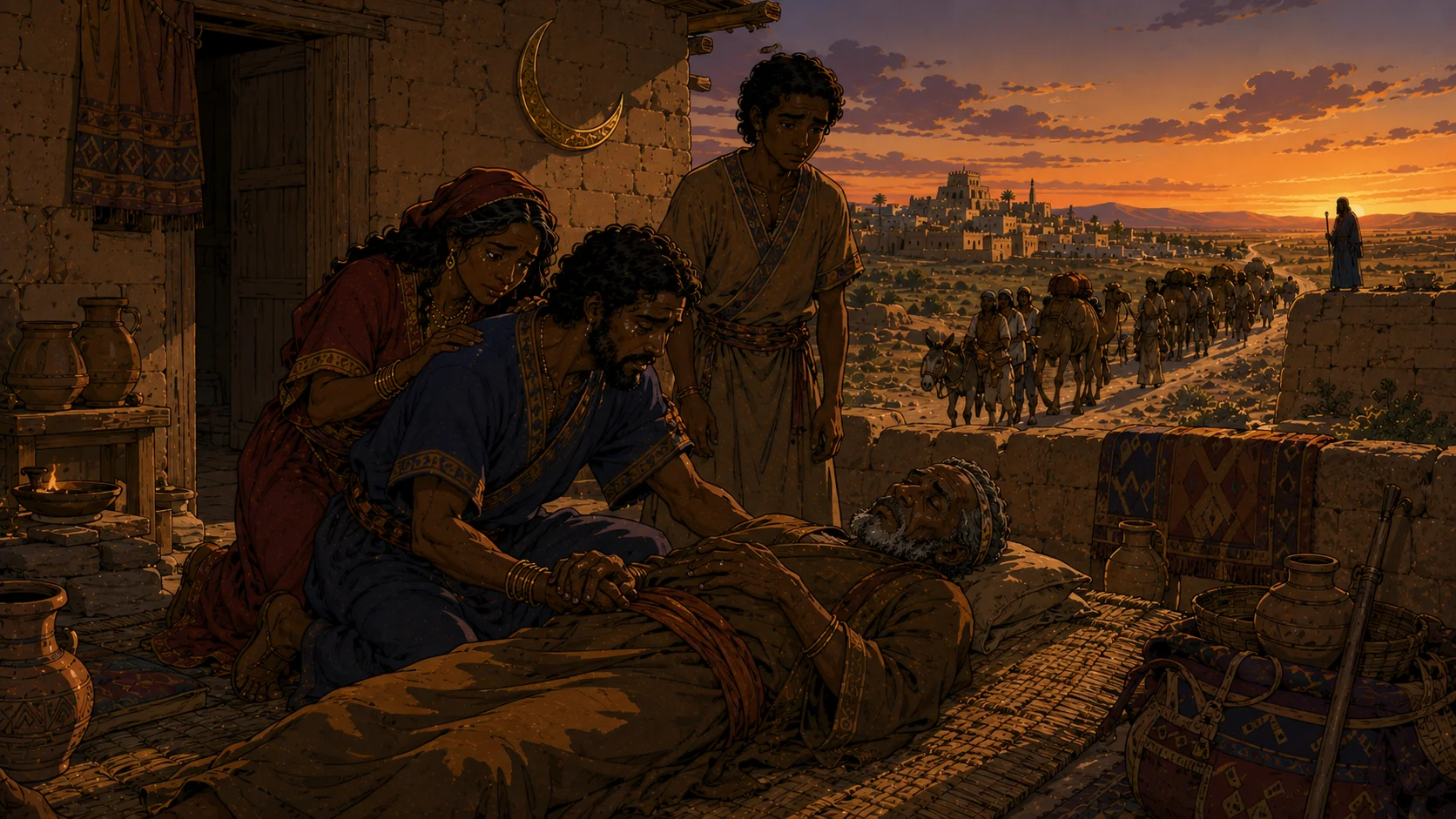
One verse. Two hundred and five years reduced to a single line, then death. The Torah does not explain Terah's inner life, his regrets, or his spiritual state. It records his age and his location and moves on. He died in Haran — in the city of the road, in the place between his beginning and his destination. The abruptness of the verse is the Torah's verdict. There is no blessing recorded for Terah, no deathbed speech, no legacy statement. The text passes through him to reach the man whose story is the reason for this genealogy.
The numerical question is worth pressing. Genesis 11:26 says Terah was 70 when he fathered Avram. Genesis 12:4 says Avram was 75 when he left Haran. That means Terah was 145 when Avram departed. But Terah lived to 205 — meaning Terah was still alive for 60 years after Avram left. The apparent contradiction with Stephen's statement in Acts 7 (that Avram left after Terah died) led the rabbis to suggest that the Torah placed Terah's death before the call narrative because "the wicked, even in their lives, are called dead." The point is not chronological precision but theological primacy: the story of Avram begins only after Terah is finished.
The death of Terah is the final severing of the old world. After this verse, the narrative leaps forward: "And YHWH said to Avram, go for yourself from your land..." The death marks the transition. It is not presented as cause and effect — as if Avram waited for his father to die before obeying the call. It is presented as threshold. What is behind Avram now is Terah's world: the moon-worship city, the dead brother whose name marks the stopping point, the 205-year generation that went part of the way and stopped. What is ahead of Avram is a land he cannot yet name. The Torah closes the gate of the old world with one verse, and turns the page.