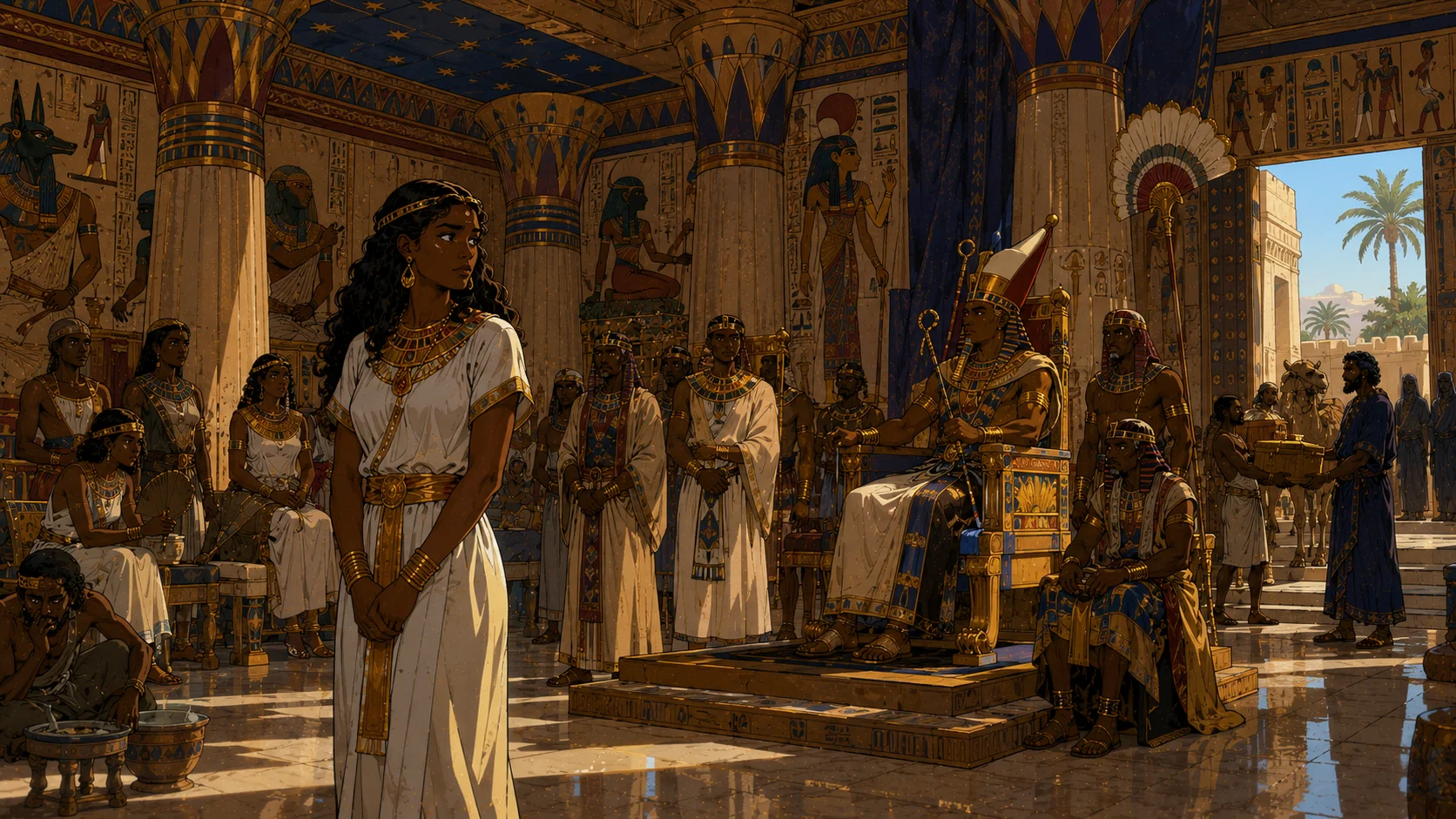
Famine strikes the land and Avram descends to Egypt. Before entering, he turns to Sarai with a strategy born of fear: tell them you are my sister, not my wife. His calculation is precise and brutal: (12:12) "They will kill me but let you live." He is choosing his own survival at the cost of her safety. The Torah does not soften this. Sarai is beautiful, the Egyptians will want her, and Avram's plan uses her beauty as currency for his protection. That she is technically his half-sister (20:12) makes the deception legal but does not make it honourable. He is trusting the lie more than he is trusting YHWH.
What follows is the fulfilment of exactly what Avram predicted — but not in the way he hoped to avoid. Sarai is seen, praised to Pharaoh, and taken into his household. Avram is enriched: sheep, oxen, donkeys, servants — all the signs of wealth. The man who left Haran carrying only what he could gather has now become wealthy in a foreign king's shadow, at the cost of his wife's honor. The Torah records no prayer from Avram during this episode, no altar, no divine encounter. He is operating entirely on human strategy, and the strategy appears to be working.
The Egypt episode is the first of three similar stories in Genesis (Isaac in Gerar, 26:7; Avraham in Gerar, 20:2). Each time a patriarch fears a foreign king will kill him for his wife's beauty; each time the wife is endangered; each time divine intervention or exposure rescues the situation. The recurring pattern is not accidental — the Torah is showing the reader a crack in the armor of faith that runs through the patriarchal generation. The promise of offspring depends on Sarai's safety. YHWH will protect that promise even when the patriarch will not. The covenant advances not because of Avram's steady faithfulness but despite his fear — which is itself a form of grace.
