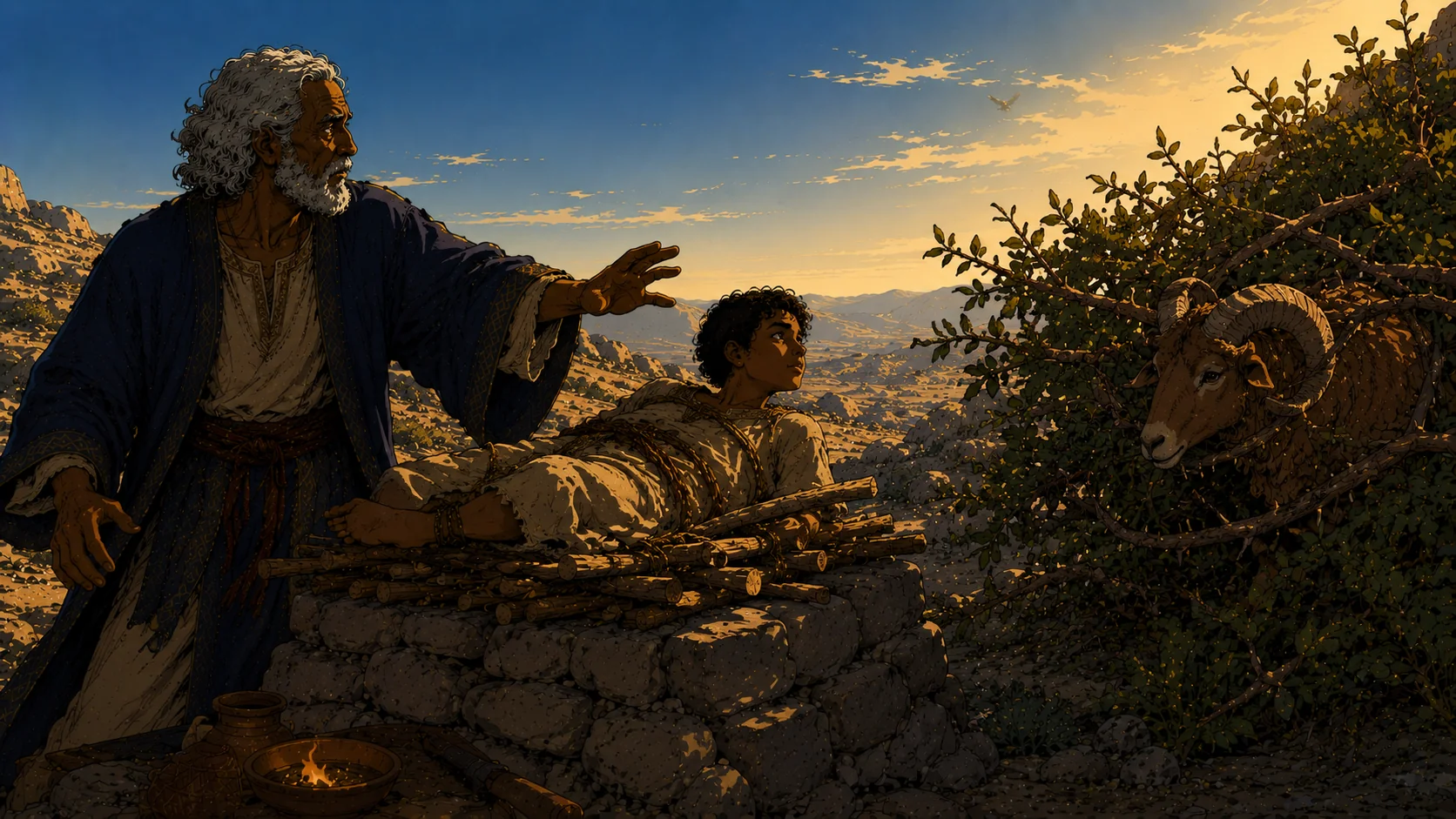
He lifted his eyes. Earlier in chapter 22, the lad lifted his eyes and saw the mountain (v.4). Now Abraham lifts his eyes from the altar and sees: וְהִנֵּה-אַיִל אַחַר — “and behold, behind him, a ram.” The particle אַחַר (achar), “behind,” is the same word used in the chapter’s first verse: “after these things” (אַחַר הַדְּבָרִים). The ram appears behind Abraham — at his back, where he was not looking — as if it has been there since before the journey began.
The ram is caught by its horns in a thicket. נֶאֱחַז בַּסְּבַךְ בְּקַרְנָיו — “caught in the thicket by its horns.” The instrument of its power is the instrument of its entrapment. The word סְּבַךְ (svach) means a dense tangle of vegetation. The ram has pushed too deep into something it cannot exit. It is available because it is caught. Abraham does not create this provision — he finds it.
And he offers it תַּחַת בְּנוֹ — “instead of his son,” literally “beneath his son,” in his son’s place. The word תַּחַת is one of the densest words in Hebrew — it means beneath, instead, in substitution. The ram goes up in the place where Isaac would have gone. Abraham names the place: YHWH Yireh — “YHWH will see” or “YHWH will provide.” The mountain has a name after this. What happened here will be said: “on the mountain of YHWH it will be seen” (v.14). The provision and the seeing are the same word in Hebrew.