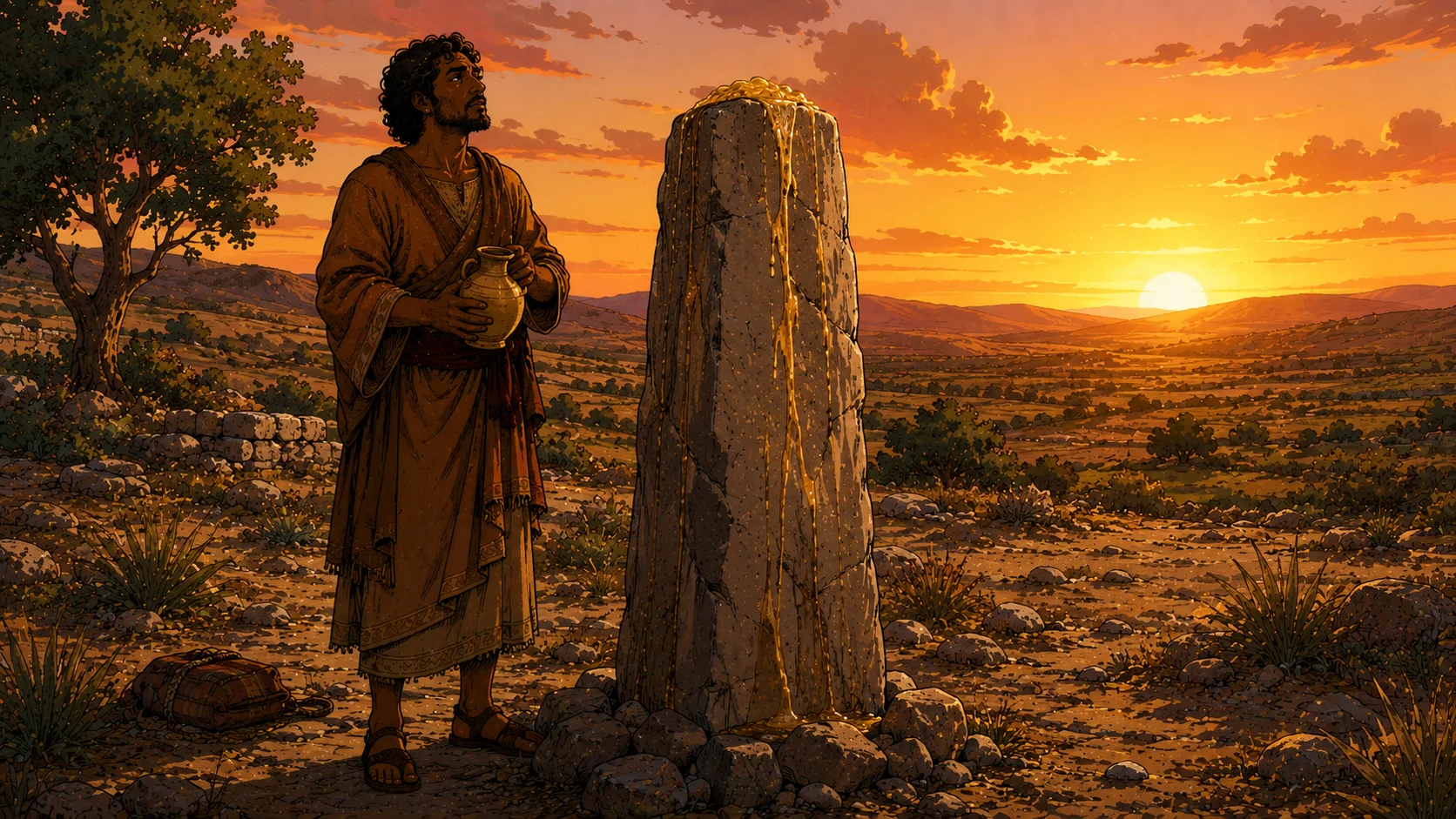
Jacob wakes early and takes the stone he used as a pillow, sets it upright, and pours oil on its head. It becomes a matzevah — a standing stone, a monument. He names the place Bethel: House of God. He says: this stone will be the house of God, and of all You give me I will give You a tenth. The actions are deliberate and slow. He is marking a place where heaven opened, so it can be found again.
Then Jacob makes a vow. The structure is conditional: if God will be with me and keep me and give me food and clothing and bring me back in peace, then YHWH will be my God. This vow is often criticized as transactional — bargaining with God, offering loyalty in exchange for protection. But read carefully, it is something else: a man who has just had his first personal encounter with the divine, responding in the only language he has, which is negotiation.
Jacob grew up in a household of calculated exchanges: a birthright for a bowl of stew, a blessing for a plate of goat meat. Covenant language, to him, looks like a deal. What the vow reveals is that Jacob wants the same God his fathers had, but on terms he can verify. God does not reject the vow. He will fulfill every condition Jacob listed. And Jacob will return, limp and renamed, with more than food and clothing — with a new name and a twelve-tribe nation.