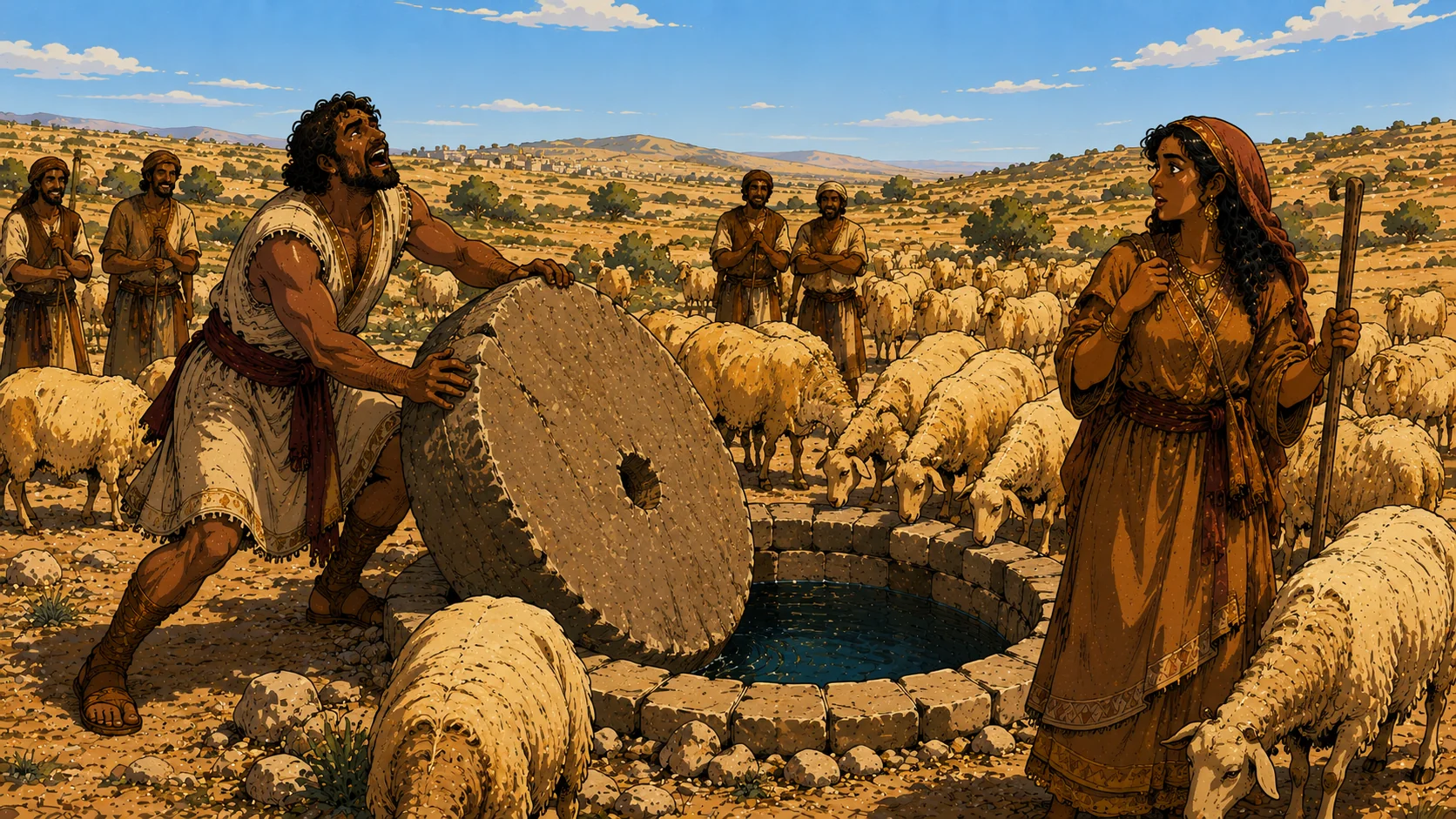
Jacob lifts his feet — the Hebrew idiom for walking with renewed energy — and travels east. He arrives at a field with a well covered by a large stone. Three flocks wait beside it. The shepherds explain: they cannot water the flocks until all the flocks have gathered and they roll the stone away together. Then Rachel arrives with her father Laban's sheep. She is the first person Jacob meets in this new land.
Jacob rolls the stone from the well's mouth by himself. The feat is noted deliberately — the same stone that requires all the assembled shepherds to move, Jacob moves alone. He waters the flock of Laban his mother's brother. Then he kisses Rachel and lifts his voice and weeps. The weeping is not explained. Loneliness, relief, recognition of beauty, the memory of home — the text does not say. It only records the sound of a man arriving somewhere after a very long walk.
Jacob tells Rachel who he is: the son of her father's brother, the son of Rebekah. She runs to tell Laban. When Laban hears, he runs to meet Jacob, embraces him, kisses him, and brings him home. You are my bone and my flesh, he says. Jacob stays a month. Then Laban asks: what shall your wages be? He has a daughter named Leah and a daughter named Rachel, and a nephew who is in love, and twenty years of work ahead of everyone.
