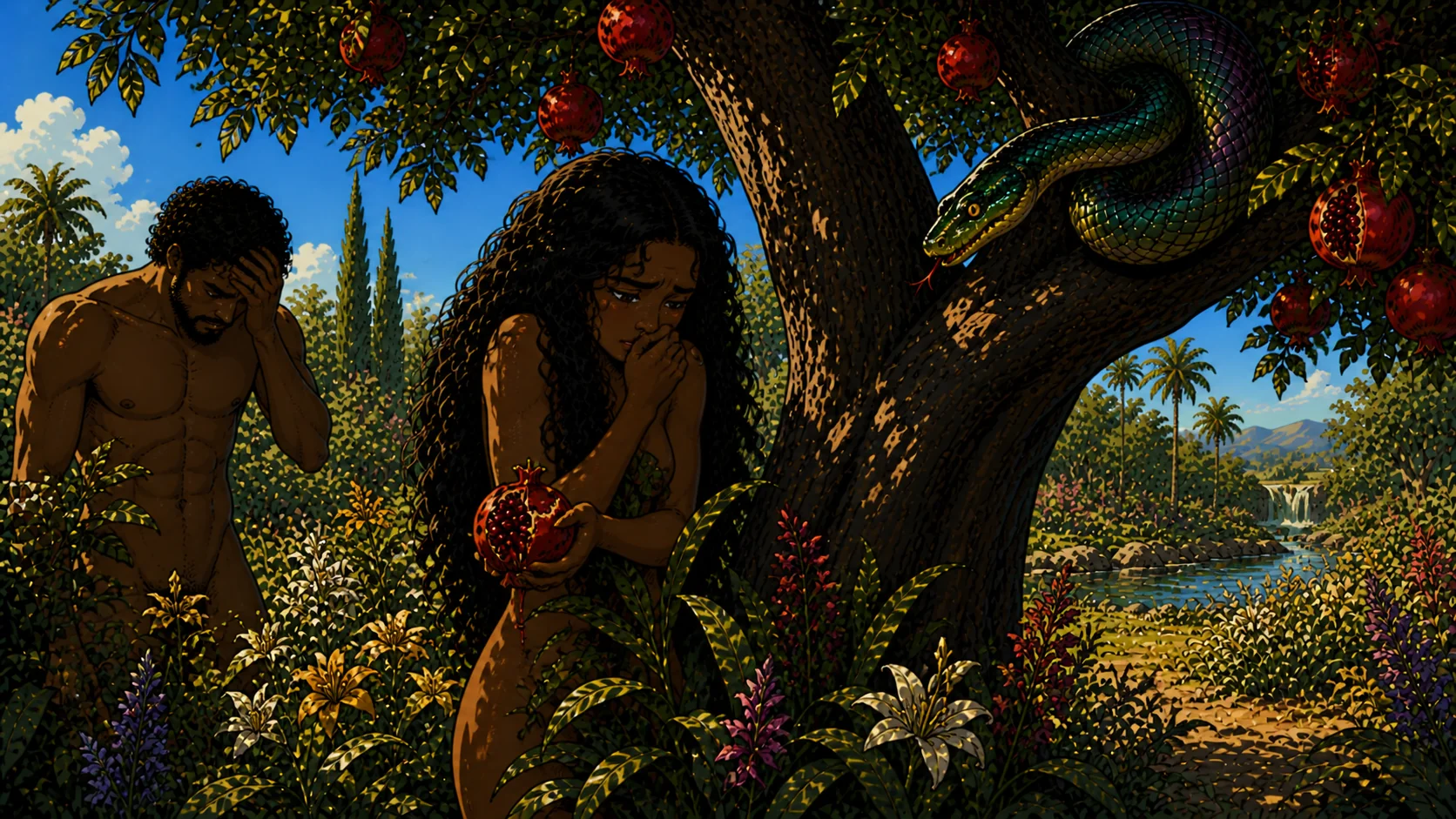
The serpent opens with a question, not a command: "Did God really say you shall not eat from any tree of the garden?" The distortion is subtle — Elohim said one tree, the serpent says all trees. The tactic is ancient: exaggerate the restriction until it feels tyrannical, then offer relief. The woman corrects the serpent but adds her own embellishment: "we may not eat it or even touch it" — a fence around the command that was never given. When we add to Elohim's words, we begin to misrepresent them.
The woman's deliberation in verse 6 is described in three escalating movements: she sees (וַתֵּרֶא) that the tree is good for food — appetite. She sees it is a delight to the eyes — beauty. She sees it is desirable to make one wise — ambition. All three are not corrupt in themselves; they are the same categories of perception that exist throughout Creation. What makes this moment fatal is not desire but disobedience — choosing personal wisdom over Elohim's word.
The man receives the fruit silently: "she also gave some to her husband who was with her, and he ate." He was there. He heard the conversation. He offered no word. The silence of the man at the tree is as consequential as the action of the woman. Sin rarely requires explicit rebellion — sometimes it only requires presence and passivity. Together they eat, and together they become aware: their eyes open to their nakedness, and the innocence of Eden is over.