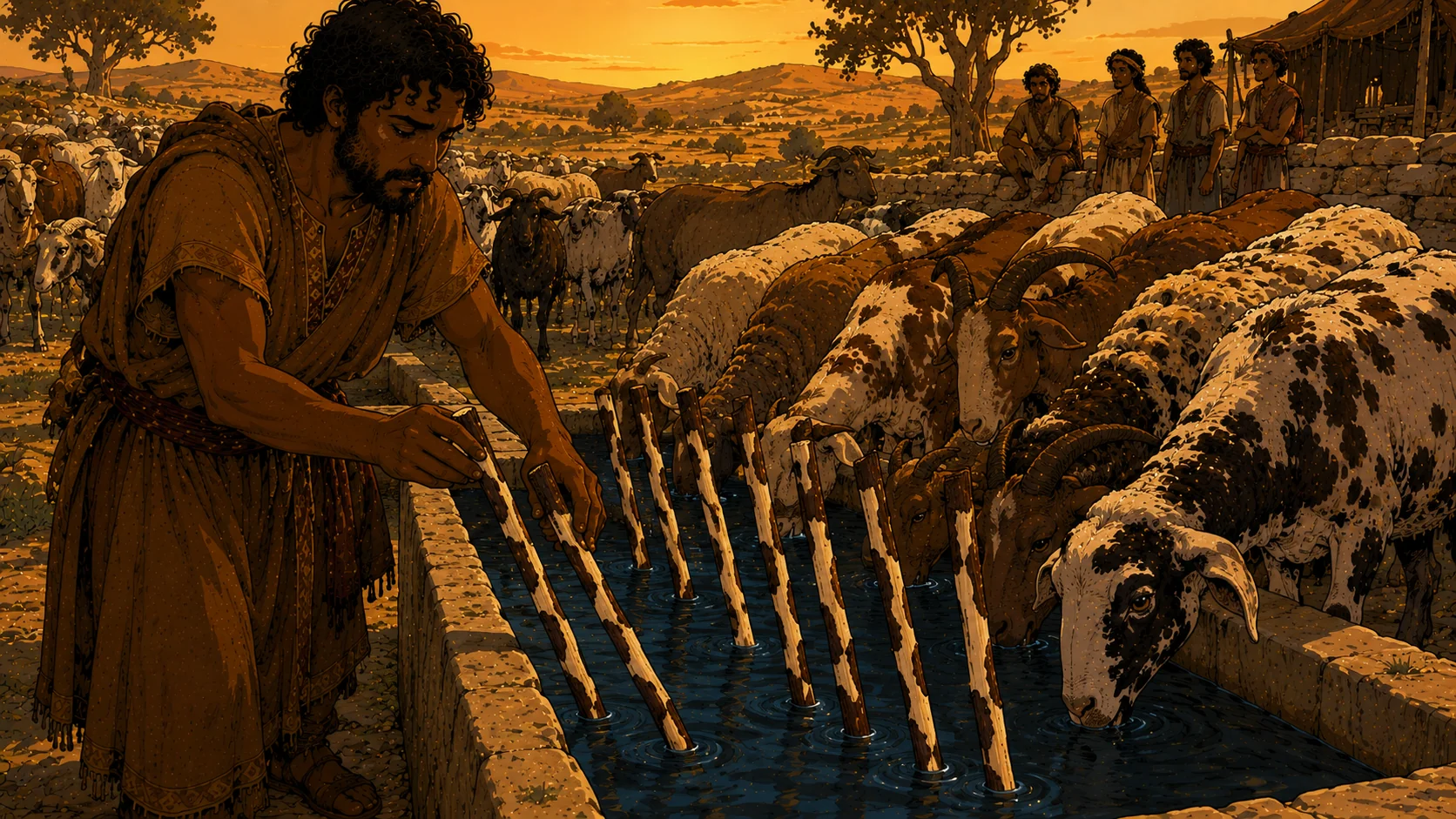
Jacob asks Laban for his wages: all the speckled, spotted, and dark animals from the flock will be Jacob's; all the rest will remain Laban's. Laban agrees and immediately removes every such animal, putting three days of distance between them and Jacob. He is ensuring Jacob starts with nothing to build from. Jacob then takes rods of fresh poplar, almond, and plane trees and peels white streaks into them. He places these striped rods in the watering troughs where the animals come to drink and breed.
The flocks conceive facing the rods and produce striped, speckled, and spotted offspring — exactly what Jacob had claimed as his wages. Jacob then does something more deliberate: when the stronger animals are breeding, he places the rods in their sight; when the weaker ones breed, he removes the rods. The stronger animals produce speckled offspring that go to Jacob; the weaker ones produce solid-colored animals that go to Laban. Over six years, Jacob's flock grows strong and Laban's weakens.
Later, Jacob will tell his wives that an angel appeared to him in a dream and showed him that the speckled and spotted males were covering the flock — a divine confirmation of what was happening. The method (rods), the biology (selective breeding by exposure), and the providence (God's promise to prosper him) are all present at once. The Torah does not separate them. Jacob uses every tool he has, and God is behind the whole arrangement.
