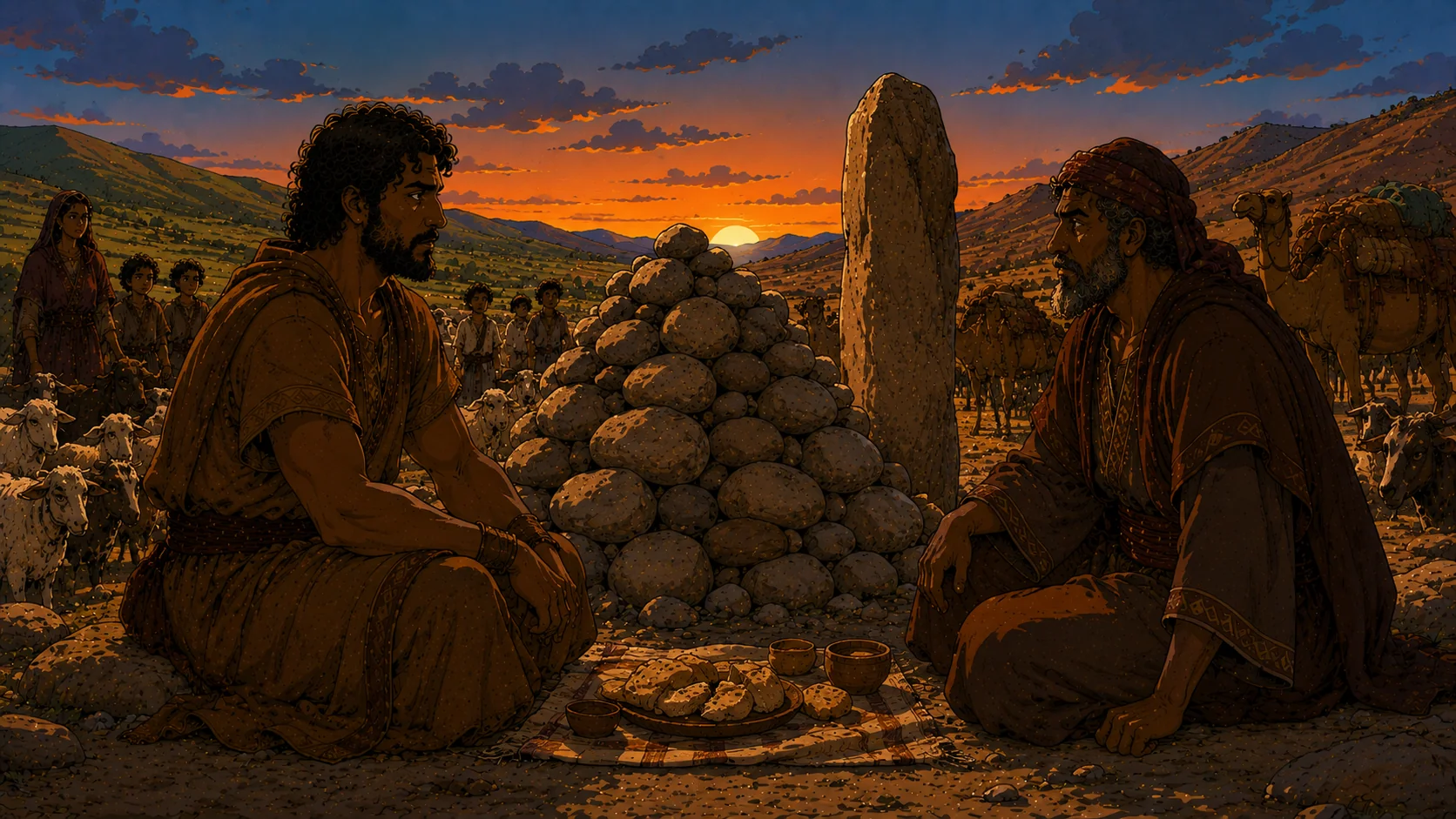
Laban catches Jacob after seven days. God had warned Laban the night before in a dream: say neither good nor bad to Jacob. Laban confronts Jacob with hurt and anger: why did you flee secretly? Why did you steal my heart? You did not let me kiss my daughters and grandchildren goodbye. He searches the tents for his teraphim and does not find them — Rachel has hidden them under her camel's saddle and says she cannot rise because the manner of women is upon her. Laban finds nothing.
Jacob, not knowing what Rachel has done, speaks with justified fury: I served you twenty years. Your ewes and female goats did not miscarry. I bore the loss of torn animals myself. You changed my wages ten times. Without the God of my father, you would have sent me away empty-handed. Laban answers with the only move left: let us make a covenant. A heap of stones is raised. Laban calls it Jegar-sahadutha in Aramaic; Jacob calls it Galeed in Hebrew. Same meaning: heap of witness.
Laban names the place Mizpah — watchtower — and says: the LORD watch between me and you, when we are absent one from another. The statement is not a blessing. It is a surveillance clause: since neither of us can watch the other, let God watch. The covenant comes with conditions: Jacob must not mistreat Laban's daughters, must not take additional wives. Then Laban rises early, kisses his grandchildren and daughters, blesses them, and returns home. He and Jacob will never meet again.
