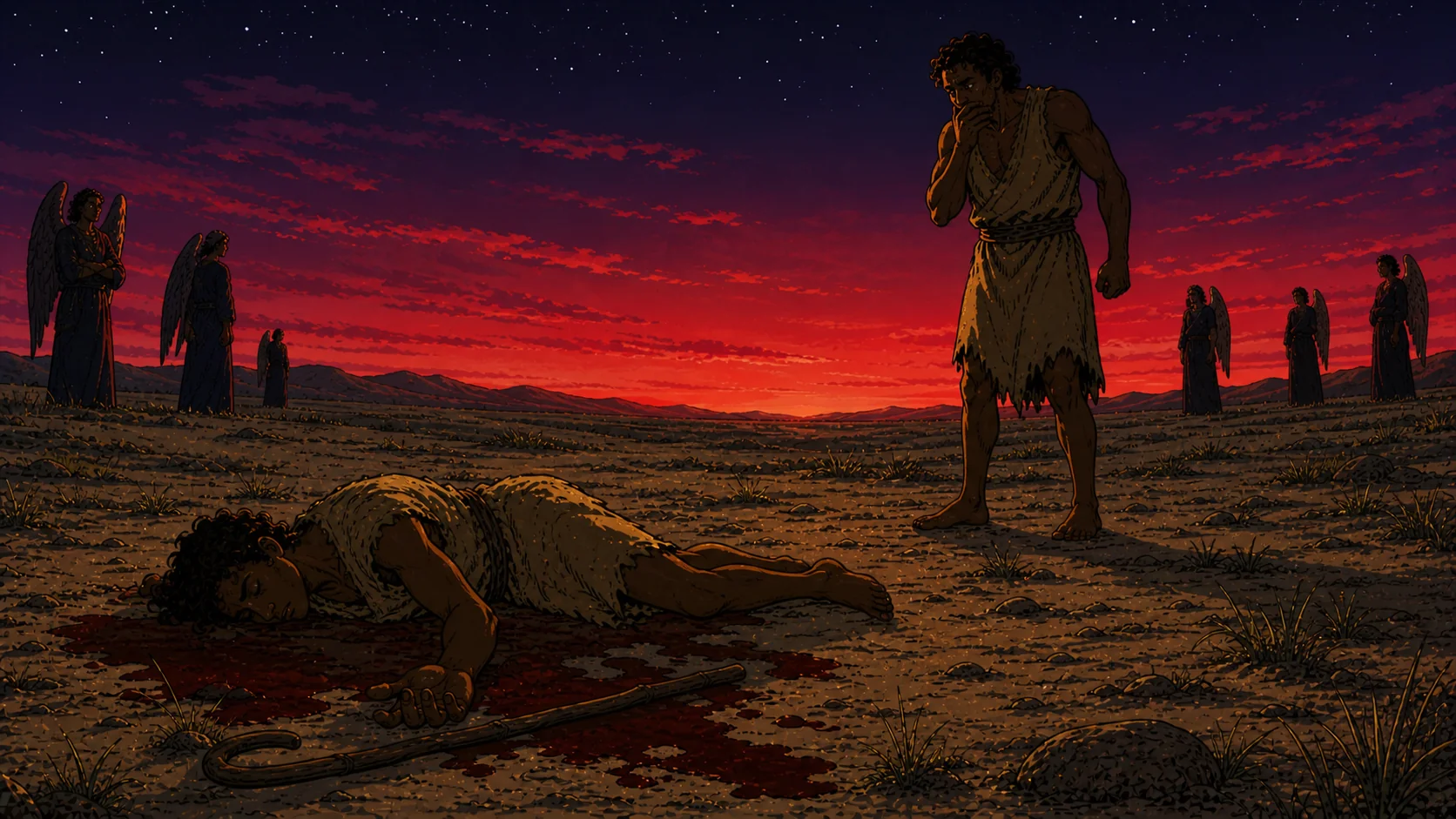
Elohim warned Cain that sin was crouching at the door. Cain did not wrestle with it — he opened the door. The text records the murder with disturbing simplicity: "Cain rose against Abel his brother and killed him." No description of the act, no record of Abel's last words, no dramatic buildup. Just the terrible fact. The Torah does not dwell on the violence — it moves immediately to what comes after, to accountability, to the voice from the ground.
Elohim's question — "Where is Abel your brother?" — is not a request for information. Elohim knows. The question is the same as the one asked of Adam: (3:9) "Where are you?". Both are invitations to confession, to self-examination, to the kind of honesty that could turn judgment into restoration. Cain answers with the most famous evasion in history: "Am I my brother's keeper?" The word שֹׁמֵר (shomer) — keeper, guardian, watcher — is the same word used for the cherubim who guarded the garden. Cain refuses the responsibility that is at the heart of what it means to be human: to be a keeper of one another.
The blood cries out from the ground — and Elohim hears it. This detail is foundational to the Hebrew understanding of justice: innocent blood shed into the earth does not simply vanish. It has a voice. It makes a claim. The ground itself becomes a witness, and Elohim Himself is the One who answers that cry. No murder is unseen. No innocent death goes unheard. The God of Israel is the God who hears blood from the ground.