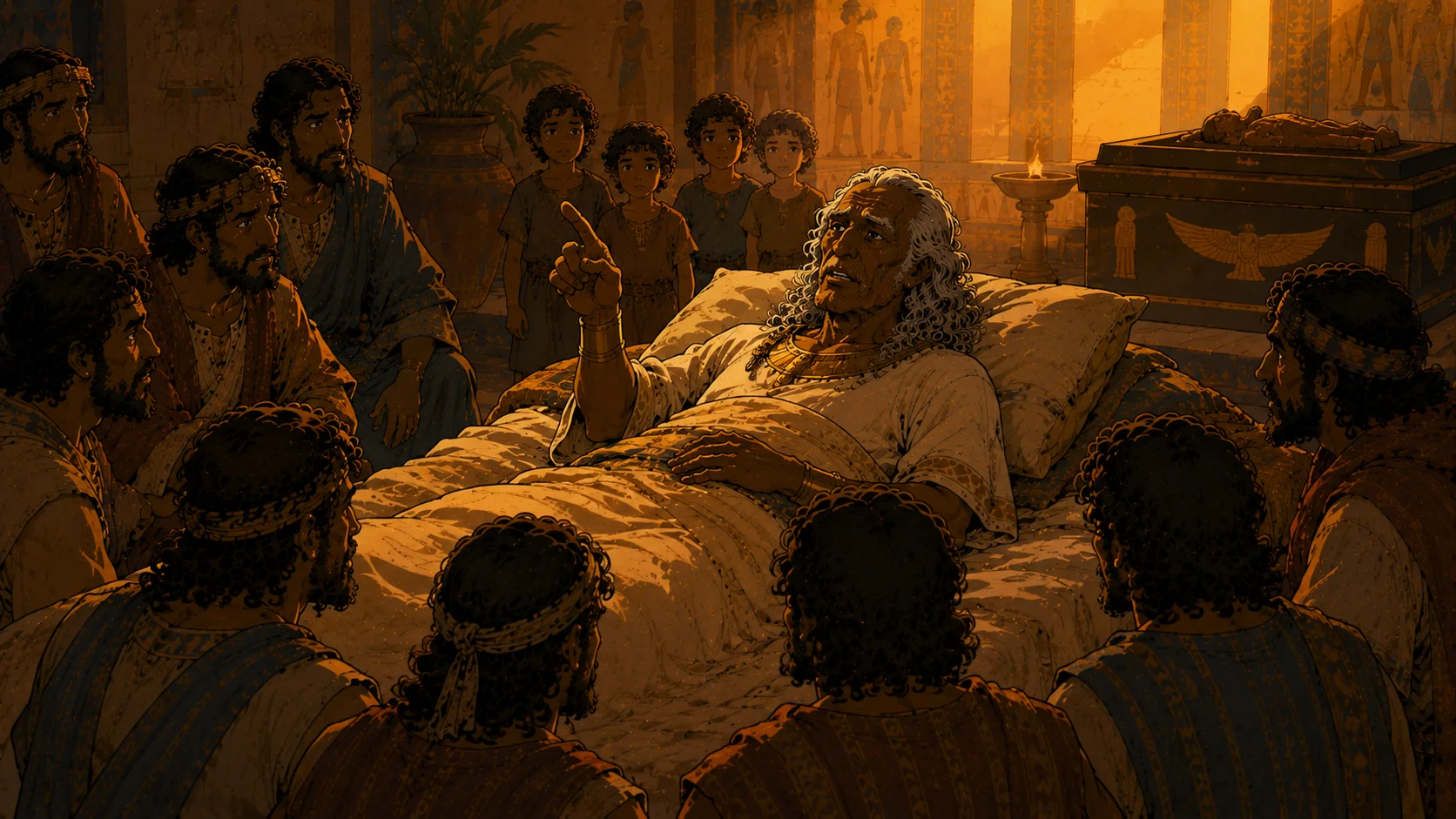
Joseph lives in Egypt, he and his father's household. He lives 110 years and sees Ephraim's children to the third generation. He sees the children of Manasseh's son Machir born upon his knees — a patriarchal blessing gesture, the grandfather receiving the grandchildren. In Egyptian wisdom literature, 110 years was the ideal lifespan, the measure of a complete life well-lived. The Torah assigns it to Joseph as a mark of divine favor on an extraordinary life.
Then Joseph tells his brothers: "I am dying. But God will surely visit you and bring you up from this land to the land he swore to Abraham, to Isaac, and to Jacob." He makes them swear an oath — the same oath he made his father swear: carry my bones from this place. The bones of Joseph will wait in Egypt for four hundred years, carried from Egypt by Moses himself at the Exodus (Exodus 13:19), and finally buried at Shechem in the promised land after the conquest of Canaan (Joshua 24:32). The oath connects the end of Genesis to the beginning of Exodus and forward to the book of Joshua.
The last image of Genesis is a coffin in Egypt. Joseph dies, they embalm him, they place him in an aron in Egypt. A coffin. The word aron is the same word used for the Ark of the Covenant (Exodus 25:10). Genesis ends not with triumph or homecoming but with bones in a box in a foreign land, and a promise that God will come. This is not an ending — it is the longest cliffhanger in the Torah. The bones wait. The promise stands. The story is not over.