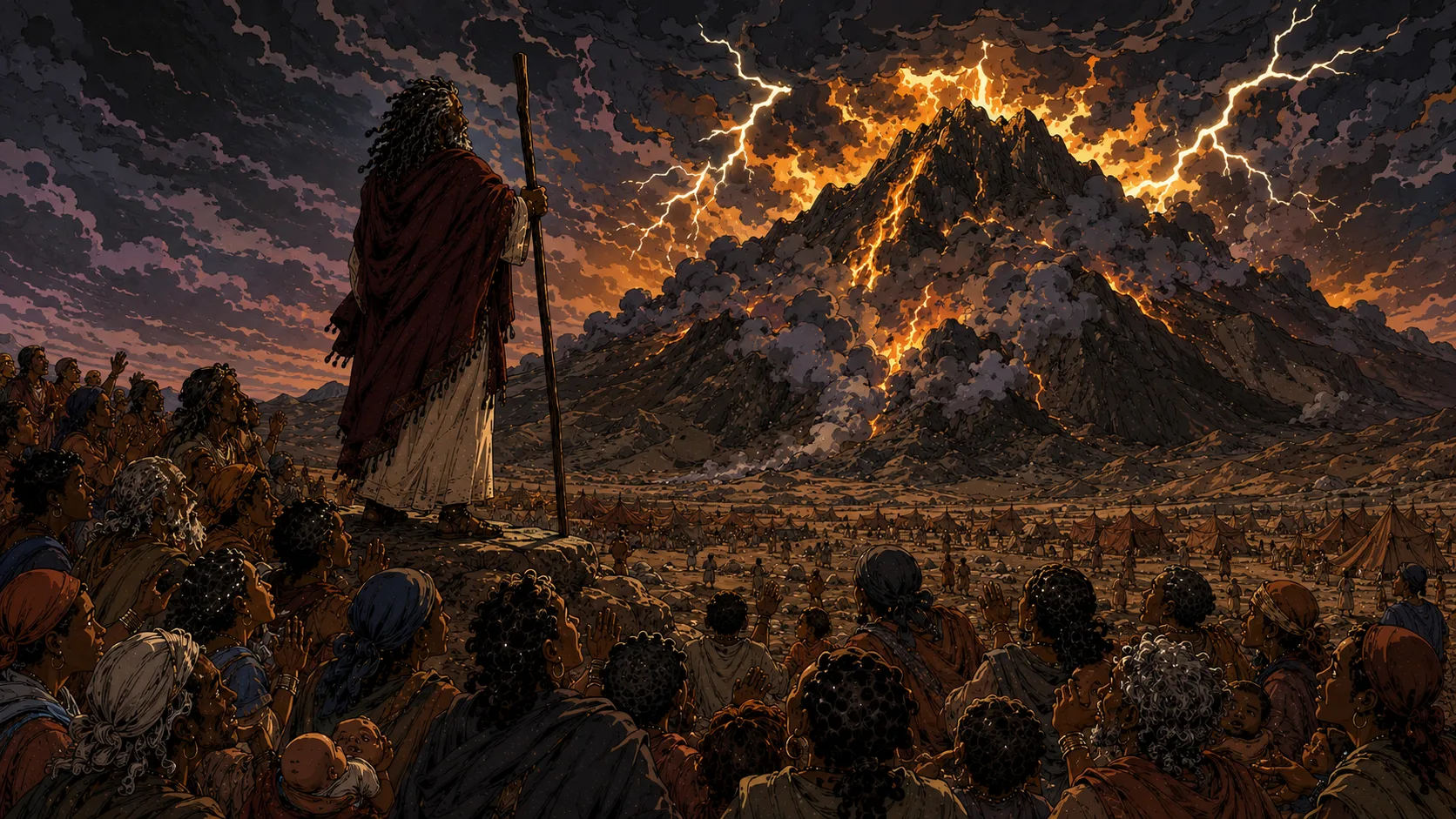
YHWH tells Moses he will come in a thick cloud — בְּעַב הֶעָנָן (be'av he'anan) — so that the people will hear when he speaks to Moses, and believe him forever. Then he gives instructions for the preparation: the people are to consecrate themselves today and tomorrow, wash their garments, and be ready for the third day. The mountain must be set apart; anyone who touches it will die. When the shofar (הַשֹּׁפָר) sounds a long blast, they are to ascend.
Moses goes down from the mountain to the people. He consecrates them. They wash their garments. He warns them: do not go near a woman. For three days, the people hold themselves in preparation — a total consecration of the body in anticipation of the encounter with the holy.
On the morning of the third day, it comes. Thunder and lightning, a thick cloud upon the mountain, and the sound of the shofar exceedingly loud. All the people in the camp tremble. Moses brings them out of the camp to meet God and they stand at the foot of the mountain. The mountain is entirely wrapped in smoke because YHWH has descended upon it in fire. The smoke rises like the smoke of a furnace. The whole mountain quakes violently. The shofar grows louder and louder — not fading as any human instrument would, but intensifying. Moses speaks and God answers him בְּקוֹל (b'kol) — in a voice, in thunder.
This scene is the entry point of divine encounter at its most overwhelming. The signs of theophany — fire, smoke, thunder, the shaking of the earth — are not decorative. They signal that what is about to be spoken comes from a source categorically beyond the human. The mountain does not simply host the presence of God. It responds to it: the earth itself trembles when YHWH descends.
Every element has a purpose in the text. The three-day preparation mirrors other three-day sequences of divine action throughout Scripture — the structure of sacred time. The shofar that grows louder defies every natural law of acoustics. The people tremble before they have heard a single commandment. Their trembling is not failure; it is the correct response to approaching the source of all being. The fear of YHWH does not begin with law — it begins with encounter.