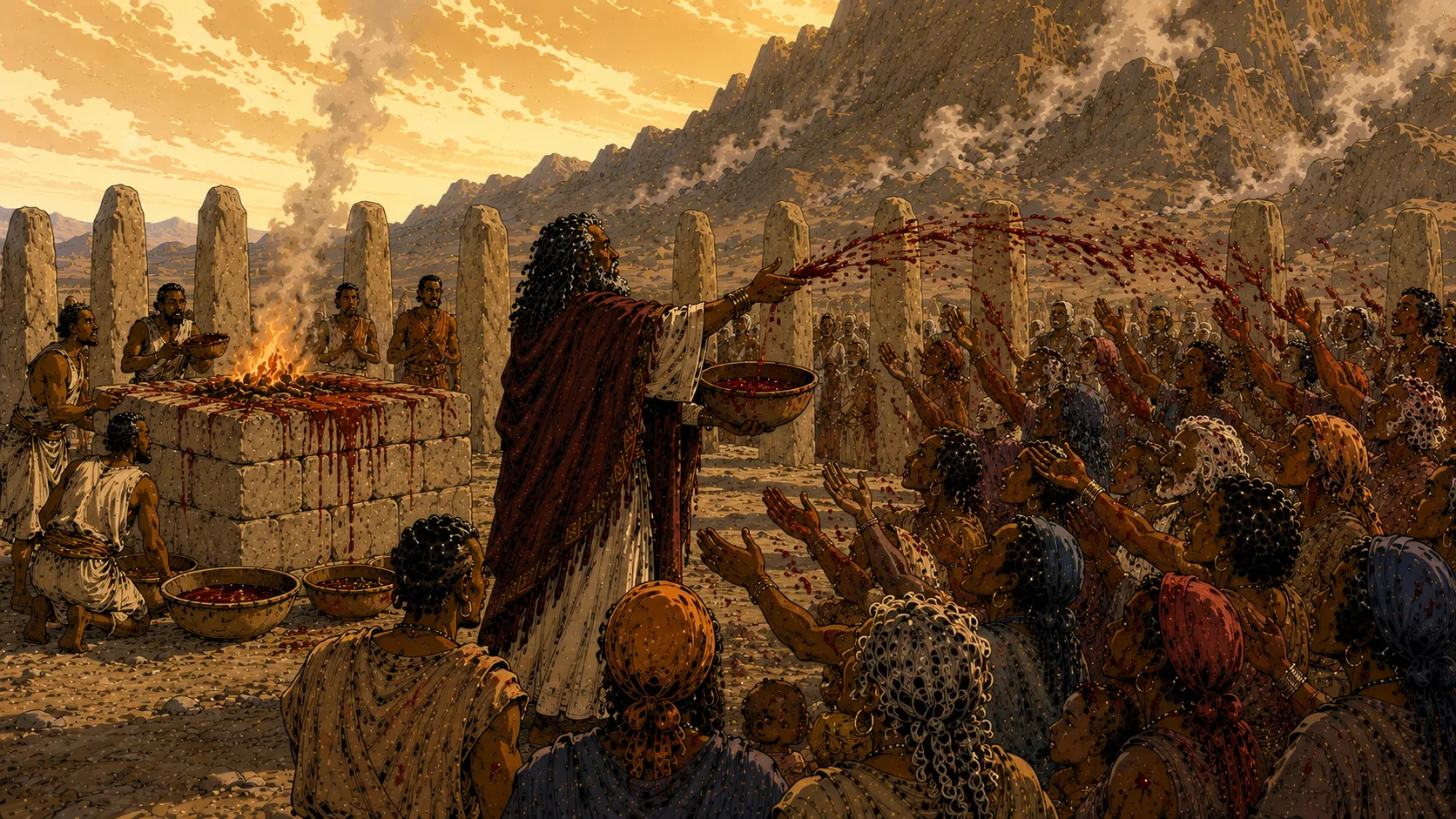
After the altar and the twelve pillars are set, Moses takes the blood of the oxen. He divides it precisely: half he puts into basins, the other half he throws against the altar. The altar represents YHWH's side of the covenant — the divine presence at the center of the sacred space. Blood on the altar is blood presented to the Holy One. The covenant sealing has begun from YHWH's side.
Then Moses reads the Book of the Covenant aloud. The people respond with their full commitment: נַעֲשֶׂה וְנִשְׁמָע — we will do and we will hear. Only after this declaration does Moses take the blood from the basins — the half he held in reserve — and throw it on the people. הִנֵּה דַם-הַבְּרִית אֲשֶׁר כָּרַת יְהוָה עִמָּכֶם — Behold the blood of the covenant which YHWH has cut with you in accordance with all these words. Half the life-substance on YHWH's altar. Half on the people of Israel. The same blood, divided and shared. One covenant, sealed from both sides.
The Hebrew verb for "making" a covenant is never עָשָׂה (asah, to make) or כָּתַב (katav, to write). It is כָּרַת (karat) — to cut. The covenant is cut. In Genesis 15, when YHWH established his covenant with Abraham, he passed alone between the divided halves of the animals — taking the covenant's full weight upon himself, as if to say: if this covenant is broken, let what happened to these animals happen to me. At Sinai, the mechanism changes but the blood remains. Animals are not divided; instead their blood is divided — half toward YHWH, half toward Israel — and both parties are marked by the same life-substance.
Blood in the Hebrew world carries a specific theological weight. דָּם (dam, blood) is the substance that carries נֶפֶשׁ (nefesh, life, breath-soul) — Leviticus 17:11 will say it explicitly: "the life of the flesh is in the blood." To shed blood without authorization is to touch life itself, which belongs to its Creator. To pour blood on an altar is to present life back to its source. And to sprinkle blood on a people after they have spoken their covenant oath is to mark them as belonging to the covenant — as living under its terms, sustained by the same life that was offered at the altar.
After the blood is thrown, the ceremony is complete. The elders of Israel then go up the mountain and behold God — they see the God of Israel, and under his feet something like a pavement of sapphire, clear as the very sky. They eat and drink in his presence (Exodus 24:9–11). The covenant is not only ratified in blood; it is celebrated at table. From the altar to the meal: the full shape of covenant fellowship.