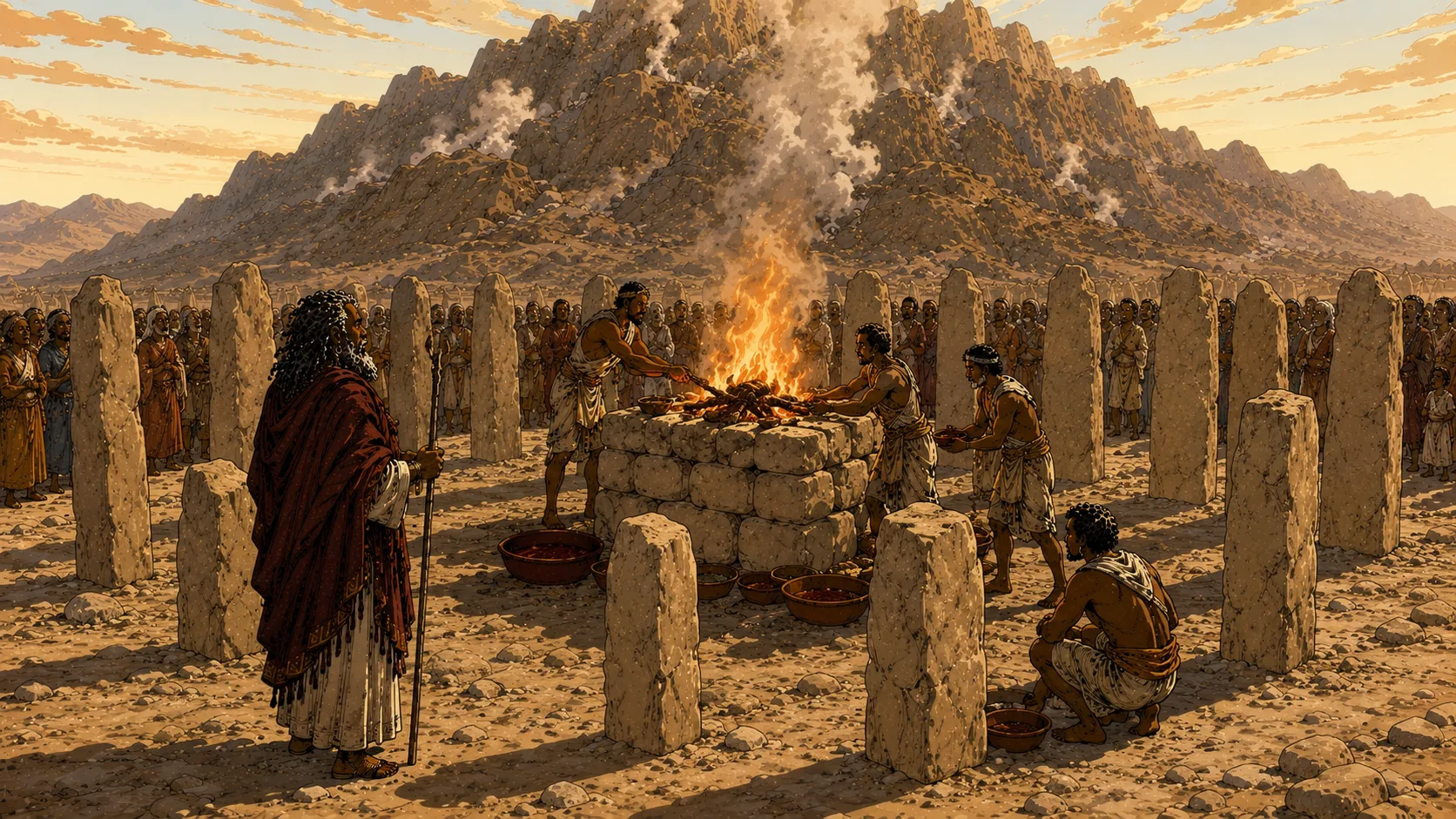
Before any blood is splashed, before any oath is sworn, Moses does two things that establish the physical landscape of covenant. He writes — כָּתַב (katav) — all the words of YHWH. Then he rises early. The early rising is characteristic: Moses throughout the Torah wakes before dawn for the acts that matter most. He builds an altar at the foot of the mountain, and then twelve standing stones — שְׁתֵּים עֶשְׂרֵה מַצֵּבָה (shteim esreh matzevah) — one for each of the twelve tribes of Israel.
The altar is the vertical axis of the scene: the point at which Israel approaches YHWH, where sacrifice is offered and blood is presented. The twelve pillars are the horizontal: the representation of all twelve tribes, assembled as partners in the covenant about to be ratified. Neither the altar alone nor the pillars alone is sufficient — both are required. The altar without the pillars would be individual devotion without corporate identity. The pillars without the altar would be national identity without a center of divine meeting. Together they map the full covenant landscape: all of Israel, gathered around YHWH.
The young men of Israel (נַעֲרֵי בְּנֵי יִשְׂרָאֵל, na'arei b'nei Yisrael) are sent to offer burnt offerings and peace offerings of oxen. These are the two types of offering that bracket the covenant ceremony: the olah (עֹלָה, burnt offering), which ascends entirely to YHWH and is completely consumed, and the shelamim (שְׁלָמִים, peace offerings), which are shared between YHWH, the priests, and the worshippers. Together they express the full movement of covenant worship: the total giving of the self to YHWH (olah) and the shared meal of reconciled relationship (shelamim).
The twelve matzevot — standing stones — are among the oldest forms of Israelite sacred monument. In the patriarchal narratives, Jacob sets up a matzevah wherever he encounters God: at Bethel (Genesis 28:18), after his wrestling at Peniel (Genesis 35:14), over Rachel's grave (Genesis 35:20). The standing stone marks a site of encounter, a moment of contact between heaven and earth, a claim that something permanent happened here. At Sinai, the twelve pillars make that same claim for every tribe simultaneously: all twelve were here. All twelve stand bound.
The detail of the twelve — rather than a single stone for all Israel — is important. The covenant is made with a people constituted by particular families, particular inheritances, particular histories. YHWH's covenant is not made with an abstraction called "Israel" but with twelve specific peoples who share a common ancestry and a common calling. The twelve pillars are the twelve names of Israel — and every one of them stands at the foot of the mountain where the fire burned.