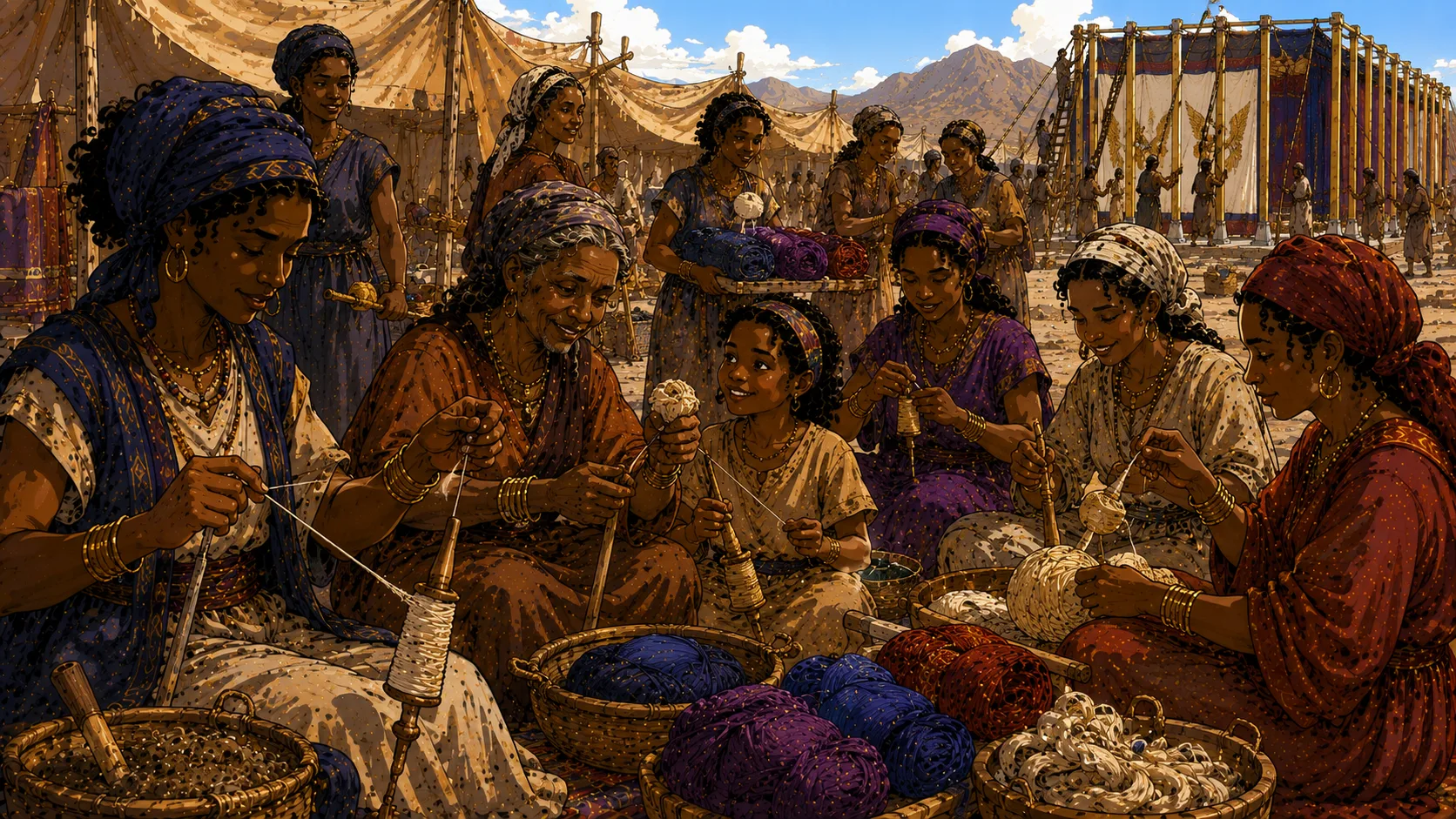
Within the larger account of the freewill offering — the bringing of gold, silver, fabric, wood, oil, and spice from all who were willing — two verses single out the women. Exodus 35:25 opens with: וְכָל-אִשָּׁה חַכְמַת-לֵב — every woman who was wise-hearted. The phrase applied earlier to the male craftsmen is now applied to the women. The category of craftsmanship by wisdom is not gendered; it describes the quality of the heart that does the work. These women spun with their hands — בְּיָדֶיהָ טָווּ — and brought what they had spun: the blue, the purple, the crimson thread, and the fine linen. The text specifies the hands. The work came from their own bodies.
Verse 26 shifts to a subset: וְכָל-הַנָּשִׁים אֲשֶׁר נָשָׂא לִבָּן אֹתָנָה בְּחָכְמָה — all the women whose hearts lifted them up in wisdom. This group spun the goat hair. The ancient Rabbis noted that spinning goat hair while it was still on the living animal — the highest form of this skill — required an exceptional combination of ability and willingness. Whatever the precise technique, the text marks it as a special category of wisdom-work: only those whose hearts rose to the level of the task could do it. The goat hair they produced became the second layer of curtains over the Mishkan — the outer protective covering that shielded the inner linen from weather and the open sky of the desert.
These women are not named. Among all the craftsmen named in these chapters — Bezalel son of Uri son of Hur, Oholiab son of Ahisamach — the women who spun receive no individual names. And yet the text does not absorb them silently into the general congregation; it gives them their own two verses, their own description, their own category of wisdom. Whoever reads Exodus 35 must pass through these verses about the spinning women before arriving at the presentation of Bezalel. They are not a footnote; they are part of the sequence.
What the spinning women made covers the tabernacle. The fine linen of verse 25 — shesh, the fine twisted linen — became the innermost curtains of the Mishkan, the first layer closest to the holiest space. The goat hair of verse 26 became the second set of curtains, covering the first. The fabric of the women's hands is the surface on which the cherubim are woven, and the weather-cover that lies over all. The inner sanctum of YHWH's dwelling is wrapped in what women spun. The tabernacle is held by the work of hands the Torah does not name.
The whole passage of Exodus 35–36 is notable for what it is not: it is not compelled labor. In Egypt, Israel worked without wages, without rest, without their own consent — building storage cities for Pharaoh with their bodies and their lives. Here, free people give what they choose to give and work what they choose to work. The women's spinning is as free as any other act in these chapters. Their hearts lifted them up. No taskmaster governed the spinning of goat hair. What they made, they made because they chose to — and the place where YHWH would dwell was built on exactly that kind of willingness.