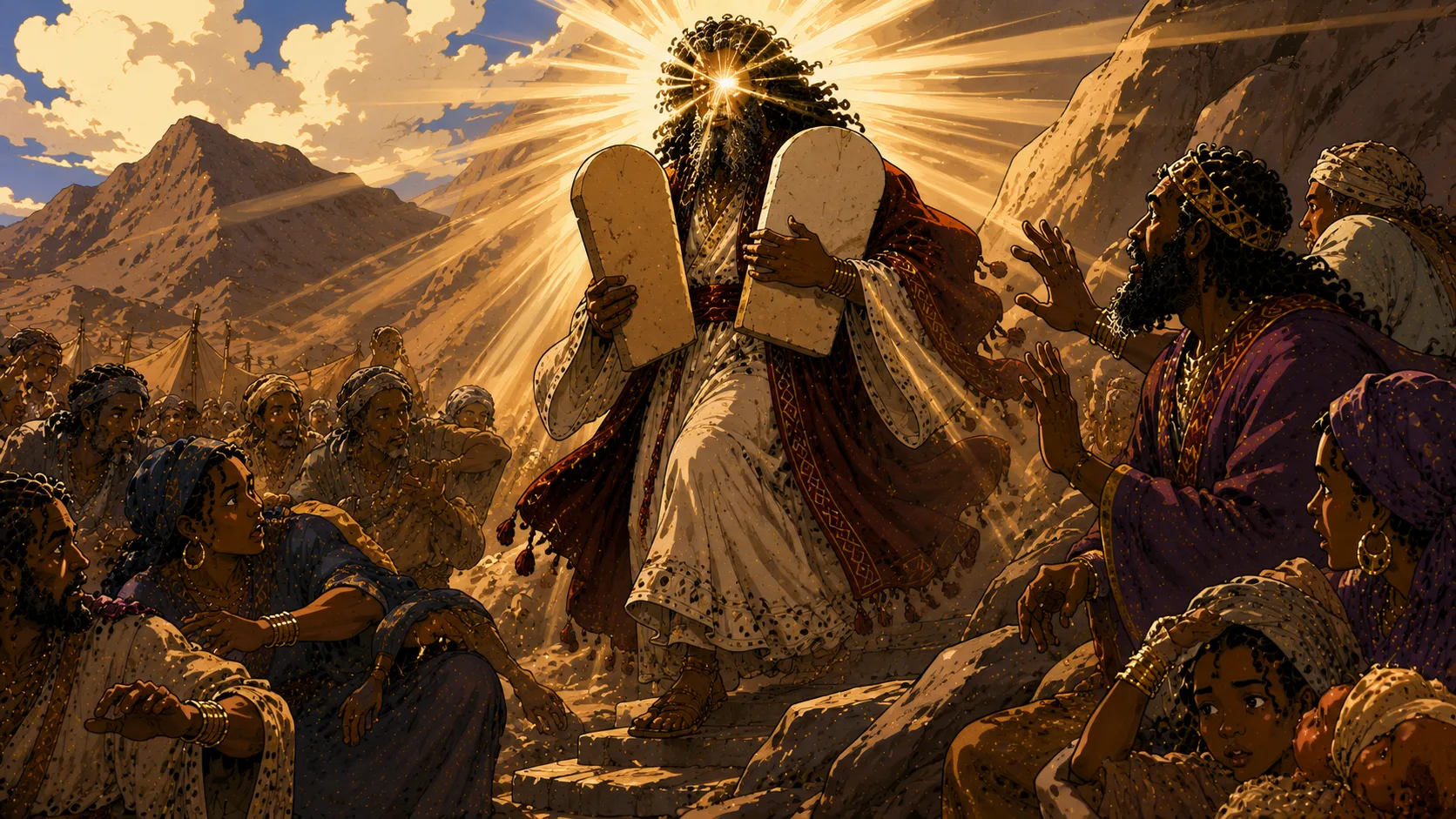
Moses descends from Sinai with the two tablets of testimony in his hands. The tablets are mentioned before the face — the covenant comes first in the sentence, then the condition of the man who carries it. The text gives us Moses in motion: coming down, tablets in hand, and then the detail that will change everything: וּמֹשֶׁה לֹא-יָדַע — Moses did not know. He does not know that the skin of his face is shining. The transformation happened to him in the encounter with YHWH — כִּי קָרַן עוֹר פָּנָיו בְּדַבְּרוֹ אִתּוֹ, because he had spoken with him — and he carries it without awareness. It is the mark of someone who has actually been with the Holy; such marks are not self-conscious. The one who performs holiness knows what he is doing. The one who has been changed by it may not.
Aaron sees him first. Then all the people of Israel see Moses — וְהִנֵּה קָרַן עוֹר פָּנָיו — and behold, the skin of his face was shining. And they are afraid to approach him. The same people who, forty days before, stood at their tent doors and worshipped as the cloud descended, are now frightened by the residual light on the face of the man who spoke with YHWH. Moses calls to them — Aaron first, then the leaders of the congregation — and they come. He speaks to them all that YHWH had commanded on Sinai. When he finishes speaking he places the veil on his face.
The pattern that follows is described with precision in verses 34–35. Whenever Moses goes before YHWH to speak with him, he removes the veil. When he comes out and tells the people what was commanded, the people see his face shining — and then he puts the veil back on until he goes in to speak with YHWH again. The veil goes on between the encounter with YHWH and the next encounter. It is not for protection; it is for the people's capacity. The full brightness of a face that has been with YHWH face-to-face is more than they can look at in everyday camp life. Moses covers the residue of glory so that Israel can function in his presence between the times when he goes back.
The detail that Moses did not know changes the quality of the encounter entirely. This is not a display. Moses is not presenting himself as the illuminated prophet, the radiant mediator. He descends carrying the tablets, not performing a revelation. The face that shines is the unintended side effect of time spent with YHWH, the visible trace of an encounter that was about the covenant written on stone, not about Moses himself. His unawareness is part of the text's characterization of him throughout Exodus: the most humble of men (Numbers 12:3), the one who consistently deflects attention from himself toward the One who called him from the burning bush.
Jerome's Latin Vulgate translated קָרַן (karan — shining) as "cornuta" (horned), and this gave Western Christian art Moses with horns — from medieval manuscripts to Michelangelo's great statue in Rome. The root קֶרֶן (keren) can mean "horn" when used as a noun, but as a verb it means to send out rays of light, to radiate. The image is of light beaming outward like the horn shape of rays in ancient solar iconography. Moses radiates. He does not have horns. But the word carried both meanings, and the mistranslation has held for centuries — a reminder that the same original text, read through different lenses, can produce very different Moseses.