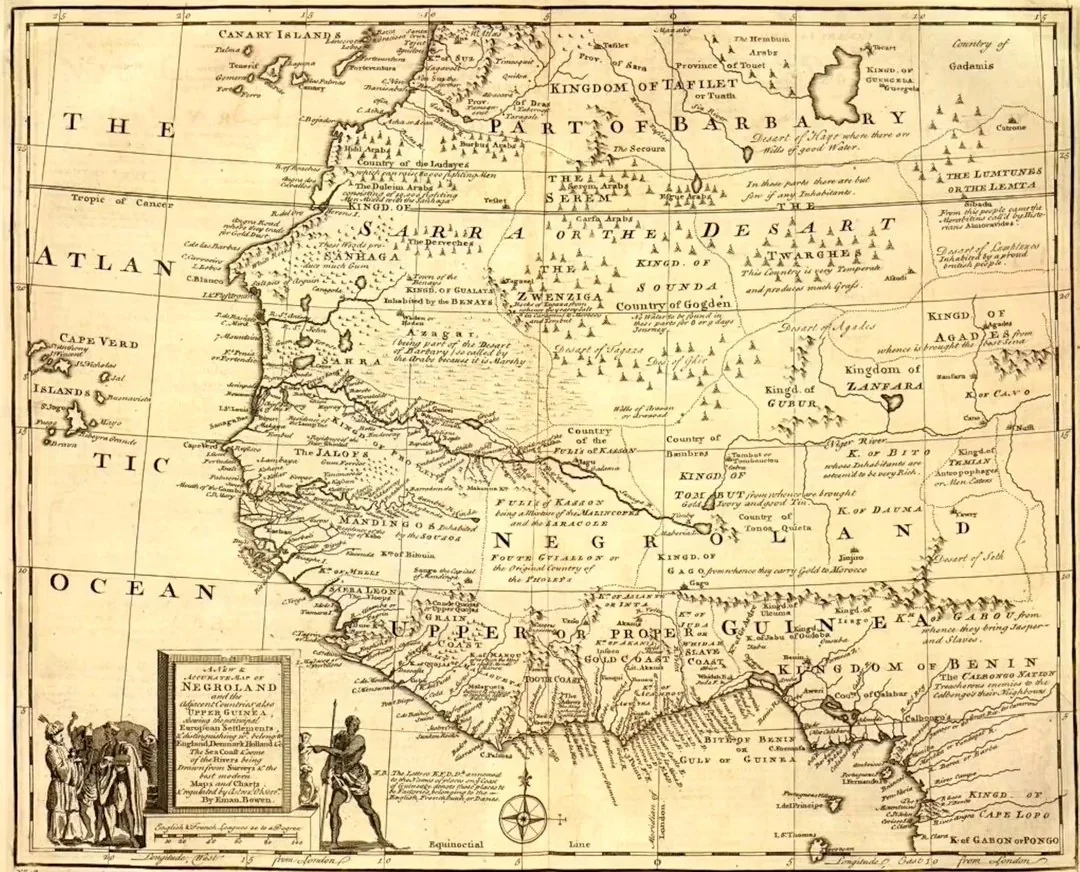
In 1747, a British cartographer named Emanuel Bowen published a map of West Africa. In the region along the coast of the Bight of Benin — the area today encompassing Nigeria, Benin, and the surrounding territories — he labeled a specific kingdom: "Kingdom of Judah."
Bowen was not the first. He was the fourth. Three other independent European cartographers — French, German, and Dutch — had labeled the same region with the same name across the preceding forty years. None of them were in communication with each other. None of them had access to the others' work when they made their maps. And all four placed the Kingdom of Judah in the same geographic location.
This article asks the question the maps themselves raise: why?
I. The Maps — Four Independent Witnesses
The convergence on a single name across four independent national cartographic traditions is the starting point of the argument, not the conclusion. It requires no interpretation — only the historical record.
| Cartographer | Nation | Date | Label Used |
|---|---|---|---|
| Guillaume Delisle | France | 1707 | Royaume de Juda (Kingdom of Judah) |
| Johann Baptist Homann | Germany | c. 1720 | Königreich Juda (Kingdom of Judah) |
| Pieter van der Aa | Netherlands | 1727 | Koninkrijk van Juda (Kingdom of Judah) |
| Emanuel Bowen | Britain | 1747 | Kingdom of Judah |
Four nations. Four languages. Four cartographic traditions. Forty years. The same label, the same geography.
Cartographers do not invent names for regions. They record what they encounter — through explorers' accounts, merchants' reports, local informants, and earlier maps. When four independent cartographic traditions from four different nations converge on the same name for the same region across four decades, the name was there to find. They did not put it there. They recorded it.

II. How Israel Reached West Africa — The Geographic Corridor
Before examining the evidence for an Israelite presence in West Africa, it is necessary to establish which exile wave most plausibly produced that presence — and equally important, which one did not.
The 722 BCE Assyrian deportation of the northern tribes moved Israel eastward — into Mesopotamia, Media, and the territories beyond the Euphrates. The Arzareth tradition of 2 Esdras 13, in which the tribes crossed the Euphrates into a "land where never mankind dwelt," points northeast and east: Persia, Central Asia, the Silk Road corridor. The eastern strand of the dispersal is a distinct and documented argument dealt with in the companion article The Arzareth Question. It is not the route that most plausibly accounts for West African Israelite presence.
The two most geographically coherent routes to West Africa are:
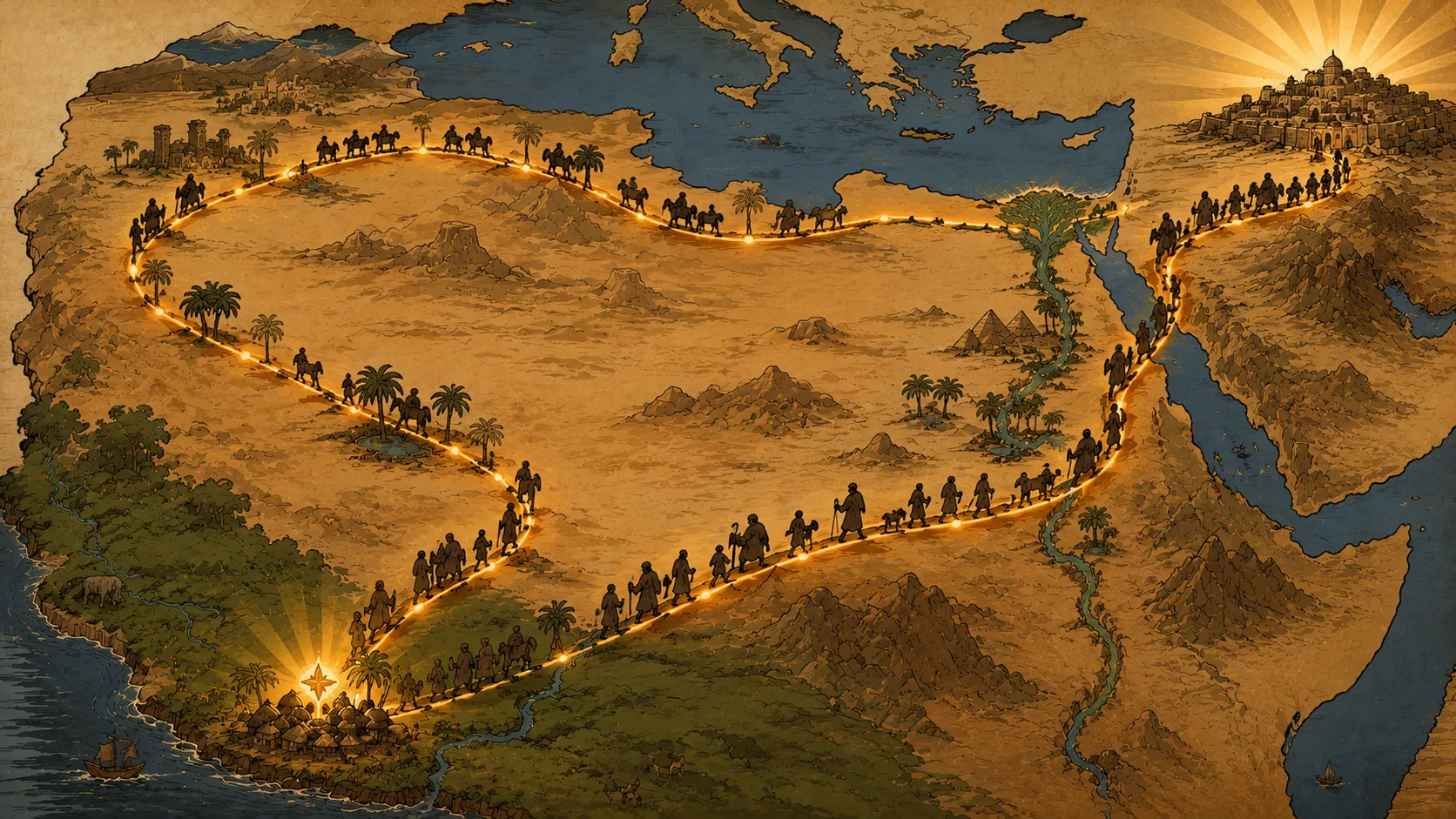
The post-586 BCE Egyptian flight (Jeremiah 43–44). After the Babylonian destruction of Yerushalayim, a community of Israelites fled southward into Egypt against the prophet Yirmeyahu's counsel. From Egypt, established trans-Saharan and Nile Valley trade routes run westward and southward into sub-Saharan Africa — routes documented by Arab geographers from the 10th century onward. Communities following this corridor over subsequent centuries would have arrived in the West African interior through the Saharan oases, the Sahel corridor, and along the Niger River basin.
The post-70 CE Roman dispersal through North Africa. The Roman destruction of Yerushalayim in 70 CE scattered Yehudim in multiple directions — westward across the Mediterranean and southward into North Africa. Arab geographers including al-Masudi (10th century) and al-Idrisi (12th century) documented Hebrew-rooted communities along North African trade corridors centuries before the Atlantic slave trade began. From the Maghreb, established trans-Saharan routes descend into sub-Saharan West Africa — the same corridor the Berber communities Ibn Khaldun documented had followed for centuries.
These two routes — the Egyptian flight southward and the North African dispersal — are the most geographically coherent explanations for Israelite communities arriving in West Africa over several centuries before the European cartographers appeared.
III. The Arab Historiographic Chain — Five Centuries of Documentation
The European maps did not arrive in a documentary vacuum. Arab historians had been documenting Hebrew-rooted communities along the North African corridor and in sub-Saharan West Africa for three to four centuries before Delisle drew his 1707 map. That Arab historiographic chain is the article's most important evidence base — because it is independent of the European cartographic record. The two streams of documentation, converging on the same geography from entirely different directions, constitute independent corroboration.
al-Masudi (10th century)
Abu al-Hasan al-Masudi, the Arab historian and geographer known as the "Herodotus of the Arabs," documented in his Muruj al-Dhahab (Meadows of Gold, c. 943 CE) Hebrew-rooted communities in sub-Saharan Africa. Writing three centuries before the Mali empire reached its height, al-Masudi recorded communities south of the Sahara observing practices consistent with an Israelite heritage along the trans-Saharan trade corridor.
al-Idrisi (12th century)
Muhammad al-Idrisi, the Arab geographer who produced the Tabula Rogeriana for the Norman King Roger II of Sicily (c. 1154 CE), documented in detail the communities along the trans-Saharan corridor and the sub-Saharan interior. His geographic records provide the most comprehensive 12th-century Arab account of the region, including communities along the Niger River basin — the geographic corridor the 1402 Tindirma community would later occupy.
Ibn Khaldun — Bani Isra'il (14th century)
Ibn Khaldun (1332–1406) — universally recognized as the founder of sociology and the sciences of history — is the most methodologically significant Arab witness for this article's argument, for a reason that goes beyond geography. He used the precise term that matters: Bani Isra'il — the Children of Israel — the bloodline patrilineal descendants of Yaakov's twelve sons. As an Arab Muslim historian writing in Arabic and drawing from the Quranic vocabulary, Bani Isra'il was his consistent term for the people the Bible calls Israelites. It is not a religious designation. It is a bloodline and genealogical one — the same distinction this platform holds throughout.
And Ibn Khaldun did something in the Muqaddimah that makes him particularly valuable: he explicitly distinguished the historical Bani Isra'il from the later Jewish religious community. He wrote that the Jewish claim to a continuous and unbroken lineage of nobility from the people of Israel at their zenith "does not correspond with reality" — that the asabiyyah (tribal solidarity and nobility) held by the Bani Isra'il in their prime was not the same unbroken thing that existed in the Jewish religious community that came after the Roman period. In other words, in 1377, the founder of sociology drew the same distinction this platform draws: Israelite is the bloodline category; Jewish is the religious identity that developed after the exile. The two are related but not identical.

In his Kitab al-Ibar (Book of Lessons), Ibn Khaldun also documented specific named North African Berber tribes carrying Hebrew-rooted practice: "Part of the Berbers professed Judaism… Among the Jewish Berber tribes were the Djeraoua, a tribe to which belonged the Kahena, a woman who was killed by the Arab conquerors… The Jewish Berber tribes were the Nefousa of Ifriquiya, the Fendelaoua, Mediouna, Bahloula, Ghiata of the Moghreb el Aksa." He noted these communities received their Hebrew-rooted identity "from their powerful neighbors, the Israelites of Syria." He used Israelites as the bloodline source.
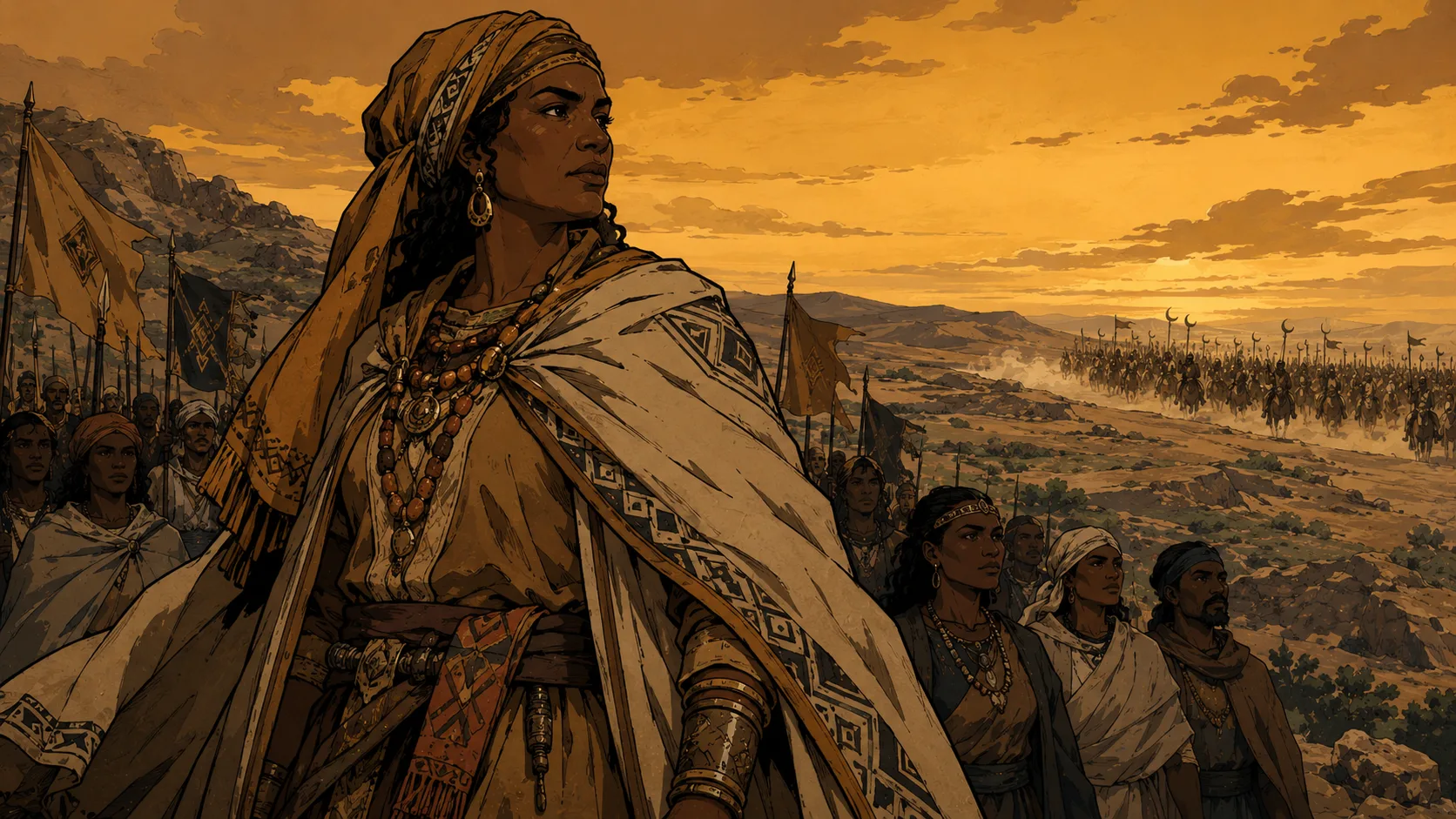
The Kahena story deserves particular attention. In 694 CE, when Arab armies invaded westward along the North African coast, the Hebrew-rooted communities allied with the Berbers against the invasion, rallying around the Kahena — called "Queen of Africa" — as their military leader. This is not a footnote. It is a documented Hebrew-rooted woman leading a North African military confederation in 694 CE, seven centuries after the Roman destruction of Yerushalayim. The community that produced her had survived, organized, and maintained enough cohesion to mount military resistance. Ibn Khaldun documented this in the 14th century from accounts he traced to older Arab sources — independently confirmed.
al-Maqrizi (early 15th century)
Taqi al-Din al-Maqrizi (1364–1442) was a direct student of Ibn Khaldun and is recognized as the most influential historian of pre-modern Egypt. Based in Cairo — the geographic gateway between the Levant and West Africa — he carried Ibn Khaldun's Bani Isra'il framework directly into the 15th century. His Kitab al-Khitat (Book of Districts) is the foundational primary source on Egypt's urban and social history. Writing contemporaneously with the documented 1402 Tindirma Bani Isra'il community, al-Maqrizi preserved and extended the historiographic chain from the North African corridor onward.
The Tarikh al-Fattash — 1402 CE
The most specific and detailed piece of primary evidence in the entire chain is not from a European cartographer but from an Arabic manuscript. Manuscript C of the Tarikh al-Fattash — the West African chronicle compiled by Mahmoud Kati — records the following for the year 1402 CE:
"In 1402, they [the Bani Israel] lived in Tindirma, possessed 333 wells, and had seven princes as well as an army."
A named community — called Bani Isra'il in the Arabic manuscript, meaning Children of Israel. A specific date: 1402 CE. Specific details: 333 wells, seven princes, an army. Geographic location: Tindirma, in the Niger River region of West Africa. This community was organized, established, and substantial enough to be documented with specific administrative and military details.
This is 1402 CE. Not a rumor. Not a folk tradition. A named, dated, documented Bani Isra'il community in West Africa — three centuries before the earliest of the four European maps appeared.
The European cartographers did not invent the Kingdom of Judah. They were mapping what the Arabic historical record had documented for three to four centuries before them.
IV. Internal Conflicts — Why the Communities Look Different
Before examining the specific West African communities and their traditions, a brief context is necessary for understanding why they differ from each other. The Israel that dispersed into Africa was not a unified community. It carried centuries of internal division with it.
- The 931 BCE split divided the twelve tribes into two kingdoms — Yehudah in the south and Israel (the northern ten tribes) in the north — which then spent two centuries in intermittent conflict before the Assyrian exile. Different communities in West Africa may descend from different sides of that split, carrying different traditions, different tribal attributions, and different degrees of preserved practice.
- The Samaritan schism. After the Assyrian exile, the northern territory was repopulated with peoples from across the empire who intermarried with remaining Israelites, producing a mixed community with a syncretistic form of Israelite practice. Communities with Samaritan background carried an Israelite heritage that looked different from the surviving Yehudi southern house.
- The Hasmonean forced conversions. Under John Hyrcanus I (c. 130 BCE), the Idumean and other neighboring peoples were forcibly converted to the practice of Judaism — creating a class of converts who practiced the religion but did not carry the bloodline. This introduced a distinction between bloodline Israelites and practicing converts that ran through the first-century community and influenced how communities in the diaspora identified themselves.
- The Pharisee–Sadducee conflicts and the post-70 CE fragmentation of the Yehudi community produced communities with different halakhic practices, different calendars, different levels of preserved Hebrew, and different oral traditions about their own origin.
These internal divisions explain why West African communities claiming Israelite heritage have different oral traditions, attribute themselves to different tribes, and observe different combinations of practices. They are not all from the same community. They arrived over different centuries, through different routes, carrying different fragments of a genuinely scattered Israel.
V. The Port of Juda — Geographic Convergence
The region the maps labeled the Kingdom of Judah contains a specific point of geographic convergence that deserves its own section.
The major slave-trading port on the Bight of Benin coast was known in colonial records variously as Ouidah, Juda, and Whydah. The name Juda — a direct phonetic rendering of the Hebrew tribal name — was used consistently in Portuguese, French, British, and Dutch colonial trading records for the same port from which over a million enslaved people were taken across the Atlantic.
This is the convergence: the region labeled the Kingdom of Judah on four independent European maps contains a major port that colonial traders of multiple nations independently called Juda. The geographic and nominal convergence — Israelite tribal name, applied independently by both cartographers labeling a kingdom and traders naming a port, in the same geographic location — is not reasonably explained as coincidence.
The port of Juda was the departure point for enslaved peoples taken primarily from the Bight of Benin and Bight of Biafra regions — including the Igbo of Nigeria, who represent the dominant ethnic group in the slave trade from this specific region, particularly for British colonial destinations. The geographic convergence of the Kingdom of Judah map label, the Juda port name, the Igbo oral traditions of Israelite descent, and the Deuteronomy 28:68 "brought back to Egypt with ships" passage from that exact coastline is the article's most striking convergence of independent evidence.
VI. Oral Traditions in West Africa
The Igbo
The Igbo of Nigeria are one of the largest and most documented West African peoples, numbering approximately 40 million today. Their oral traditions of Israelite descent are real, multiple, and internally diverse — which is itself consistent with a genuine diaspora community rather than a fabricated claim.
Some Igbo traditions attribute descent to the tribe of Gad specifically, through the figure of Eri ben Gad (Numbers 26:16). Others claim descent from different northern tribes. Still others hold a broader pre-tribal Hebraic identity that precedes tribal attribution. The diversity of the claims mirrors what would be expected from a community that arrived through multiple waves over multiple centuries, carrying different fragments of the tradition.
What is consistent across Igbo oral tradition is the claim of ancient Israelite descent — a claim that predates any contact with European missionaries and cannot be explained as derived from Christian influence, since the specific tribal and genealogical details of the claims go far beyond what Christian mission teaching would have transmitted.
The Igbo were the dominant ethnic group taken from the Bight of Biafra in the Atlantic slave trade, particularly to British colonial destinations. They were taken through the ports adjacent to the region the European maps labeled the Kingdom of Judah. The geographic convergence — Israelite oral tradition, Kingdom of Judah map label, Juda port name, Deuteronomy 28:68 ships — is concentrated in the same region.
The Sefwi Wiawso Community (Ghana)
The Sefwi Wiawso community of Ghana is the strongest independently-documented case in the article, and it deserves more space than it typically receives in treatments of this question.
In the early 20th century — before modern media, before the internet, before any mechanism existed for cultural diffusion of Jewish practice into rural Ghana — Christian missionaries and anthropologists documented a community in the Sefwi Wiawso region observing:
- The Passover (with unleavened bread)
- Rosh Hashanah
- The seventh-day Sabbath
- Dietary restrictions consistent with Torah food laws
- Hebrew prayer fragments preserved in oral tradition
- Circumcision on the eighth day
The timing of the documentation matters enormously. These practices were not adopted from missionaries — the missionaries were the ones who discovered them. The community was observing practices consistent with ancient Israelite practice independently, in rural Ghana, in the early 20th century, with no contact with the Jewish world that could explain the parallels through cultural diffusion.
This is independent documentary corroboration from a Christian missionary source — a source with no interest in confirming Israelite heritage in West Africa — documenting practices that cannot be explained except by tracing them to their Israelite origin.
The Ashanti and Akan Peoples
The Ashanti and broader Akan-speaking peoples of Ghana preserve oral traditions and cultural practices with documented parallels to ancient Israelite practice: prohibitions on certain foods, purification rituals, naming conventions that parallel Hebrew patterns, and royal court traditions with structural similarities to the Israelite monarchic period. The Akan oral tradition of descent from "the East" — from peoples who crossed water and traveled a long road — is consistent with a dispersal from the Levantine region through the North African corridor.
VII. The 1492 Expulsion — History Confirms the Pattern
The year 1492 is the most striking single date in this article's argument — because in that single year, on both sides of the Sahara, the same pattern activated simultaneously.
- Spain — the Alhambra Decree (March 31, 1492). The Spanish Crown gave approximately 150,000–200,000 people of Sephardic descent four months to convert to Catholicism or leave. These were communities that had lived in Iberia since the Roman destruction of 70 CE — communities that included genuine Israelite bloodline descendants who had preserved Hebrew practice through centuries of exile. The Spanish Inquisition, running since 1478, had been targeting not religion but bloodline — tracking conversos (forced converts) who secretly continued Shabbat, dietary laws, and Hebrew practice. It was tracking a people, not a theology.
- Mali/Songhai — Askia Mohammed's decree (1492). In the same year, on the other side of the Sahara, Askia Mohammed came to power in the Songhai Empire and decreed that the Bani Isra'il — called by that name in the Arabic records — must convert to Islam or leave. Leo Africanus, writing in 1526, documented the aftermath: "The king is a declared enemy of the Jews. He will not allow any to live in the city. If he hears it said that a Berber merchant frequents them or does business with them, he confiscates his goods." The Bani Isra'il community documented at Tindirma in 1402 — 333 wells, seven princes, an army — was expelled 90 years later.
- Columbus sails (August 1492). Three months after the Alhambra Decree, Columbus sails westward. The mechanism that becomes the Atlantic slave trade — the "brought back to Egypt with ships" of Deuteronomy 28:68 — begins its operation in the same year as both the Iberian and West African expulsions.
One year. Two hemispheres. The same outcome: people with Israelite heritage losing their land, their name, their community, or their freedom.
The article that traces this pattern across empires and centuries — the Crusades, the Almohad conquests, the Spanish and Portuguese Inquisitions, the Ottoman dhimmi system, the colonial prohibition of Hebrew practice — is forthcoming in this series as The Crafty Counsels. Psalm 83:4 named the intention: "Let us cut them off from being a nation; that the name of Israel may be no more in remembrance." The 1492 convergence is one year in a pattern that runs across fifteen centuries and every inhabited continent.
VIII. Genetic Evidence
The genetic record provides partial support that must be read carefully.
The haplogroup most directly relevant to the argument is J1 — the Y-chromosome haplogroup associated specifically with the ancient Near East and the Semitic-speaking populations of the Levant. J1 appears at statistically elevated frequencies in certain West African communities, particularly those with oral traditions of Israelite descent. Its presence in those specific communities — rather than in the broader West African population as background frequency — is consistent with a distinct Near Eastern patrilineal contribution to those communities' ancestry.
The Lemba of Southern Africa provide the most precisely documented genetic case in the region. A 2000 study published in the American Journal of Human Genetics found that the Lemba carry the Cohen Modal Haplotype — a specific Y-chromosome marker associated with the patrilineal line of Israelite priests — at frequencies comparable to Jewish populations in Israel and elsewhere. The Lemba's own oral tradition holds that their male ancestors came from a place called Sena in the north, traveled south by water, and brought with them the commandments, the Sabbath, and dietary restrictions. The genetic evidence confirmed what the oral tradition described: a Levantine patrilineal contribution to a Southern African community's ancestry.
The haplogroup E1b1b is occasionally cited in this context but should be named with precision: it is broadly distributed across all of Africa and North Africa and is not specifically a Near Eastern or Semitic marker. It does not, on its own, support a specific Israelite connection. J1 is the marker that carries genuine argumentative weight for this specific claim.
IX. What the Map Cannot Prove
This article has assembled real, documented, multiple-sourced evidence. It is worth being precise about what that evidence establishes and what it does not.
What it establishes: Four independent European cartographic traditions labeled the same West African region the Kingdom of Judah across forty years. Arab historians documented Hebrew-rooted and Bani Isra'il communities in North Africa and sub-Saharan West Africa from the 10th through the 15th centuries — independently of and prior to the European maps. An Arabic manuscript records a Bani Isra'il community at Tindirma in 1402 CE with specific details (333 wells, seven princes, an army). A major slave-trading port in the same region was independently called Juda in multiple colonial records. West African communities — the Igbo, the Akan, the Sefwi Wiawso, and others — preserve oral traditions and cultural practices with documented parallels to ancient Israelite practice. The Lemba carry the Cohen Modal Haplotype. The J1 haplogroup appears at elevated frequencies in specific communities with oral traditions of Israelite descent.
What it does not establish: It does not prove which specific modern individuals or communities are the bloodline descendants of which specific Israelite tribe. It does not adjudicate whether any given person's ancestry traces specifically to the Bani Isra'il rather than to neighboring peoples who adopted Israelite practice. It does not confirm every claim of Israelite descent made by every community that makes one.
The biblical identifier Yah gave: The platform does not adjudicate who is an Israelite. The curses do. The Deuteronomy 28 pattern — matched against documented history — is the biblical identifier Moshe gave for recognizing the scattered Israelites regardless of where their tribal names were lost. The scattered among all nations (Deuteronomy 28:64). The serving of other gods — the religion of the captors (Deuteronomy 28:64). The name of Israel no longer in remembrance among them (Psalm 83:4). The carried into Egypt with ships (Deuteronomy 28:68). The sold as bondmen and bondwomen with no buyer (Deuteronomy 28:68). The stranger rising above them and they coming down very low (Deuteronomy 28:43–44).
The platform names the pattern. The reader who encounters that pattern in their own history is left to sit with what it means for their own identity. That is the right discipline. The foundational question — who the Israelites are, why the bloodline and religious identity distinctions matter, and what the biblical record actually says — is answered directly in Who Are the Israelites?
X. The Call
The 1747 map asks a question the platform exists to help answer. The Kingdom of Judah was not invented by a European cartographer. It was recorded. Arab historians had documented it for three centuries before Bowen drew his map. A community called Bani Isra'il was living there in 1402 with 333 wells and seven princes and an army. They were expelled in 1492. Their descendants — scattered by expulsion, captivity, and the Atlantic slave trade — are in every nation now.
Yeshua said it directly, on the Mount of Olives: "They shall fall by the edge of the sword, and shall be led away captive into all nations... until the times of the Gentiles be fulfilled" (Luke 21:24). The captivity into all nations. The until. The times of the Gentiles are numbered. When that measure is full, the gathering that Jeremiah 50:4, Ezekiel 37, Zechariah 10:6, and Isaiah 11:12 all describe begins its completion.
This article speaks to two groups.
To the Israelite — the bloodline descendant of Yaakov's twelve tribes who may be reading this and finding their own history in it: the Deuteronomy 28 pattern is not an argument someone invented. Moshe named it fifteen centuries before the Atlantic slave trade. The maps, the Arab historians, the oral traditions, and the genetic record are all pointing at the same thing. The gathering is underway. The commandments are the path back to the covenant your ancestors kept. The final commandment — Do Not Forsake the Covenant — is the legal frame Deuteronomy 29 gives for why Israel's scattering happened and what Deuteronomy 30 says comes after. All 613 are gathered at hebroni.com/en/commandments/.
To the Christian — who has been following the Messiah of Israel without knowing his Hebrew context or his people's story: the first community called Christian at Antioch included a prophet named Shimon — a Black African man whose Hebrew name is the second son of Yaakov. The faith you follow was born among the Bani Isra'il the maps and the Arab historians document. Return to the Hebrew roots is return to what the first believers actually practiced.
The gathering is for both. The commandments are the road.
A Note on Method
This article builds its argument on documented historical sources: cartographic records (Delisle 1707, Homann c.1720, van der Aa 1727, Bowen 1747), Arab historiographic texts (al-Masudi 10th century, al-Idrisi 12th century, Ibn Khaldun Muqaddimah and Kitab al-Ibar 14th century, al-Maqrizi 15th century), the Tarikh al-Fattash Arabic manuscript (1402 CE Tindirma account), Leo Africanus (1526), independently-documented oral traditions and cultural practices, and genetic evidence (Lemba Cohen Modal Haplotype, AJHG 2000; J1 haplogroup). The claim that Jewish merchants dominated the Atlantic slave trade is not included — it is not supported by the scholarly record, was originated by the Nation of Islam's 1991 Secret Relationship and rejected by the American Historical Association, and would damage the article's credibility without strengthening its argument. The Igbo oral traditions are presented with honest acknowledgment that multiple tribal attributions exist rather than a single unified claim. The haplogroup evidence is limited to J1 as the Near Eastern marker — E1b1b is too broadly distributed across Africa to carry specific argumentative weight for this claim. The geographic corridor correction (post-586 BCE Egyptian flight and post-70 CE North African dispersal as the most plausible routes to West Africa, rather than the 722 BCE Assyrian exile which went east) is documented in Jeremiah 43–44 and the Arab geographic record. The 722 BCE Assyrian exile and the Arzareth tradition are treated in the companion article The Arzareth Question.
Companion Reading
- The Arzareth Question — the eastern strand of the dispersal: where the ten tribes went after 722 BCE
- Deuteronomy 28: The Curses, the Prophecy, and the Way Back — the biblical pattern this article applies to documented history
- Who Are the Israelites? — the foundational context for the platform's full framework
- The Apple of His Eye — what Yah himself says about the people this article traces
Sources
- Emanuel Bowen, A New and Accurate Map of Negroland and the Adjacent Countries (1747) — David Rumsey Map Collection
- Guillaume Delisle, Carte d'Afrique (1707); Johann Baptist Homann, Regnum Congo (c. 1720); Pieter van der Aa, Koninkryk Juda (1727)
- Ibn Khaldun, Muqaddimah and Kitab al-Ibar (14th century) — on Bani Isra'il and Berber-Hebrew communities
- Mahmoud Kati, Tarikh al-Fattash, Manuscript C — 1402 CE Tindirma Bani Isra'il entry
- Leo Africanus, Description of Africa (1526) — on Askia Mohammed's 1492 expulsion decree
- Thomas MG et al., "Y Chromosomes Traveling South: The Cohen Modal Haplotype and the Origins of the Lemba" — American Journal of Human Genetics 66(2):674–86, 2000
- Deuteronomy 28 — Hebroni Torah Reader
- Isaiah 11:12 — Hebroni Nevi'im Reader
✡ The Commandments Are the Road Back
The same covenant the prophets spoke from — every one of the 613 commandments given at Sinai, numbered, explained, and linked to their biblical source.
The 613 Commandments Read the Torah