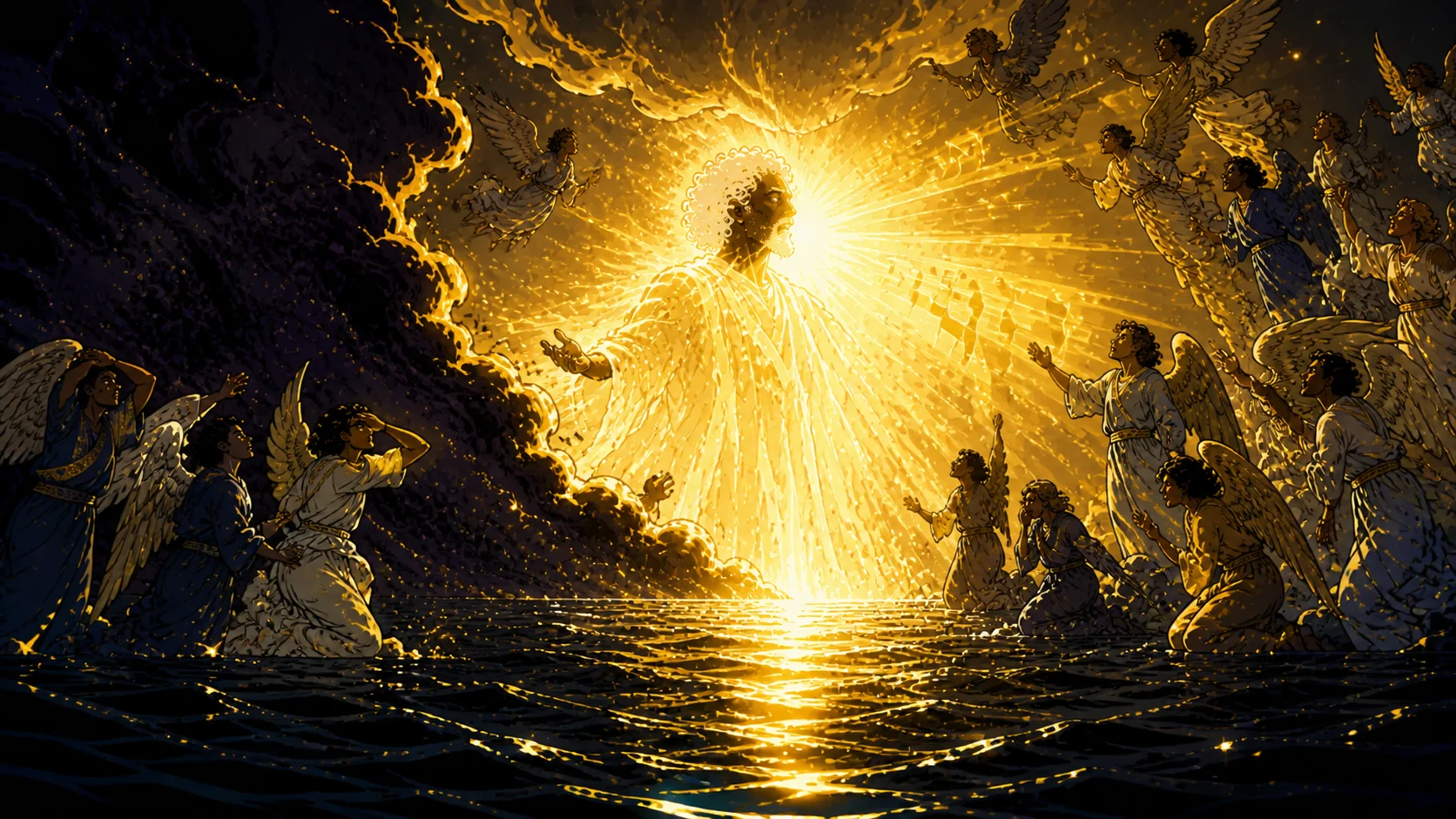
The book does not begin with Israel. It does not begin with a covenant, a law, or a chosen people. It begins with everything — the heavens, the earth, the darkness, the waters, and a wind of God hovering over the face of the deep. Bereshit is the most universal book in the Torah. Before it narrows to one family, one nation, one covenant, it lays claim to all of reality: this is where everything came from, and every nation on earth has a stake in what happens next.
The Hebrew name of the book is its first word: Bereshit — "In the beginning." The Greeks titled it Genesis — origins, beginnings — but that name describes the book from outside. Bereshit enters it. The word is prepositional: be- (in) + reshit (beginning, firstness, priority). It does not say "Once upon a time." It says: this is the first thing, the thing everything else depends on. The seven days of creation are not mythology. They are structure. Light before the lights. The sea before the fish. The land before the creatures. Order produced from formlessness — not gradually, but by speech. Elohim speaks and things exist.
 Bereshit 2:7 — "And the LORD God formed man from the dust of the ground and breathed into his nostrils the breath of life, and man became a living being."
Adam — אָדָם — was formed from adamah — אֲדָמָה — the ground, the red earth. His name is not separated from the soil; he carries it. The breath of life — nishmat chayyim — was not spoken into existence the way light was. Elohim bent down and breathed directly into his nostrils. No other creature receives this. The text marks him as different in kind: matter shaped by divine hands, animated by divine breath. He was placed in a garden eastward in Eden — not to possess it, but to work it and keep it. The Hebrew words are l'ovdah u'l'shomrah: to serve it and to guard it. The first human job was not dominion. It was stewardship.
The woman — Havah, life-giver — was formed from Adam's tzela: the word commonly translated "rib" but meaning, more completely, "side." She was not made from his feet to be beneath him or from his head to be above him. The first recorded human speech is Adam's exclamation when he sees her: zot hapa'am — "this one at last." There was recognition before there were words for it. The two were naked and not ashamed. Then the serpent spoke. The fruit was taken. The eyes were opened — not to wisdom as promised, but to shame. They hid. They made coverings. When Elohim called, Adam said: "I was afraid because I was naked, and I hid." The rupture was not primarily about a rule. It was about the relationship. They could no longer stand before Elohim uncovered.
Before the exile, a promise was embedded in the curse: Elohim told the serpent that enmity would be placed between his seed and the woman's seed — and the woman's seed would bruise his head. This single verse, Genesis 3:15, is the earliest hint in the Torah that the damage would not stand. Then Elohim made garments of skin and clothed them — the first act of covering shame was performed by God Himself. They were sent out from the garden. The way back was guarded by cherubim and a turning sword of fire.
 Bereshit 2:8–15 — The garden planted eastward in Eden: a place of work, provision, and communion — before the break.
The first children born outside the garden brought the rupture inside themselves. Cain — farmer, firstborn — and Abel — shepherd, secondborn. Both offered to Elohim. The text does not say why Abel's offering was accepted and Cain's was not. What it records is the aftermath: Cain's face fell. The word for fell — vayipol — is the same word used for a body dropping to the ground. His face collapsed before anything happened. Elohim asked him: "Why has your face fallen? If you do good, will it not be lifted up?" — the first recorded divine invitation to choose differently. Cain did not answer. He spoke to his brother and rose against him in the field.
The first human death was not an accident or a war. It was intimate — a brother's hands. Elohim's question came again: "Where is your brother Abel?" Cain's answer has echoed through history: hashomer achi anochi? — "Am I my brother's keeper?" The blood — dam — of Abel cried out from the ground. The Hebrew plays on the name: dam (blood) and adam (man) share the same root. The earth that was Adam's mother was now drinking his son's blood and crying to Elohim. Cain was cursed from the soil and driven eastward — further east than Eden. He built a city and named it after his son. The first recorded urban civilization was built by a fugitive.
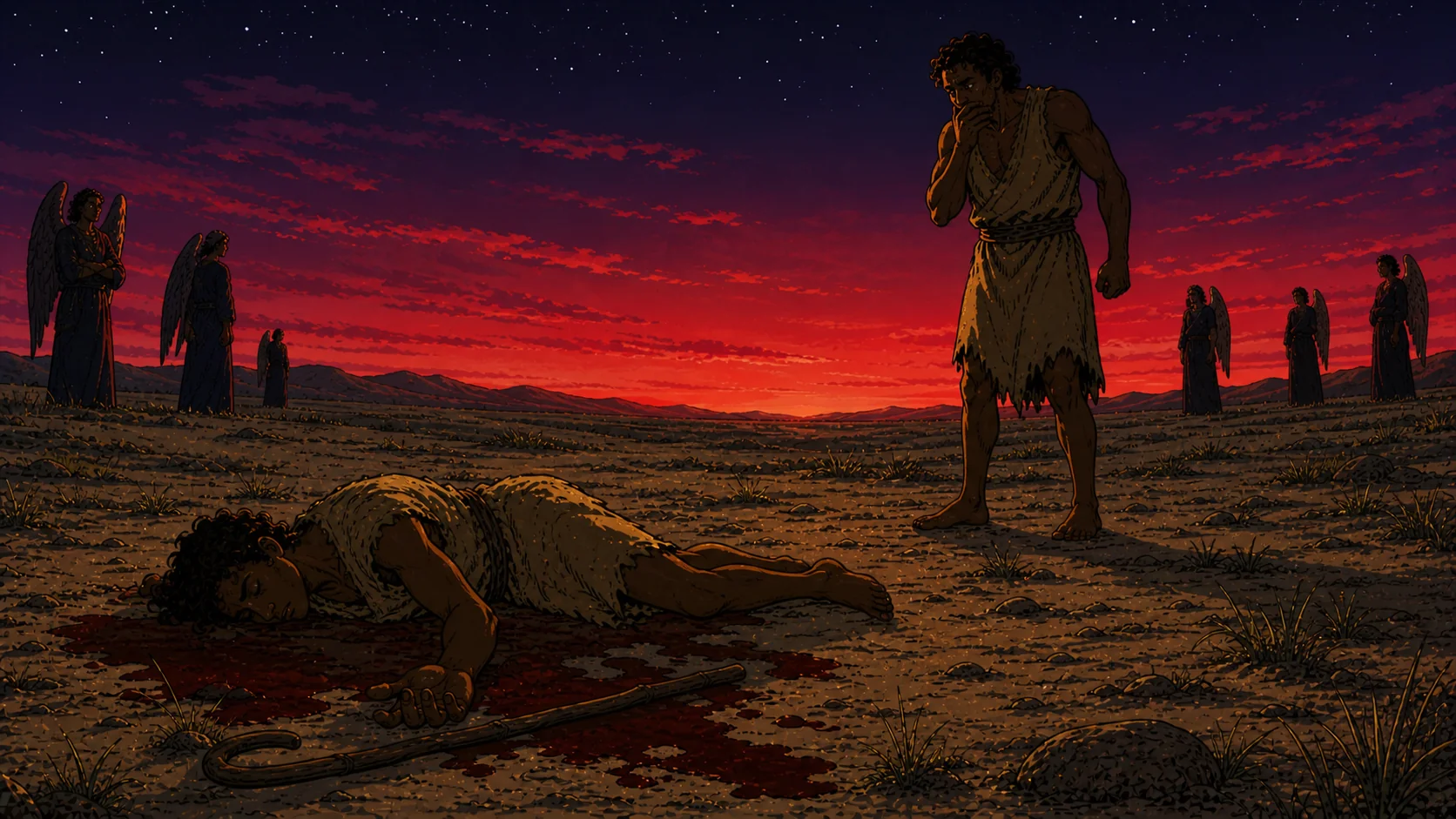 Bereshit 4:8–10 — "And it came to pass when they were in the field that Cain rose up against his brother Abel and killed him."
Ten generations after Adam, Elohim saw that "the wickedness of man was great in the earth, and every imagination of the thoughts of his heart was only evil all the time." The language is total. Not occasionally evil, not mostly evil — the word kol (all, every) appears twice in the same sentence. The creation had been handed to image-bearers who carried it in the wrong direction. Elohim grieved — vayit'atzzev — the word describes interior pain, not bureaucratic disappointment. The judgment that followed was not indifferent. It came from a being who was wounded by what had happened to what He had made.
Noah was tzadik tamim in his generations — righteous, blameless. The same word tamim that would later describe Avraham at the covenant of circumcision. He built the ark from instructions: three hundred cubits long, fifty wide, thirty high. It was not built to navigate — there is no rudder in the text, no sail. It was built to survive. The rain came for forty days. The waters prevailed for one hundred and fifty. A raven was sent; it returned. A dove was sent; it returned with an olive branch — aley zayit — fresh and living, meaning the waters had receded. Noah came out. The first thing he did was build an altar and offer burnt offerings. Elohim smelled the fragrance and said, in His own heart: "I will not again curse the ground because of man."
Then came the covenant — brit — not with Israel, not with believers, but with Noah and his sons, with "every living creature on earth," and with "the earth itself." The sign was the rainbow. The scope was all flesh forever. This is the oldest formal covenant in the Torah and its parties are all of creation. Every nation that has ever looked at a rainbow has been looking at a sign of a promise made to their ancestors. Elohim did not start over. He recommitted.
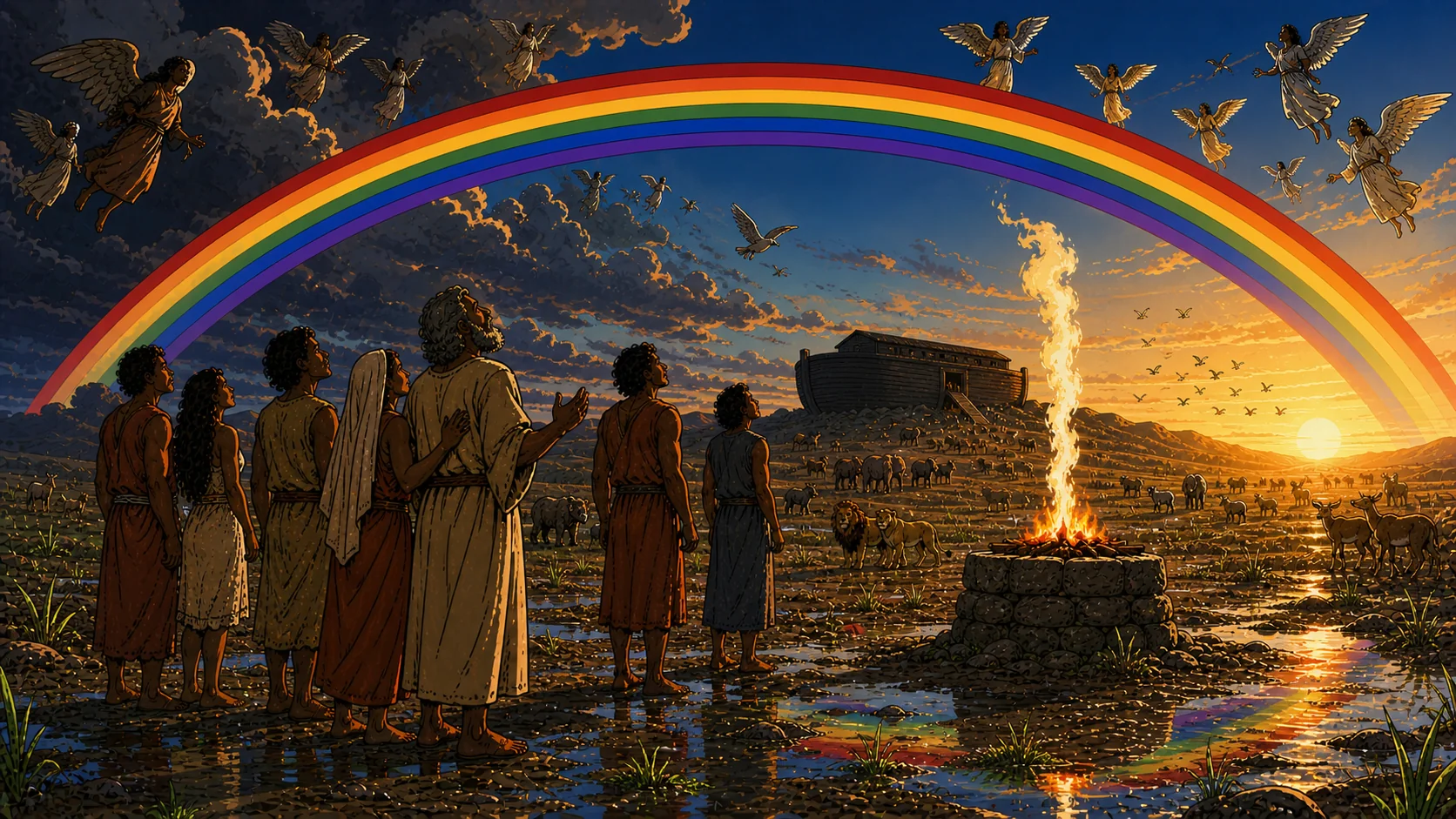 Bereshit 9:12–17 — The rainbow: a sign between Elohim and every living creature on earth, for all generations.
Genesis 10 is the most comprehensive ethnographic document in the ancient world. From Noah's three sons — Shem, Ham, and Japheth — the Torah traces seventy nations by name: fourteen from Japheth, thirty from Ham, twenty-six from Shem. No other text of the ancient Near East attempted this. Greek histories started with Greece. Egyptian records started with Egypt. Bereshit started with all of humanity and worked inward. The chapter is not an appendix. It is the architecture beneath the rest of the Torah.
From Japheth came the peoples of the north and west: Gomer, Magog, Madai, Javan — the Medes, the Greeks, the peoples of the Aegean coasts. From Ham came the peoples of the south: Cush, Mizraim, Put, Canaan — the Ethiopians, the Egyptians, the North Africans, the Canaanites. From Shem came the peoples of the east and the middle: Elam, Asshur, Arpachshad, Lud, Aram — the Persians, the Assyrians, the Arameans — and through Arpachshad's line, eventually, Avraham. The table does not rank nations by importance or proximity to Israel. It lists them all. Every people that has ever existed traces its line to this chapter.
The number seventy is not incidental. Seventy elders stood with Moses at Sinai. Seventy palm trees were waiting at Elim after the sea crossing. Israel spent seventy years in Babylonian exile. The Torah counts seventy souls who went down with Jacob to Egypt. When the Septuagint translators counted the Table of Nations, they came to seventy-two — and seventy-two is the number of elders in the tradition of the seventy plus Moses and Aaron. The text is patterned. The number of nations on earth corresponds to the structures of covenant itself. No nation is outside the accounting.
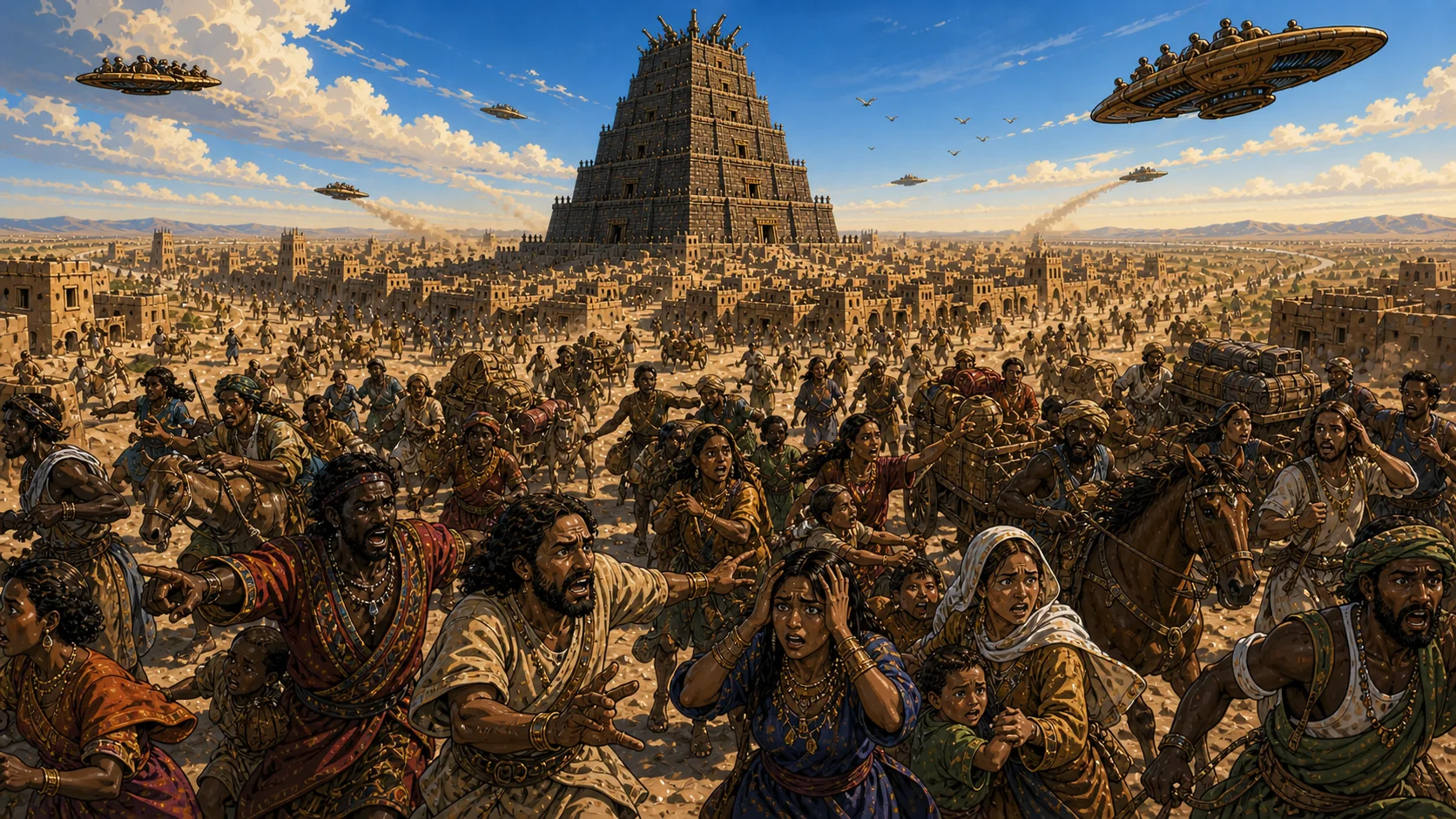 Bereshit 11:7–8 — "And the LORD scattered them from there over all the face of the earth, and they stopped building the city."
After the flood, the survivors moved east and settled in a plain in Shinar. They still spoke one language — safah echat u'devarim achadim — one lip, one set of words. Unity, in the text, is not automatically good. What they did with their unity reveals the problem: they wanted to build a city and a tower whose top reached the heavens, and to make a name for themselves, lest they be scattered over the face of the earth. The project was explicitly defensive. They feared dispersion. They wanted permanence, concentration, self-made greatness. The word shem — name — echoes forward: soon Elohim will tell Avraham, "I will make your name great" (12:2). A name made by human hands and a name given by Elohim are two different things.
Elohim descended to see what they were building. The divine observation — "and now nothing they plan to do will be impossible for them" — is not admiration. It is diagnosis. A humanity unified under its own ambition, without accountability to anything greater than itself, becomes ungovernable in the wrong direction. The confusion of languages was not only punishment. It was mercy — the same mercy that drove Adam from Eden before he could eat from the Tree of Life in his fallen state. Babel's tower was stopped not because Elohim feared human power, but because Elohim knew where unchecked human power goes.
The nations scattered over the face of the earth — and the very next thing the text does is trace Shem's genealogy down to Terah, and Terah's son Avram. Babel is not the end of the story. It is the condition for the next chapter. The nations are scattered and nameless in Canaan, Mesopotamia, and Egypt — and Elohim chooses one man from one city to be the instrument through which all those scattered families will eventually hear a blessing. The first eleven chapters of Bereshit ask a question: who will be responsible for this broken world? The answer begins in chapter twelve. Every nation starts here.
Bereshit does not begin with Israel. It begins with everything — and then asks which family will carry the weight of the answer to what went wrong with all of it.