A Bible Built to Control
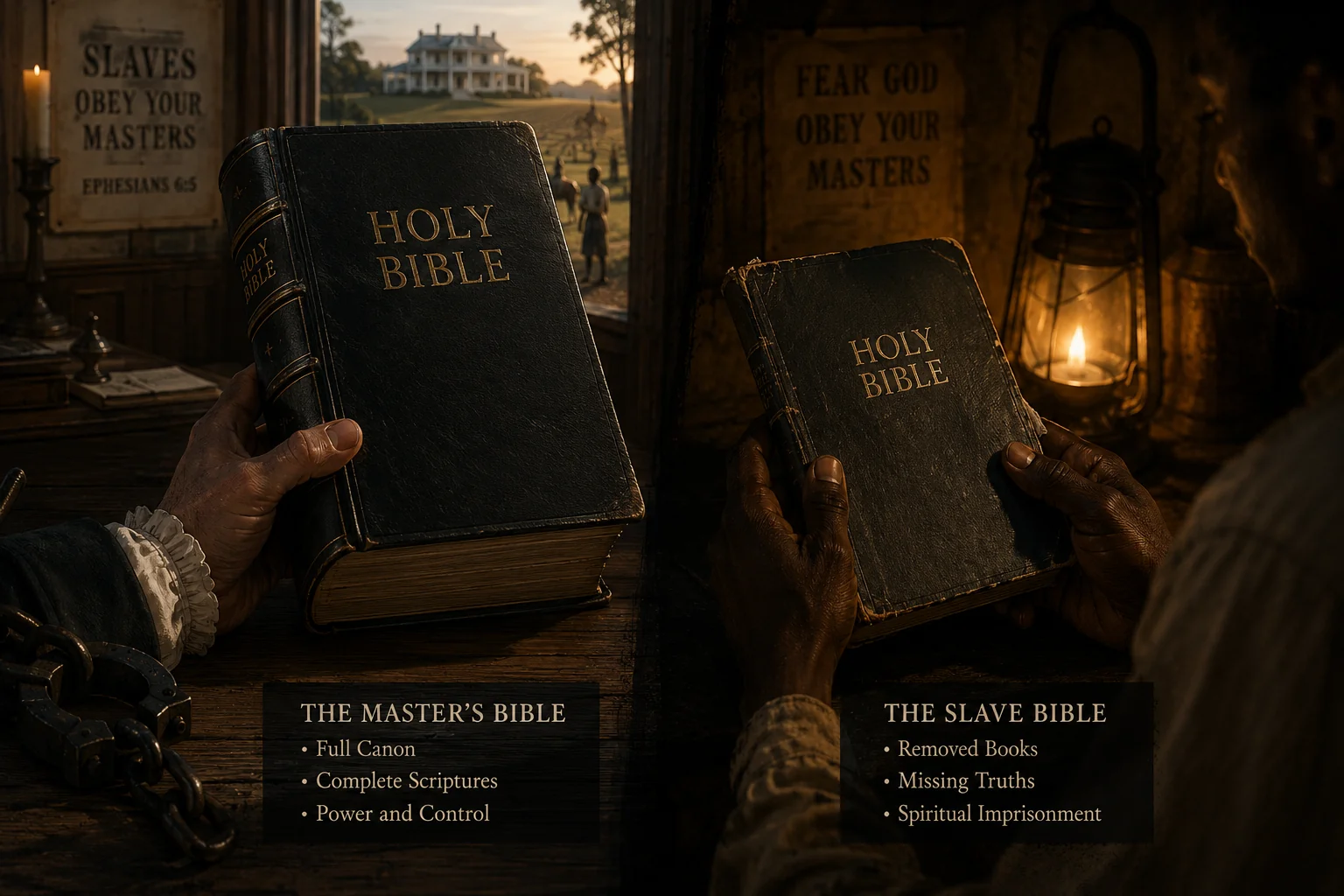
In 1807 — the same year Britain formally abolished the Atlantic slave trade — a small volume was quietly published in London bearing the title: "Parts of the Holy Bible, Selected for the Use of the Negro Slaves, in the British West-India Islands." It was produced under the direction of the Society for the Conversion of Negro Slaves, a British missionary organization operating with the backing of the plantation class. What they produced was not a paraphrase or a summary. It was surgical removal — scripture cut down to a tool of governance, stripped of every passage that might give an enslaved person reason to believe God was watching, that history had a direction, or that the social order they lived under was not God's final word.
Of the 1,189 chapters in a complete Bible, this edition retained roughly 232. Approximately 90% of the Old Testament was gone. Half of the New Testament was gone. What remained was carefully constructed to deliver one message: that God ordained the existing order, that masters were to be obeyed, and that the reward for patience was a heaven that waited after death.
Who Made It and Why
The Society for the Conversion of Negro Slaves was not a fringe group. It operated with the quiet approval of the British colonial establishment and the financial interests of West Indian planters who had long understood that a certain kind of Christianity — emptied of its most dangerous content — was useful for keeping an enslaved population compliant. The planters had reason to fear the full Bible. Missionaries who brought complete scriptures onto plantations were frequently expelled. The 18th-century slave rebellions across the Caribbean had been led by men who had read it in full.
Sam Sharpe, who led the 1831 Christmas Rebellion in Jamaica — the largest slave uprising in British Caribbean history — was a Baptist deacon who had read the full Bible and preached that no Christian could own another person as property. Denmark Vesey, who organized the 1822 Charleston conspiracy, cited the book of Zechariah. Nat Turner, who led the 1831 Virginia uprising, was a literate preacher. Toussaint Louverture, who led the Haitian Revolution to its completion in 1804, knew the Exodus narrative by heart. The planter class knew exactly what a literate enslaved person with a complete Bible was capable of believing about themselves — and about their captors.
The Slave Bible was the colonial solution. Not to ban the Bible outright — that would have been its own kind of problem for a society that justified slavery partly through Christian mission — but to produce a version safe enough to distribute. A version where God never freed a nation of slaves. Where there was no covenant chapter predicting curses for disobedience that sounded uncomfortably specific. Where Israel had no history of exile, return, and restoration that might suggest God had a pattern of reversing the condition of a scattered people.
Where It Was Used
The primary distribution was through the British Caribbean colonies: Jamaica, Barbados, the Windward Islands (Dominica, Grenada, St. Lucia, St. Vincent), Tobago, and the Leeward Islands. These were sugar islands built entirely on enslaved African labor, where the ratio of the enslaved to free colonists ran as high as ten to one on major plantations. The planters' anxiety was not merely spiritual — it was existential.
Similar practices shaped scripture distribution across the Atlantic world. In the American South, plantation owners routinely controlled what passages the enslaved were permitted to hear. Many were forbidden from owning or reading scripture at all — literacy among enslaved people was criminalized across most Southern states by the 1830s. Where scripture was given orally, white preachers selected their texts with precision: Ephesians 6 about servants obeying masters, Romans 13 about submission to authority — never the Exodus, never the prophets, never Deuteronomy 28. The Slave Bible formalized in print what American planters practiced in church.
In Portuguese Brazil — the largest single destination of the transatlantic slave trade, receiving an estimated 4.9 million enslaved Africans — the Catholic Church performed comparable functions through selective catechism: suffering as a path to salvation, submission as Christian virtue, eternal reward as the answer to earthly conditions. The liberation history of Israel was effectively absent from the religion that enslaved people were converted into across the Portuguese colonial world.
What Was Removed
The list of what was cut reads like a precise map of every reason an enslaved people might believe God was watching and preparing to act:
- The book of Exodus — almost entirely removed. No burning bush. No "Let my people go." No ten plagues on an empire holding God's people in bondage. No parting of the Red Sea. The central liberation narrative of the entire Hebrew Bible, the story that defines who the God of Israel is and what He does for His people — gone.
- Deuteronomy 28 — the great covenant chapter. God's list of blessings for obedience and curses for turning away, including the curse of being carried back to a place of bondage in ships, to be sold as enslaved people to enemies who would not redeem them. This passage is recognized by many in the African diaspora as a direct description of the transatlantic slave trade in prophetic language. It was removed.
- Leviticus 25 — the year of Jubilee. The commandment that every fifty years, all bondservants are to be freed, all debts cancelled, all land returned. "Proclaim liberty throughout all the land unto all the inhabitants thereof" — the inscription on the Liberty Bell — was cut.
- Isaiah 61 — "to proclaim liberty to the captives, and the opening of the prison to them that are bound." The passage that Yeshua reads aloud in the synagogue in Luke 4 to announce the purpose of His ministry. Removed.
- Most of the Major and Minor Prophets — Jeremiah's lamentations over a people in exile and his promises of their return, Ezekiel's vision of dry bones rising into an army, Amos thundering against those who sell the poor for a pair of sandals, Micah declaring that God requires justice — all largely absent.
- Galatians 3:28 — "There is neither Jew nor Greek, there is neither bond nor free, there is neither male nor female: for ye are all one in Christ Jesus." Removed.
- Revelation 18 — the judgment of Babylon, including the indictment of the city that traded in "slaves, and souls of men." Removed.
What They Left In
What remained was not accidental. The editors understood scripture well enough to construct a coherent theology of submission from the passages they kept. The New Testament they preserved was curated almost entirely around a single theme: the duty of the servant toward the master.
- Exodus — Israel freed from slavery by God
- Deuteronomy 28 — curses including captivity in ships
- Leviticus 25 — Jubilee, liberty for all bondservants
- Isaiah 61 — liberty to the captives
- The Prophets — exile, return, justice
- Galatians 3:28 — no bond nor free in Christ
- Luke 4 — Yeshua proclaims release to captives
- Revelation 18 — judgment on the slave trade
- Ephesians 6:5 — "Servants, be obedient to your masters"
- Colossians 3:22 — "Servants, obey your masters in all things"
- Romans 13:1 — "Be subject unto the higher powers"
- Titus 2:9 — "Servants, be obedient to your masters"
- 1 Peter 2:18 — "Servants, be subject to your masters"
- Selected Psalms of praise
- The Beatitudes (endure; inherit heaven)
- Genesis 1–2 (creation, without the covenant)
The Passage They Feared Most
Of everything removed, none is more telling than Deuteronomy 28. This chapter lays out in detail what will happen to Israel if the nation abandons the commandments of God. Among the curses described:
"And the LORD shall bring thee into Egypt again with ships, by the way whereof I spake unto thee, Thou shalt see it no more again: and there ye shall be sold unto your enemies for bondmen and bondwomen, and no man shall buy you."
— Deuteronomy 28:68
For many in the African diaspora — and increasingly for historians engaging seriously with the text — this verse describes the transatlantic slave trade with a precision that demands explanation. The only route by which Africans were transported to the Americas was by ship. The phrase "no man shall buy you" echoes the condition of people whose legal status as property made self-purchase nearly impossible. The word rendered "Egypt" carries the broader meaning of a place of bondage and oppression in the Hebrew.
Whether or not the editors of the Slave Bible consciously recognized this passage as applying to the people they were enslaving, they removed it. So did the preachers who administered oral scripture on American plantations. The verse that most directly described — from within the enslaved people's own ancestral scripture — what was being done to them was the one most consistently withheld.
The Full Bible Was Contraband
Across the American South, the stakes of possessing a complete Bible were not abstract. Teaching an enslaved person to read was a criminal offense in most states by the 1830s. In Georgia, the penalty was a fine for a first offense and flogging for repeat violations. In Virginia, up to sixty days in jail — for the person doing the teaching. In South Carolina, one hundred dollars for teaching an enslaved person to write; the same for teaching them to read. The law did not distinguish between scripture and subversion. For the planter class, they were the same thing.
In Jamaica, after the Christmas Rebellion of 1831 — led by Sam Sharpe, who had access to the full Bible — colonial authorities turned on missionary churches. Buildings where complete scriptures had been distributed were burned. Missionaries who had taught enslaved people to read were expelled from the island. The full Bible, in the hands of an enslaved population, was treated as an incitement document because it functioned as one. It told a different story than the plantation did.
After Abolition — What Survived
The Slave Bible was printed in three editions between 1807 and 1809, primarily for the British West Indies. Only a handful of copies survive. One is held at Fisk University in Nashville, Tennessee — a historically Black university founded in 1866 to educate formerly enslaved people and their descendants, one year after emancipation. Another is held at the Museum of the Bible in Washington, D.C., where it was the centerpiece of a 2018 exhibition titled "The Bible and Slavery." Smithsonian Magazine covered the artifact in detail.
The Black church tradition that survived and carried scripture through four centuries did so in defiance of everything the Slave Bible represented. The spirituals that emerged from plantation life encoded the full Exodus narrative in imagery that plantation owners read as passive religious feeling: "Go Down, Moses," "Swing Low, Sweet Chariot," "Wade in the Water." The full Bible was being transmitted orally in coded form even when it could not be held in hand. What could not be killed was the memory that the same God who freed Israel from Egypt was still the God being prayed to.
Why It Matters Now
The Slave Bible is not just a historical document. It is a key — because what was removed most aggressively is a guide to what should be recovered. The passages cut with the most care are precisely the passages that bear most directly on the identity, history, and prophetic future of the scattered Israel: the Exodus, the covenant of Deuteronomy 28, the year of Jubilee in Leviticus 25, the promises of return from exile in Isaiah and Jeremiah.
When readers today encounter the full Torah — Exodus from chapter 1, Deuteronomy 28 from verse 1 to verse 68, Leviticus 25 on the Jubilee — and read it alongside the history of the African diaspora, they are reading what was systematically withheld from their ancestors for generations. The full KJV, translated faithfully from the Hebrew by 47 scholars a century before the Slave Bible was published, contained all of it. The scripture did not fail. The people who decided which parts of it others were permitted to read — and what those choices tell us about what they understood the Bible to say — is the real history.
Sources
- Fisk University — The Slave Bible Returns Home (institutional record, one of three surviving copies)
- Smithsonian Magazine — "Heavily Abridged 'Slave Bible' Removed Passages That Might Encourage Uprisings" (Jan. 4, 2019)
- Deuteronomy 28 — Sefaria full chapter; Leviticus 25 — Sefaria; Exodus 1 — Sefaria
✡ Read the Torah they tried to hide
Exodus, Deuteronomy 28, Leviticus 25 — every passage removed from the Slave Bible is in the full Torah, now readable in English and the original Hebrew.
Read the Torah Who Authorized the KJV?