Ask where the "Middle East" is and everyone can point to it. Ask how old the name is, and almost no one knows the answer: it is younger than the telephone. The lands are thousands of years old. The label is barely more than a hundred.
The Question Hiding in a Familiar Word
We say "the Middle East" the way we say "the sky" — as if it had always been there, a fixed and natural feature of the world. It is on every news broadcast, in every atlas, in every classroom. It feels permanent.
It is not. The name is modern, foreign to the region, and strategic in origin. And once you see how recently it was invented and who invented it and why, a second and much larger question opens beneath it: if the name is this new, what about the people? Are the populations of those lands today simply the unbroken continuation of the ancient peoples of the Bible — Israel, Judah, Canaan, Aram, Egypt, Cush — or has something happened across the centuries that the modern map quietly hides?
This article asks two plain questions and tries to answer them honestly. Since when was there a "Middle East"? And are the people there the same people who were there then?
I. A Name Younger Than the Automobile
Here is the fact that surprises almost everyone: the term "Middle East" was coined around 1900–1902.
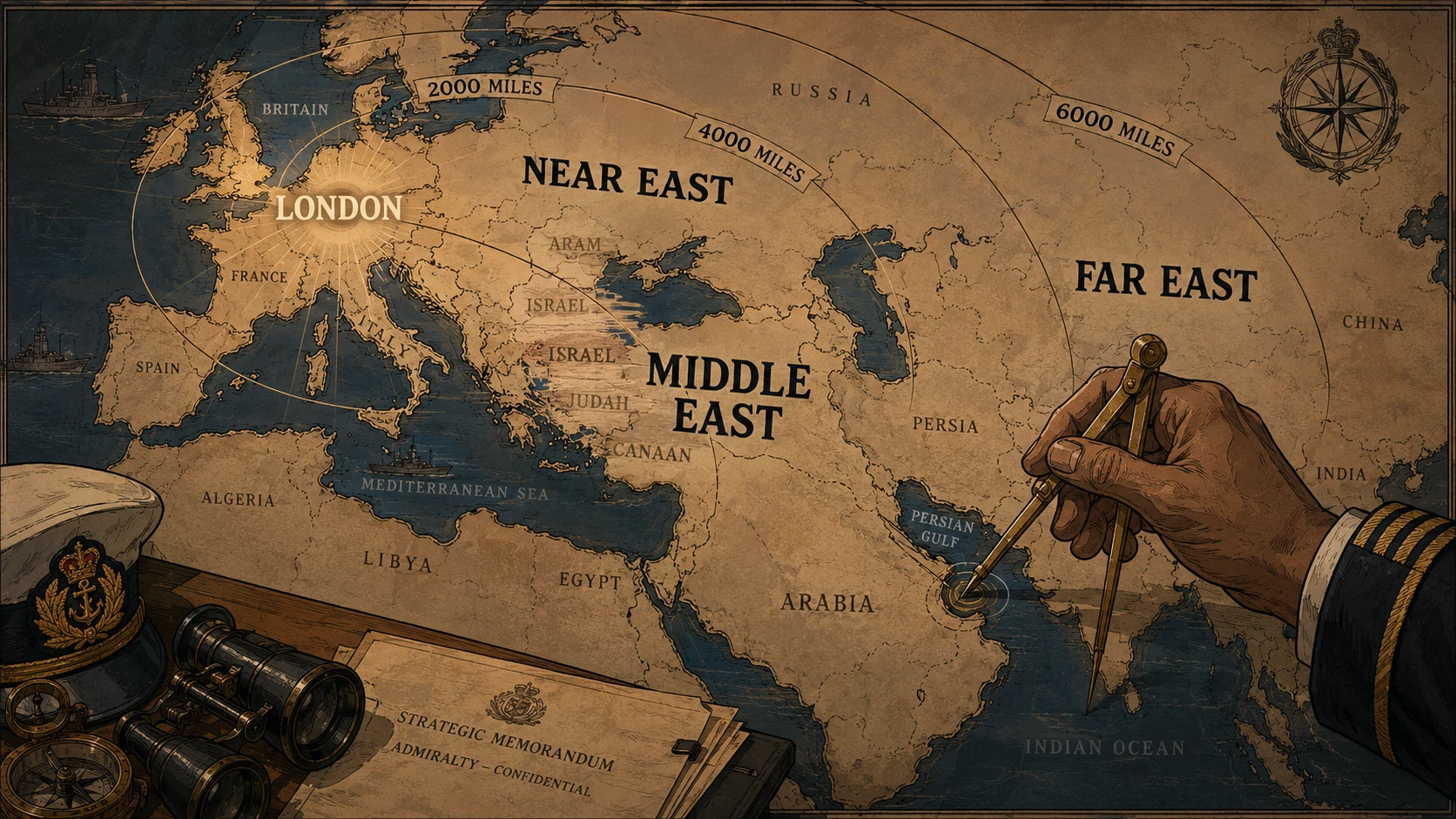
It became common currency in 1902, when the American naval strategist Alfred Thayer Mahan used it in an article — "The Persian Gulf and International Relations," published that September in the British journal The National Review — to describe the strategic waters between Arabia and India. Mahan himself claimed the coinage; in his own words he wrote: "The Middle East, if I may adopt a term which I have not seen, will some day need its Malta, as well as its Gibraltar." He was not naming a homeland or a culture. He was naming a chokepoint — the sea-lanes and shores around the Persian Gulf that the British Empire needed to control to keep Russia from advancing toward British India.
Shortly after, The Times correspondent Sir Ignatius Valentine Chirol expanded the term in a series of essays to cover the regions of Asia commanding the approaches to India — and by the time the series ended, the newspaper had quietly dropped the quotation marks. An invented phrase had become, in barely a year, simply "the truth."
So the answer to the first question is precise and a little startling. There was no "Middle East" in the time of Moses, or David, or Jesus, or Muhammad, or Saladin, or even Napoleon. There was no "Middle East" when the United States declared independence. The name is about as old as the radio.
II. Near, Middle, Far — Measured From London
The word did not arrive alone. It came as one of a set — and the set gives the game away.
European usage divided the East into three: the Near East (the Ottoman lands closest to Europe — the Balkans, Anatolia, the eastern Mediterranean shore), the Middle East (Persia, the Gulf, the route to India), and the Far East (China, Japan, and beyond). Together they were called the "three Easts."
Read those three names together and ask the obvious question: near, middle, and far from where? The answer is always the same — from Europe. From London. Every one of the three measures its distance from the imperial capital. The region was not named by the people who lived in it but by outsiders who needed a convenient way to organize an empire.
And here is the quiet absurdity at the heart of it: the region is not "middle" or "near" or "far" to the people who live there. To them it is the center of their own world — the place where their cities, their rivers, their holy sites, their ancestors' graves have always been. "Middle East" is an address written from someone else's house.
The peoples of those lands had their own names, far older and entirely internal:
These are names from the inside — what the inhabitants called their own homes, some of them thousands of years before Mahan picked up his pen. "Middle East" is the external label laid over all of them, roughly 1,900 years after the biblical events it now blankets. The old names say who lived here. The new name says how far this is from us.
III. The Land That Was Conquered Again and Again
To answer the second question — are the people the same? — we have to look at what actually happened to those lands across three thousand years. And the honest summary is this: few places on earth have been conquered, emptied, and refilled as many times.
The pattern runs straight through the Bible and the historical record:
In 722 BCE, the Assyrian Empire conquered the northern kingdom of Israel and deported its population — the origin of the "lost ten tribes." The Assyrians then resettled the land with peoples from elsewhere in their empire. In 586 BCE, the Babylonian Empire destroyed Jerusalem and the First Temple and carried the people of Judah into the Babylonian exile. Then came the Persians, the Greeks under Alexander and his successors, the Romans, the Arab conquests of the 7th century, the Crusaders, the Turkic peoples and the Ottomans — wave upon wave, each conquest bringing new rulers, new settlers, new languages, and new bloodlines into the same stretch of earth.
Every one of those conquests did to the people what Mahan would later do to the name: it overwrote what was there before. Populations were killed, enslaved, deported, scattered, and replaced. The land kept its hills and its rivers, but the human map on top of it was redrawn again and again.
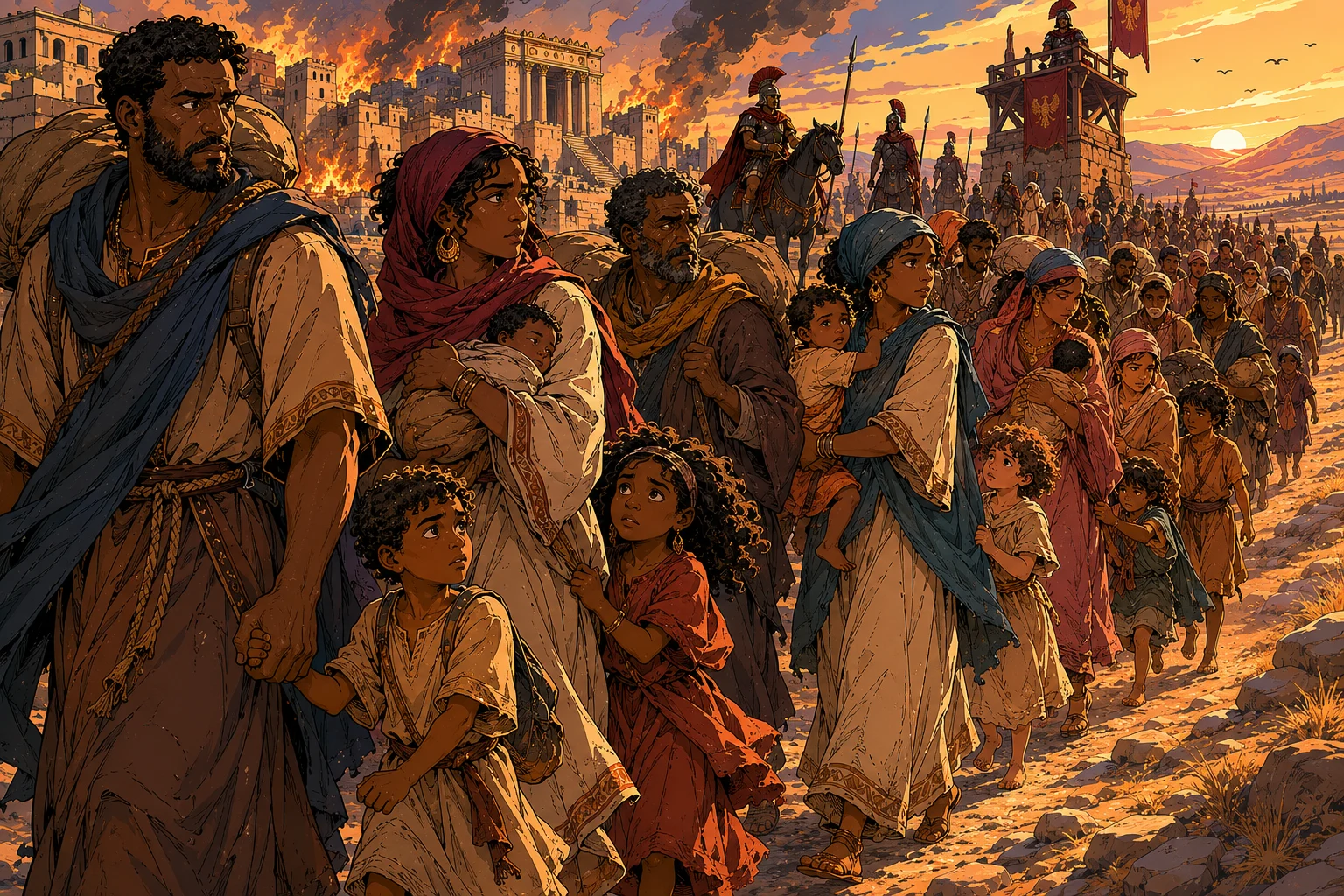
The Babylonian and Assyrian deportations — the people of Israel and Judah carried away from the land · 722 and 586 BCE
IV. Herod: An Outsider Crowned Over the People
There is one figure who shows, in a single life, how thoroughly conquest reshuffled who counted as "the people" of this land — and how empire installed rulers over them from outside.
Herod the Great, the "King of the Jews" of the Christmas story, was not a Judean by blood at all. He was an Idumean — that is, an Edomite, the people the book of Genesis traces to Esau, Jacob's brother. His father, Antipater, was an Idumean noble; his mother, Cypros, was a Nabatean Arab princess from Petra. Neither parent was ethnically Jewish. Herod was raised a Jew only because, a couple of generations earlier, the Hasmonean ruler John Hyrcanus had conquered Idumea and forced its people to convert to Judaism.
And how did this Idumean become king over Judea? Not by the will of the Judeans — by the decree of Rome. Herod hurried to Rome, won over Mark Antony and Octavian, and the Roman Senate proclaimed him "King of the Jews" in 40 BCE; he then took the throne by force with the backing of a Roman army. Josephus called him a "half-Jew"; later Jewish tradition remembered him as the "Hasmonean slave." Being both an Idumean convert and a creature of Rome made him, to the people he ruled, an outsider twice over.
Herod is the whole theme in one man: a people conquered, their neighbors forcibly converted and absorbed, and then an imperial power crowning a ruler over the native population who was not of them — and propping him up with foreign legions. The "King of the Jews" was installed by the very empire occupying the Jews.
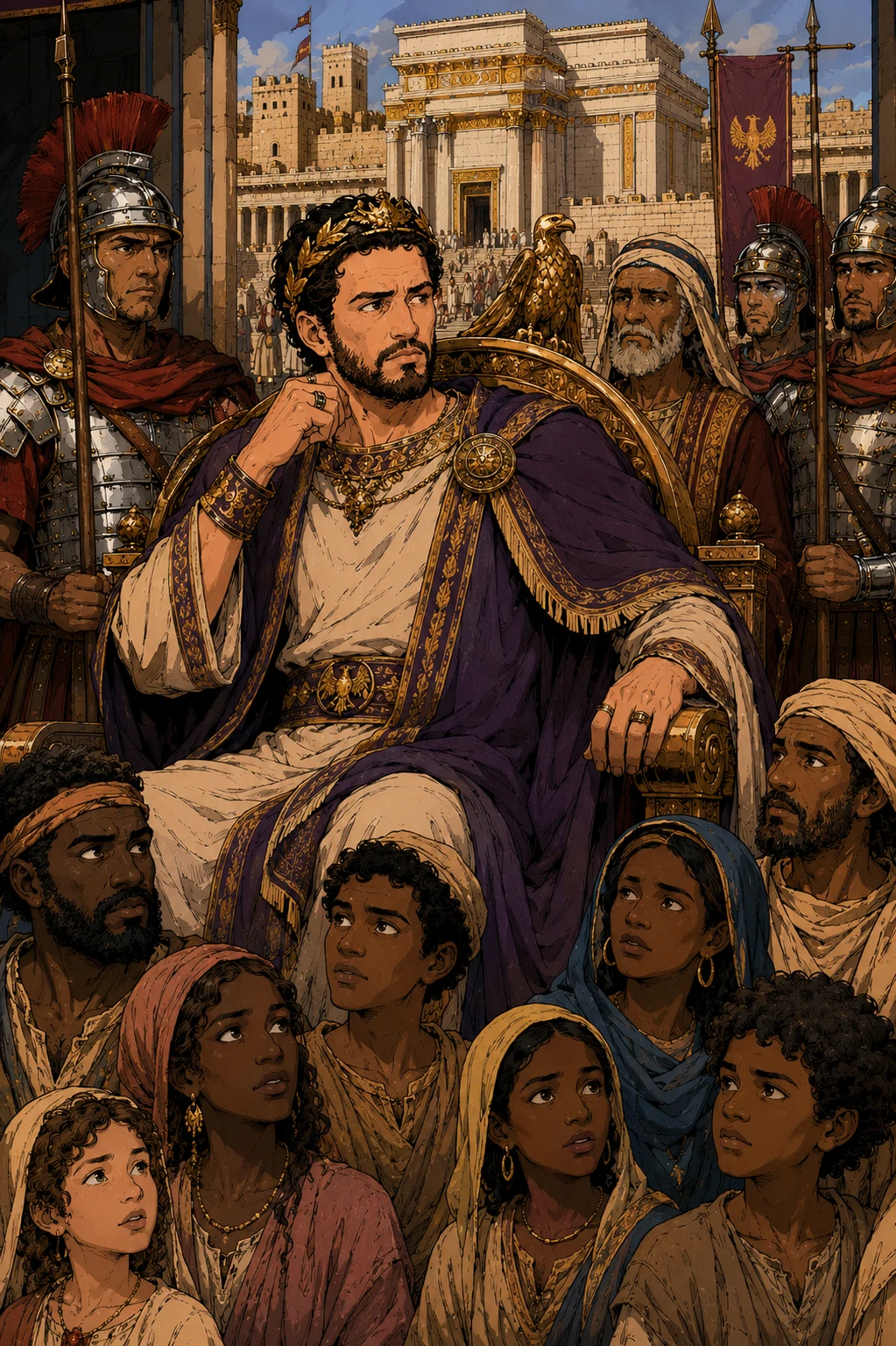
Herod the Great — Idumean father, Nabatean mother, crowned King of the Jews by the Roman Senate · an outsider installed over his own subjects by a foreign empire
V. So — Are They the Same People?
Now the honest answer to the second question, and it must be handled carefully, because it is both fascinating and easy to abuse.
The answer is: not simply, and not as a whole. The modern population of the lands we call the "Middle East" is the product of all those waves — Assyrian, Babylonian, Persian, Greek, Roman, Arab, Turkic, Crusader, Ottoman — layered over the ancient peoples. The modern regional population is not a clean, unbroken continuation of the people of the Bible.
But here is the part that makes the question worth asking at all: the ancient line was not erased — it was scattered and preserved in specific descendant communities rather than in the regional average. In her study of the appearance of first-century Judeans, the scholar Joan Taylor concluded that the people of that time and place were biologically closest to the Iraqi Jewish population of today — a community that, through long isolation, preserved more of the ancient Judean line with less of the later admixture that reshaped the broader region.
In other words: the original peoples did not vanish. They were deported, exiled, dispersed across the world — and their descent ran on in scattered communities far from the homeland, sometimes better preserved outside the region than within it.
To find the ancient people, you often have to look not at the modern map of the "Middle East" at all, but at the long trails of exile that led away from it.
VI. Looking Past the Map
So, since when was there a "Middle East"? Since about 1902 — a strategic coinage by a naval officer, measuring an ancient homeland by its distance from London.
And are the people there the same? Not the regional population as a whole; that is the layered result of three thousand years of conquest. The ancient lines survive, but scattered — carried out along the roads of exile, preserved in specific communities, often far from the land itself.
The lesson is the same for anyone trying to recover a heritage that empire has buried: do not mistake the modern map for the ancient truth. The names we were handed — "Middle East," and before it the conquerors' renamings going back to antiquity — were acts of power, written from the outside, for the purposes of the namer. Beneath "Middle East" lie Israel and Judah and Canaan and Aram and Mizraim and Cush. Beneath the modern population lie the scattered descendants of peoples conquered and carried away.
The map shows you where things sit relative to London. It does not show you who was there first, or where they went. To find them, you have to look past the map — to the older names, and to the long trails of the scattered.
A note on care: This article is about two things only — the recent, documented origin of the term "Middle East," and the long history of conquest, exile, and population change in the lands of the Bible. It is not a statement about who rightly governs any territory today, nor an endorsement of any side in any present-day political dispute. The argument here is older and narrower: that the name is young, the land has been conquered many times, the original peoples were scattered rather than simply continuous — and that recovering a true history begins with noticing the names we were handed and asking who wrote them, and why.
Sources & Further Reading
- The coinage of "Middle East" (1902): Alfred Thayer Mahan, "The Persian Gulf and International Relations," The National Review, September 1902 — Mahan's own claim to the coinage; the Persian Gulf as a strategic British chokepoint against Russian advance toward India.
- Chirol's expansion and the "three Easts": Sir Ignatius Valentine Chirol in The Times; Wikipedia, "Near East" on the Near, Middle, and Far East as explicitly Eurocentric terms, all measured from Europe.
- The Eurocentric origin of the term: Commisceo Global, "Why Is The Middle East Called The Middle East?"; Arab America / Wisconsin Muslim Journal, "Etymology and Empire: How Did the Middle East Get Its Name?"
- The conquests and exiles of the biblical lands: Standard historical references on the Assyrian conquest and deportation of the northern kingdom of Israel (722 BCE) and the Babylonian destruction of Jerusalem and the exile of Judah (586 BCE); the succeeding Persian, Greek, Roman, Arab, Crusader, Turkic, and Ottoman periods.
- Herod the Great as an Idumean convert installed by Rome: Wikipedia, "Herod the Great" and "Herodian dynasty"; Josephus, Antiquities of the Jews, xiv.15.2; Israel My Glory, "Herod the Great?"; Bart Ehrman, "Herod the Great: His Rise, Rule, and Brutal Legacy"; TheTorah.com, "How Jewish Was Herod?"
- The descent of the ancient Judean population: Joan E. Taylor, What Did Jesus Look Like? (T&T Clark, 2018) — the conclusion that 1st-century Judeans were biologically closest to today's Iraqi Jewish population.
The dated facts in this article — the 1902 coinage, the exile dates, Herod's origins — are drawn from the encyclopedic and scholarly record. The interpretation is the article's argument, built on those facts, and is offered as a historical lens, not as a position on any contemporary political question.
✡ Read the Names Beneath the Name
Israel. Judah. Canaan. Aram. These are the original names of the lands the Bible describes — read the text that carried them.
The Abraham Arc Saint George Was Never English