Issachar was the fifth son of Leah and ninth overall, born after the mandrake negotiation between Leah and Rachel. His birth name means both "man of wages" and "there is a reward" — Leah linked it to her hiring of Jacob and to God's reward for giving Zilpah as a maidservant (Genesis 30:18).
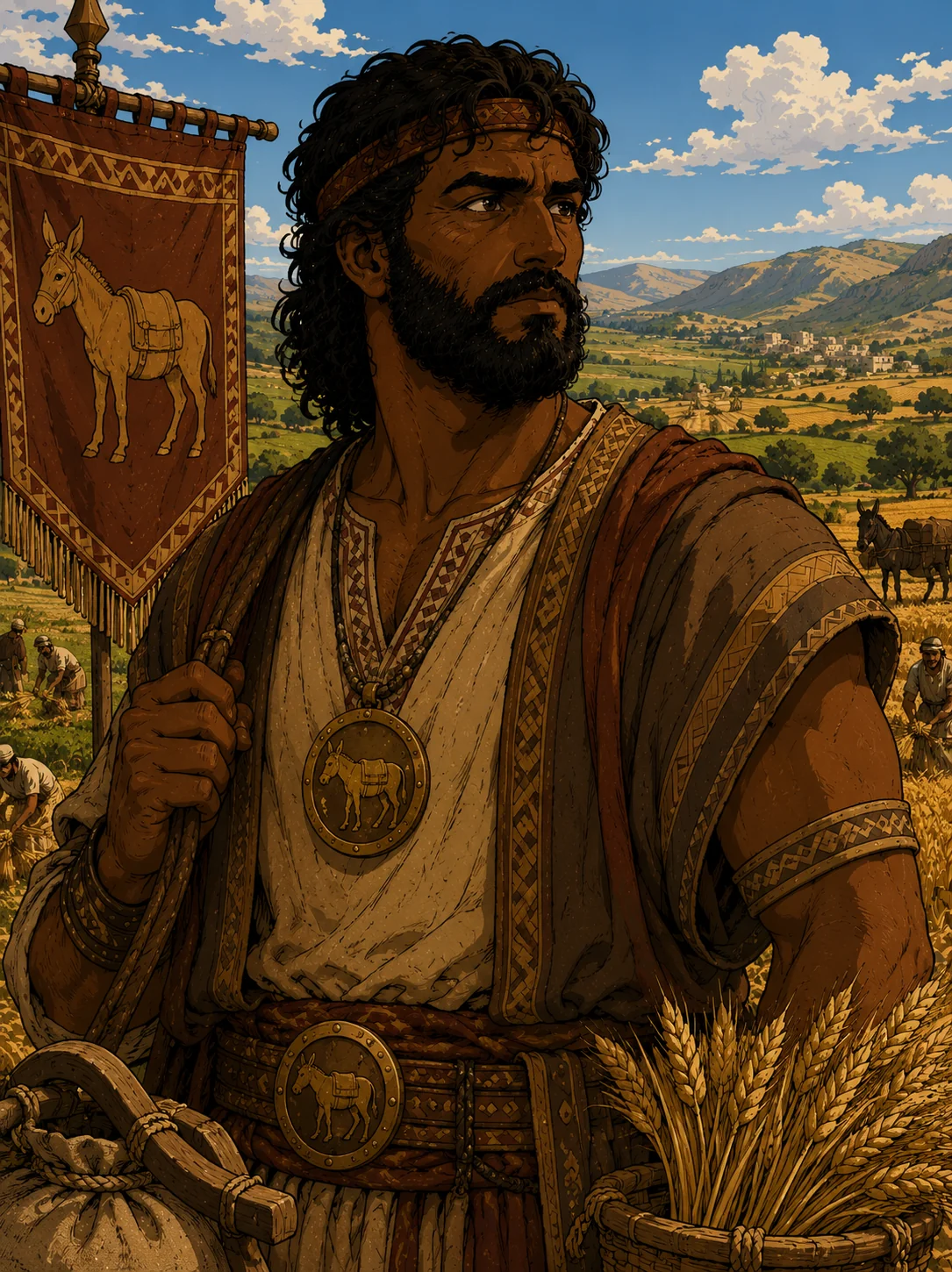
Jacob's blessing (Genesis 49:14–15) is the most ambiguous of the twelve: "Issachar is a strong donkey, crouching between the sheepfolds. He saw that a resting place was good, and that the land was pleasant, so he bowed his shoulder to bear, and became a servant at forced labor." The donkey imagery reads either as strength and endurance, or as a tribe content to carry burdens in exchange for the pleasure of good land. Most ancient interpreters read it as a tribe that traded military and political engagement for scholarly and agricultural stability.
Issachar's territory in Joshua's allotments (Joshua 19:17–23) lay in the Jezreel (Yizre'el) Valley — one of the most fertile stretches of land in ancient Canaan. The tribe's most striking reference in Scripture is 1 Chronicles 12:32, listing those who came to David at Hebron: "Of Issachar, men who had understanding of the times, to know what Israel ought to do, 200 chiefs, and all their kinsmen under their command." This verse gave Issachar a lasting reputation in Jewish tradition for scholarship and calendar knowledge — the tribe associated with Torah learning, astronomical calculation, and knowing the right moment to act.
"Issachar is a strong donkey, crouching between the sheepfolds. He saw that a resting place was good, and that the land was pleasant, so he bowed his shoulder to bear, and became a servant at forced labor." (Genesis 49:14–15)