Benjamin was the twelfth and final son of Jacob, born to Rachel on the road between Bethel and Bethlehem — and Rachel died giving birth to him. She named him Ben-Oni ("son of my sorrow"), but Jacob renamed him Benjamin ("son of my right hand") — honoring the child's birth without carrying the grief forward (Genesis 35:18–19). Benjamin never knew his mother.
In the Joseph narrative, Benjamin is the passive center around whom every character's true nature is revealed. Jacob's reluctance to send him (Genesis 43:1–14), Joseph's demand for him, Judah's pledge to be surety — and finally Joseph's planting of his silver cup in Benjamin's sack to test his brothers' hearts. Benjamin's innocence throughout makes his role pivotal: the one everyone protects, whose threatened loss becomes the mirror for every brother.
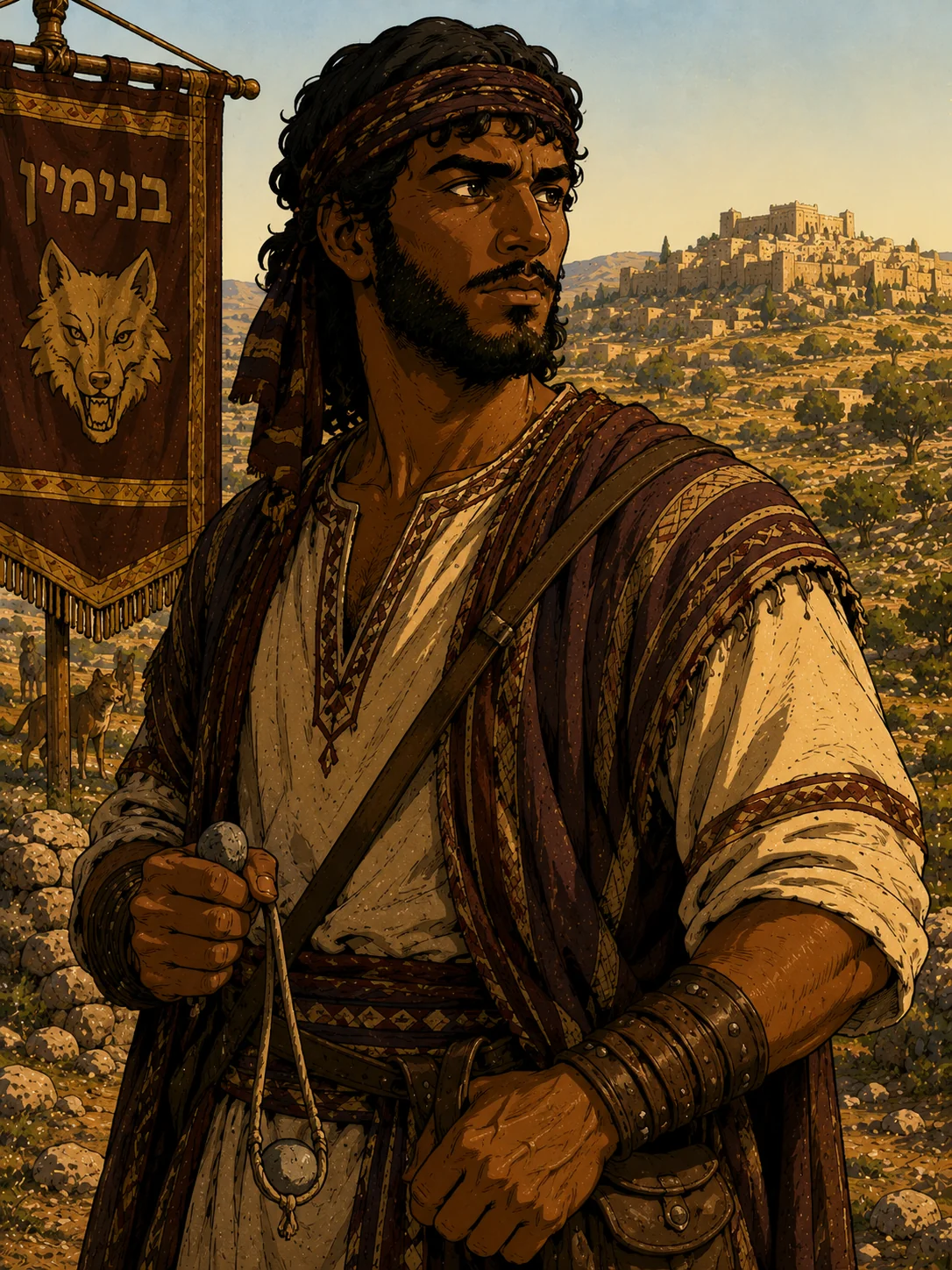
Jacob's blessing (Genesis 49:27) is fierce: "Benjamin is a ravenous wolf; in the morning he devours the prey and in the evening divides the spoil." The warlike imagery fit the tribe's warriors — including 700 left-handed slingers who could hurl a stone at a hair without missing (Judges 20:16). Ehud, the left-handed judge who assassinated Eglon of Moab, was a Benjaminite (Judges 3:15).
The tribe's territory lay between Judah and Ephraim, including Gibeah, Gibeon, and Mizpah (Joshua 18:11–28). Israel's first king, Saul son of Kish, was a Benjaminite from Gibeah (1 Samuel 9:1–2). Mordechai, the Diaspora official whose resistance saved Israel in the Purim story, is identified as a Benjaminite in Esther 2:5. The apostle Paul identified himself as "a Hebrew of Hebrews, of the tribe of Benjamin" (Philippians 3:5; Romans 11:1).
"Benjamin is a ravenous wolf; in the morning he devours the prey and in the evening divides the spoil." (Genesis 49:27)