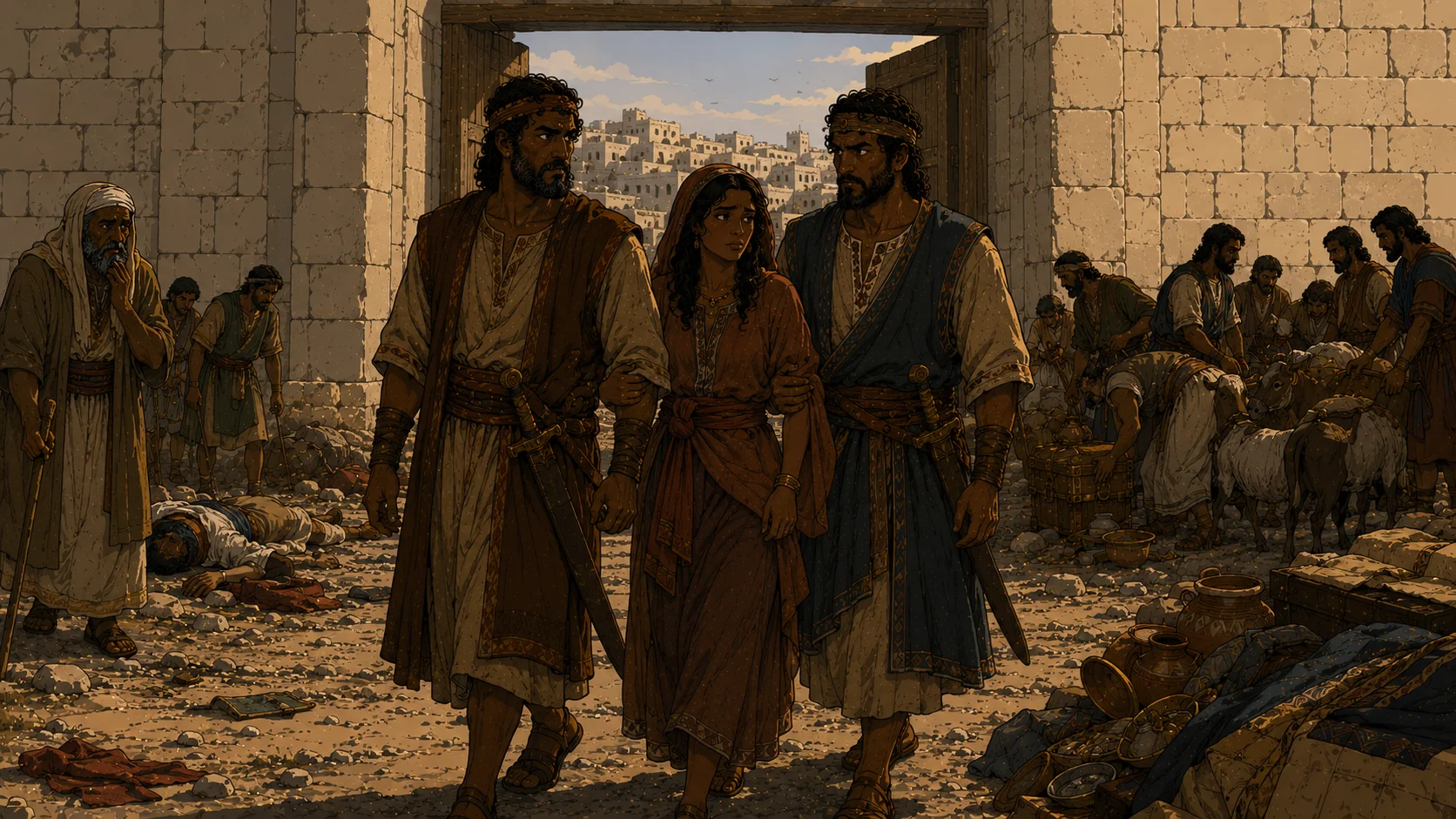
The plan had worked through deception. Hamor and Shechem agreed to circumcise every male in the city as the price for Dinah's hand, and the men of Shechem had complied. Three days later, when the wound is at its most painful, Simeon and Levi come. Not the full household of Jacob. Two brothers. Each with his sword. The Hebrew says they came upon the city betach — safely, confidently — because the men of the city could not defend themselves.
They killed every male. They took Dinah from Shechem's house and left. Then the other sons of Jacob came and plundered the city — the flocks, herds, donkeys, women, children, wealth. Everything. The text records the plunder in careful inventory. It is thorough. What had been a two-man killing becomes a household action against the entire city.
Jacob's rebuke to Simeon and Levi is not moral — it is political. You have made me stink among the inhabitants of the land. I am few in number. They will gather against me and destroy me and my household. The danger is to Jacob, not the principle of what they did. And their answer ends the chapter: Should our sister have been treated like a prostitute? The Torah does not answer. The question hangs over the rest of Genesis.