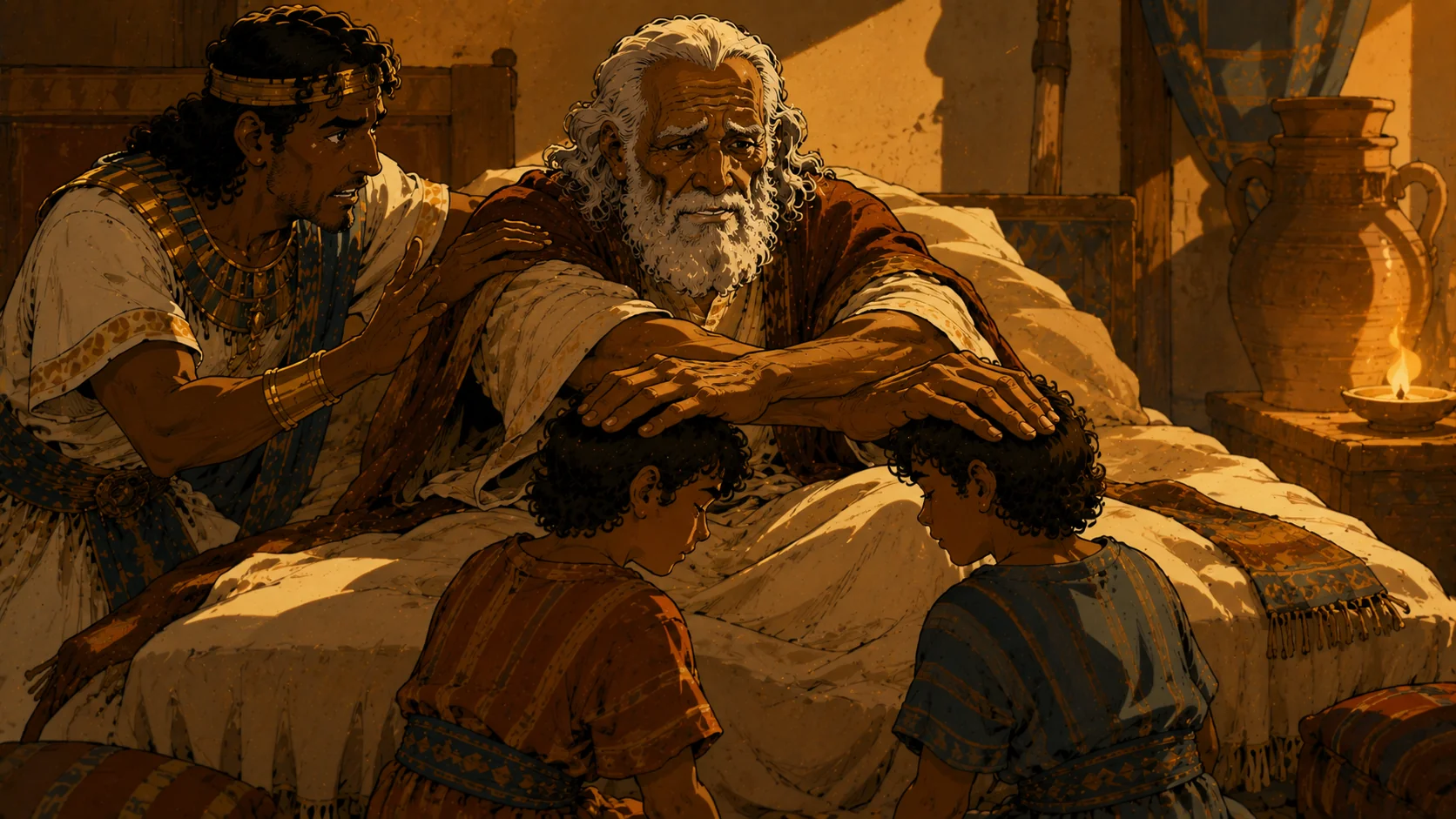
Joseph hears that his father is ill and brings his two sons — Manasseh the firstborn and Ephraim the younger — to receive the patriarchal blessing. Jacob rallies his strength, sits up in bed, and recounts the covenant promise: "God Almighty appeared to me at Luz in Canaan and blessed me." He then declares that Ephraim and Manasseh are adopted as his own sons — equal to Reuben and Simeon. They will each be a full tribe. Joseph is the only son whose children become tribal heads in their own right — giving him the double inheritance that his firstborn status deserved.
Joseph positions his sons for the traditional right-hand blessing: Manasseh on the right to receive Jacob's stronger hand, Ephraim on the left. Jacob crosses his hands — deliberately. The Torah uses the word sikkel: he acted with wisdom, with full discernment. His right hand rests on Ephraim's head. Joseph is alarmed and tries to correct him: "Not so, my father. This one is the firstborn." Jacob refuses. "I know, my son. I know. He also will be great — but his younger brother will be greater. His seed will be melo hagoyim — the fullness of nations."
The crossing of hands is the fourth iteration of the Genesis pattern of the younger overturning the elder: Isaac over Ishmael, Jacob over Esau, Joseph (eleventh son) ruling over all his brothers, and now Ephraim over Manasseh. This is not disorder — it is the Torah's persistent witness that divine election does not follow human convention. Jacob crossed his hands on purpose. The Torah marks it with a word that means wisdom.